

Clinical Trials vs Real-World Evidence Comparison Tool
Measures whether a treatment works under ideal conditions with strict protocols and controlled variables
Measures how a treatment performs in routine clinical practice with diverse populations and real-world complexities
Key Comparison Parameters
| Parameter | Clinical Trials | Real-World Evidence |
|---|---|---|
| Enrollment Criteria | Strict, excludes 80% of patients | Inclusive, reflects diverse populations |
| Data Collection | Fixed intervals (e.g., 3 months) | Variable timing (avg. 5.2 months) |
| Completeness | 92% for primary endpoints | 68% completeness |
| Primary Purpose | Measure efficacy | Measure effectiveness |
| Patient Diversity | Limited demographic range | Reflects real-world diversity |
| Regulatory Use | Primary basis for drug approval | Supports post-approval monitoring |
Clinical Trials
Provide rigorous evidence of safety and efficacy under controlled conditions. Essential for initial drug approval and establishing baseline treatment effectiveness.
Real-World Evidence
Reveals how treatments perform across diverse populations in everyday practice. Critical for understanding real-world effectiveness, safety, and cost-effectiveness after approval.
The future isn't clinical trials vs real-world evidence—it's both working together. Modern healthcare decisions require the rigor of clinical trials combined with the practical insights from real-world data.
Clinical trials and real-world evidence data gathered from everyday healthcare settings to measure how treatments perform outside of controlled environments reveal different truths about medical treatments. One is precise but artificial; the other is messy but real. Understanding this gap isn’t just academic-it affects your health decisions every time a new drug hits the market.
Core Difference: Efficacy vs Effectiveness
Clinical trials test efficacy: whether a drug works under perfect conditions. Real-world evidence measures effectiveness: how well it works in everyday life. Danny Wiederkehr, Global Team Lead at Pfizer, puts it simply: "While clinical trials serve an important purpose, real-world data can provide valuable information about a drug in routine clinical practice."
Imagine a diabetes medication that lowers blood sugar perfectly in a trial. But in real life, patients might skip doses, have other health issues, or take other medications. Real-world evidence captures this complexity, showing what actually happens outside the lab.
| Aspect | Clinical Trial Data | Real-World Data |
|---|---|---|
| Enrollment Criteria | Strict, excludes 80% of patients | Inclusive, reflects diverse populations |
| Data Collection | Fixed intervals (e.g., 3 months) | Variable timing (avg. 5.2 months between measurements) |
| Completeness | 92% for primary endpoints | 68% completeness |
| Primary Purpose | Measure efficacy | Measure effectiveness |
How Clinical Trials Work (and Their Limitations)
Clinical trials are designed to isolate variables and minimize bias. They use strict enrollment criteria, often excluding 80% of potential patients due to comorbidities, age, or other health factors. For example, a 2024 Scientific Reports study analyzed 5,734 diabetic kidney disease patients in trials versus 23,523 in electronic health records. The trial group was significantly healthier, with more consistent data collection and higher completeness (92% vs 68% in real-world data).
These strict protocols ensure reliable results but limit how much they reflect real patients. Dr. Alexander Spira, a medical oncologist, explains: "Clinical trial patients must be able to get to their study site and tend to be healthier than the general population." This creates a gap between trial results and actual practice.

Real-World Data Sources and Challenges
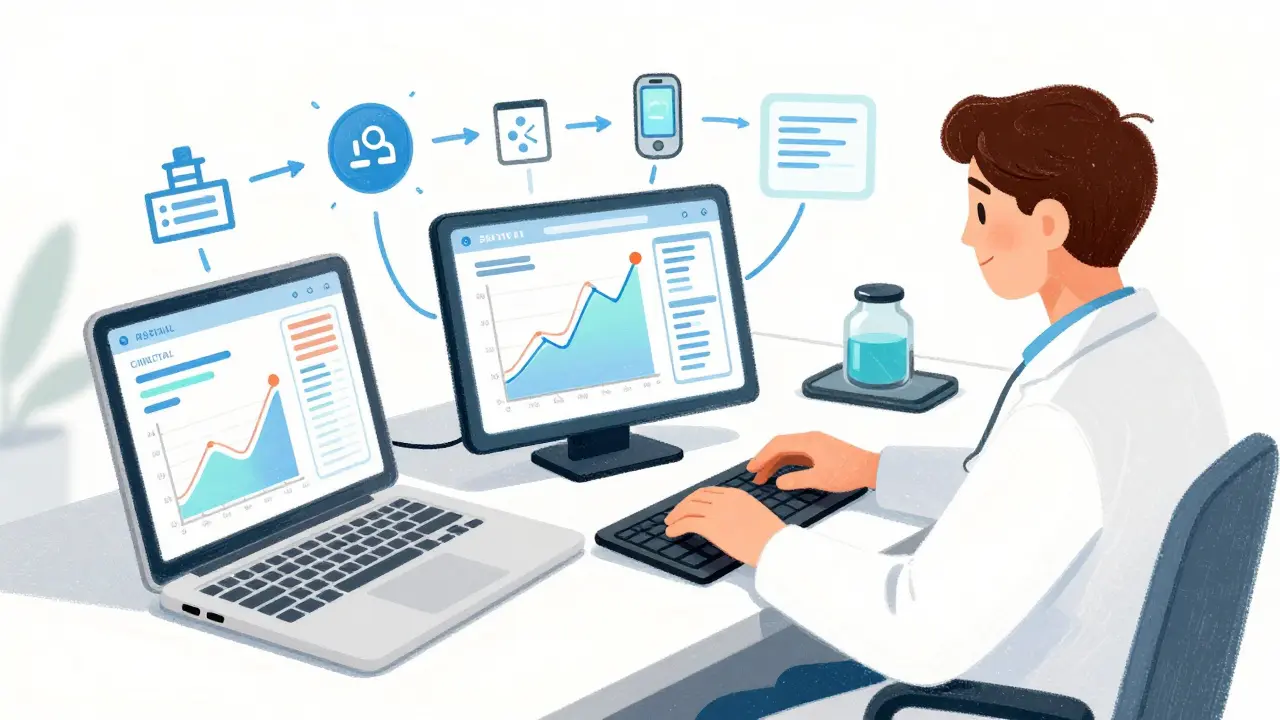
Real-world data comes from electronic medical records (EMRs), insurance claims, patient registries, and even wearable devices. In the U.S., companies like Optum, IQVIA, and Truven aggregate data from 270 million patients. But this data has challenges. Health systems use 900+ incompatible EHR platforms, leading to fragmented records. Data completeness varies-only 68% of real-world datasets capture primary endpoints versus 92% in trials.
Flatiron Health’s oncology database, which tracks 2.5 million cancer patients across 280 clinics, took 5 years and $175 million to build before Roche acquired it for $1.9 billion. This shows the investment needed to make real-world data usable. Without proper standards, biases can creep in, like patients with better access to care being overrepresented.
Regulatory Perspectives: FDA vs EMA
The U.S. Food and Drug Administration (FDA) The U.S. government agency responsible for regulating drugs and medical devices formally recognized real-world evidence’s potential in the 21st Century Cures Act of 2016. However, former FDA Commissioner Dr. Robert Califf testified that "real-world evidence can complement traditional clinical trial data, but it cannot replace the rigor of randomized controlled trials for initial efficacy determinations."
In contrast, the European Medicines Agency (EMA) The European regulatory body for medicines and health products has been more aggressive. In 2022, 42% of post-authorization safety studies used real-world data versus 28% at the FDA. This reflects differing philosophies: the EMA embraces real-world evidence for faster decisions, while the FDA prioritizes clinical trial rigor for initial approvals.
Real-World Evidence in Action - Oncology and Beyond
Oncology leads in real-world evidence use. High drug costs and ethical challenges with placebo trials make RWE essential. For example, when a new cancer drug shows promise in trials, real-world data tracks survival rates across diverse populations. A 2023 study found 45% of RWE studies focus on oncology, while rare diseases account for 22% since RCTs are impractical for small groups.
Payers like UnitedHealthcare and Cigna now require RWE for reimbursement. According to Drug Topics, 78% of U.S. payers use RWE in formulary decisions. This shift helps ensure treatments are both effective and cost-efficient in real-world settings.
The Future - Blending Both Approaches
The future isn’t clinical trials versus real-world evidence-it’s both working together. The FDA’s 2024 draft guidance on hybrid trial designs combines elements of both. Google Health’s 2023 study showed AI algorithms can predict treatment outcomes from EHR data with 82% accuracy, outperforming traditional trial analysis.
However, challenges remain. A 2019 Nature study found only 39% of RWE studies could be replicated due to poor transparency. The VALID Health Data Act aims to fix this by setting quality standards. As Dr. Nancy Dreyer of IQVIA says, "The future is RCTs and RWE working together to create better healthcare decisions."
What’s the key difference between clinical trial data and real-world evidence?
Clinical trial data measures efficacy-how well a treatment works under controlled conditions. Real-world evidence measures effectiveness-how well it works in everyday practice with diverse patients. Think of it as "does it work in theory?" versus "does it work in practice?"
Why do clinical trials exclude so many patients?
Trials exclude patients to control variables and ensure clear results. Common reasons include comorbidities, age restrictions, or other health factors. For example, a 2023 NEJM study found only 20% of cancer patients would meet trial criteria, with Black patients excluded 30% more often due to socioeconomic barriers.
Can real-world data replace clinical trials?
No. Clinical trials remain essential for initial safety and efficacy approval. Real-world evidence complements them by showing how treatments perform in broader populations. The FDA and EMA both state RWE is supplemental, not a replacement, for rigorous trial data.
What are the biggest challenges with real-world data?
Data fragmentation across 900+ U.S. health systems, inconsistent EHR formats, privacy laws like HIPAA, and missing information (only 68% completeness for primary endpoints). Without proper statistical methods like propensity score matching, real-world studies can be biased.
How is real-world evidence used in practice?
Payers use RWE for reimbursement decisions (78% of U.S. insurers do), drug manufacturers refine trial designs using RWE, and regulators approve drugs based on combined data. For example, Flatiron Health’s oncology database helps track treatment outcomes across diverse patient groups.




Dr. Sara Harowitz
February 6, 2026 AT 04:34 AMClinical trials are the ONLY way to get reliable data! Real-world evidence is just a buzzword for lazy doctors-full of biases, incomplete records, and no control over variables. The FDA knows this-why are we even considering it?!
Laissa Peixoto
February 7, 2026 AT 22:16 PMWhile clinical trials provide controlled data, real-world evidence offers insights trials can't capture-like drug interactions with comorbidities or real patient adherence. It's not about replacing trials but complementing them. Proper methodology is key. Dismissing RWE outright ignores its value in diverse populations and long-term outcomes.
Joyce cuypers
February 8, 2026 AT 12:57 PMReal world data is super important but yeah the fragmentation is a real pain. Like in my hospital, we got 12 different EHRs and it's a nightmare to get consistent data. But still, it's better than nothing for sure.
Sam Salameh
February 8, 2026 AT 19:15 PMHey Joyce, totally agree! American healthcare has the best systems, and even with EHR issues, we're still ahead of other countries. Real-world data helps us see how treatments work in our specific population. It's all about using the best of both worlds!
anjar maike
February 8, 2026 AT 23:49 PMRWE is the future 🌟
Danielle Vila
February 10, 2026 AT 10:53 AMWait, RWE is the future? 😂 You think it's that simple? Let me tell you something-Big Pharma is manipulating real-world data to push their drugs! They cherry-pick data, hide adverse effects, and use it to get FDA approval faster. It's all a scam to make more money. You're being played!
Carol Woulfe
February 11, 2026 AT 09:45 AMThe notion that real-world evidence complements clinical trials is a dangerous fallacy perpetuated by those who lack scientific rigor. The FDA's caution is entirely warranted; real-world data is riddled with uncontrolled variables, selection bias, and systemic inaccuracies. Trusting such data would be akin to building a skyscraper on sand-utterly unstable. The European Medicines Agency's embrace of this flawed approach is a stark warning of regulatory decline.
Thorben Westerhuys
February 12, 2026 AT 20:34 PMCarol, I completely agree! It's so frustrating how people just accept real-world data without questioning it! The lack of standards is terrifying! How can we trust anything from these chaotic healthcare systems? It's like trying to navigate a stormy sea without a compass! I can't believe how naive some people are about this!
Elliot Alejo
February 12, 2026 AT 23:18 PMBoth clinical trials and real-world evidence have their place. Trials give us controlled efficacy data, while RWE shows real-world effectiveness. The key is integrating them thoughtfully-using RWE to refine trials and vice versa. It's not about choosing one over the other but creating a synergistic approach for better healthcare outcomes.
Pamela Power
February 13, 2026 AT 21:34 PMLet's be real here-real-world evidence is a joke. Clinical trials are the only way to get accurate data because they control variables, use strict criteria, and have high completeness rates. Real-world data? It's messy, inconsistent, and riddled with biases. For example, in the US alone, there are over 900 different EHR systems that don't talk to each other, leading to fragmented records. And only 68% completeness for primary endpoints? That's like saying you have a 68% chance of hitting a target blindfolded. Meanwhile, clinical trials have 92% completeness and are designed to minimize bias. Real-world data is just a way for hospitals to cut corners and save money, not a legitimate scientific method. The FDA is right to be cautious. If you want to know if a drug works, you need controlled environments, not random hospital data. It's basic science 101. And the EMA's embrace of RWE is just another example of European regulatory weakness. America knows better. This isn't even a debate. It's clear-cut. Real-world evidence is a dangerous distraction from proper medical science.
Lana Younis
February 14, 2026 AT 23:11 PMHey Pamela, I see where you're coming from, but it's not that black and white. RWE isn't about replacing trials but filling gaps-like how drugs work in diverse populations with comorbidities. Yeah, data fragmentation is a problem, but initiatives like the VALID Health Data Act are fixing it. Also, 45% of RWE studies are in oncology because RCTs are hard there. It's about using both together, not picking sides. Chill out, it's not a competition!
one hamzah
February 16, 2026 AT 05:24 AMBoth approaches have strengths! RWE helps us see real-life impact, trials give us solid proof. Together, they make better healthcare decisions. 🌈
Jenna Elliott
February 18, 2026 AT 00:30 AMReal-world data is unreliable. Clinical trials are the only way. Period.