
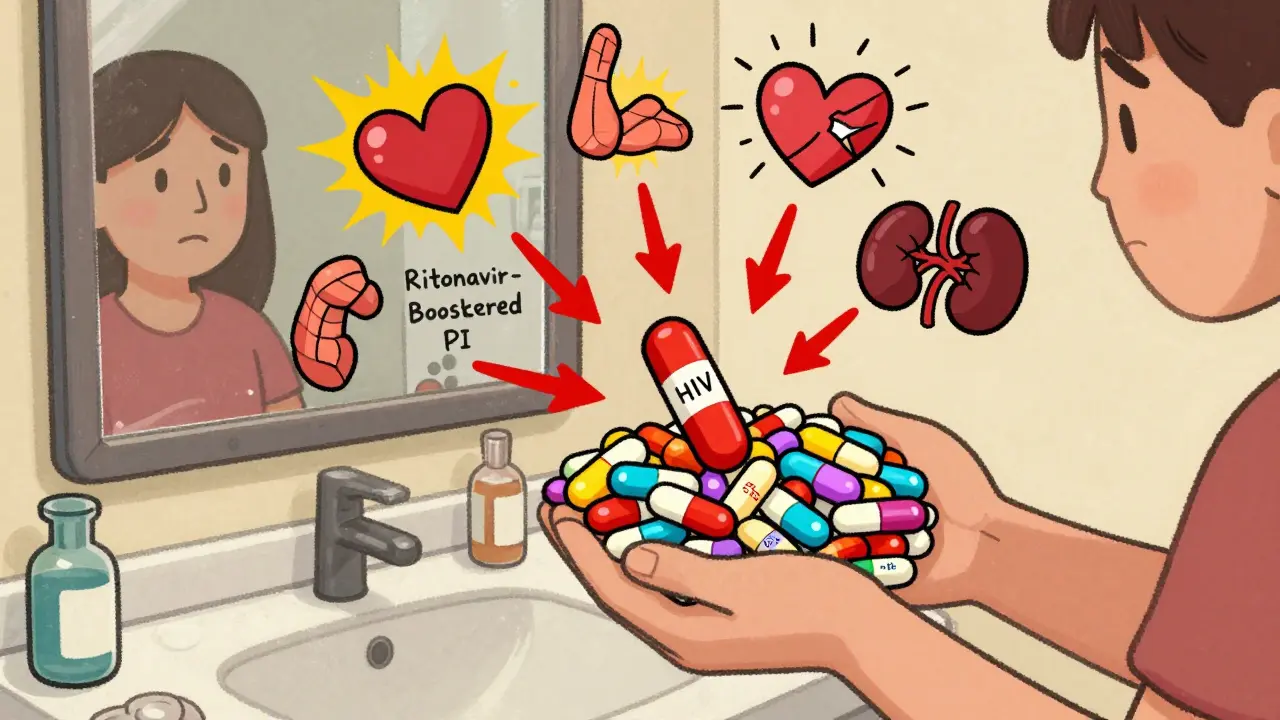
When someone is on antiretroviral therapy (ART) to manage HIV, they’re not just taking one pill. They’re often managing a whole list of medications-for high blood pressure, cholesterol, diabetes, depression, or even just a bad back. And that’s where things get dangerous. Some of the most common drugs people take every day can interact with HIV meds in ways that are silent, serious, and sometimes deadly. It’s not about being careless. It’s about not knowing.
Why Some HIV Meds Are More Dangerous Than Others
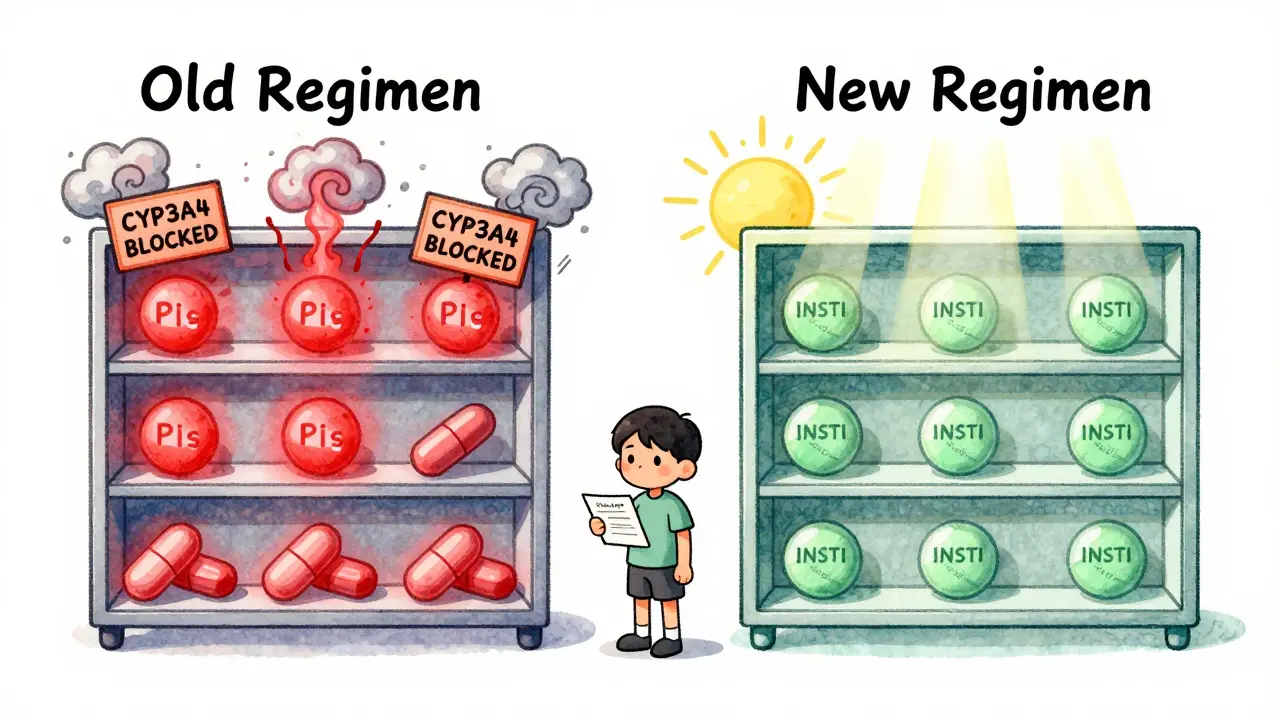
Not all antiretroviral drugs play nice with other medications. The biggest troublemakers are the older ones: protease inhibitors (PIs), especially when they’re boosted with ritonavir or cobicistat. These drugs are like bulldozers in your body’s chemical system. They slam the brakes on CYP3A4, an enzyme that breaks down about 60% of all prescription drugs. When that enzyme is blocked, other meds pile up in your bloodstream. And when they pile up too high, they can cause organ damage, muscle breakdown, or even sudden heart failure.Take statins, for example. If you’re on simvastatin or lovastatin to lower cholesterol-and you’re also on a ritonavir-boosted HIV regimen-your statin levels can spike 20 to 30 times higher than normal. That’s not a typo. That’s enough to trigger rhabdomyolysis, where muscle tissue starts dying and leaks into your blood. It can shut down your kidneys. It’s been fatal. The same thing happens with certain sedatives, erectile dysfunction drugs, and even some nasal sprays.
On the other side of the spectrum are integrase strand transfer inhibitors (INSTIs) like dolutegravir and bictegravir. These newer drugs barely touch CYP3A4. They’re quiet. They don’t interfere. A 2018 study found that patients on ritonavir-boosted darunavir had over three times more dangerous interactions than those on dolutegravir. That’s why most new HIV patients today start on INSTI-based regimens. Simpler. Safer. Fewer surprises.
The Silent Killers: Over-the-Counter and Herbal Risks
You’d think the big prescription drugs are the only concern. But nearly 40% of dangerous interactions come from things you can buy without a prescription. St. John’s Wort is one of the worst. It’s sold as a natural remedy for depression, but it’s a powerful enzyme inducer. If you’re on efavirenz, St. John’s Wort can slash its levels by 50% to 60%. That’s like skipping doses for weeks. The virus rebounds. Resistance builds. Treatment fails.Even something as simple as an inhaled steroid for asthma or allergies can be risky. Fluticasone and budesonide are common. But when paired with ritonavir-boosted ART, they can flood your system with cortisol-like effects. The result? Adrenal insufficiency-your body stops making its own stress hormones. People collapse. They go into shock. Hospitals report that 17% of patients on boosted PIs who used these nasal sprays ended up in the ER with adrenal crisis. It’s not rare. It’s predictable.
And don’t forget recreational drugs. Ketamine, MDMA, even marijuana can behave differently when CYP3A4 is blocked. With ritonavir, ketamine’s effects last longer. The dose you’ve used safely before could now be too strong. There’s no warning label on a bag of powder. But your body knows.
Cardiovascular Drugs: The Hidden Danger Zone
People with HIV are living longer. That means more heart disease. About 27% of those over 50 have cardiovascular issues. That means statins, blood pressure meds, and blood thinners are everywhere. And guess what? Many of them clash hard with ART.Amlodipine, a common calcium channel blocker for high blood pressure, can spike in concentration by 60% when taken with ritonavir. That’s not just a little dizziness. That’s a sudden drop in blood pressure-enough to cause fainting, falls, or worse. Sildenafil (Viagra) is another one. The usual dose of 50 or 100mg becomes dangerous. It must be cut to 25mg and used no more than once every 48 hours. Avanafil? Completely off-limits. No exceptions.
And then there’s the statin puzzle. Simvastatin and lovastatin? Absolute no-gos. Pitavastatin and fluvastatin? Safe. Why? Because they don’t rely on CYP3A4. Your pharmacist should know this. But if they don’t ask about your HIV meds, they might miss it. That’s why you have to speak up.
INSTIs Aren’t Perfect-Here’s What Still Matters
INSTIs are the gold standard for new patients. But they’re not magic. Dolutegravir, for instance, has one sneaky interaction: metformin. If you’re on metformin for type 2 diabetes, dolutegravir cuts its levels by a third. That’s not a small drop. It can mean your blood sugar spikes. You might not notice until you’re dizzy, thirsty, or peeing constantly. Your doctor needs to check your HbA1c more often if you switch to dolutegravir.And bictegravir? It’s even quieter than dolutegravir. But if you’re on rifampin-for tuberculosis, for example-it can slash bictegravir levels by 71%. That’s enough to let HIV replicate again. So if you have TB, or are being treated for it, your HIV regimen must change. No guessing. No hoping.
What You Need to Do Right Now
This isn’t theoretical. It’s happening every day. Here’s what you need to do:- Make a full list of everything you take-prescription, over-the-counter, vitamins, herbal supplements, even occasional marijuana or alcohol. Write it down. Bring it to every appointment.
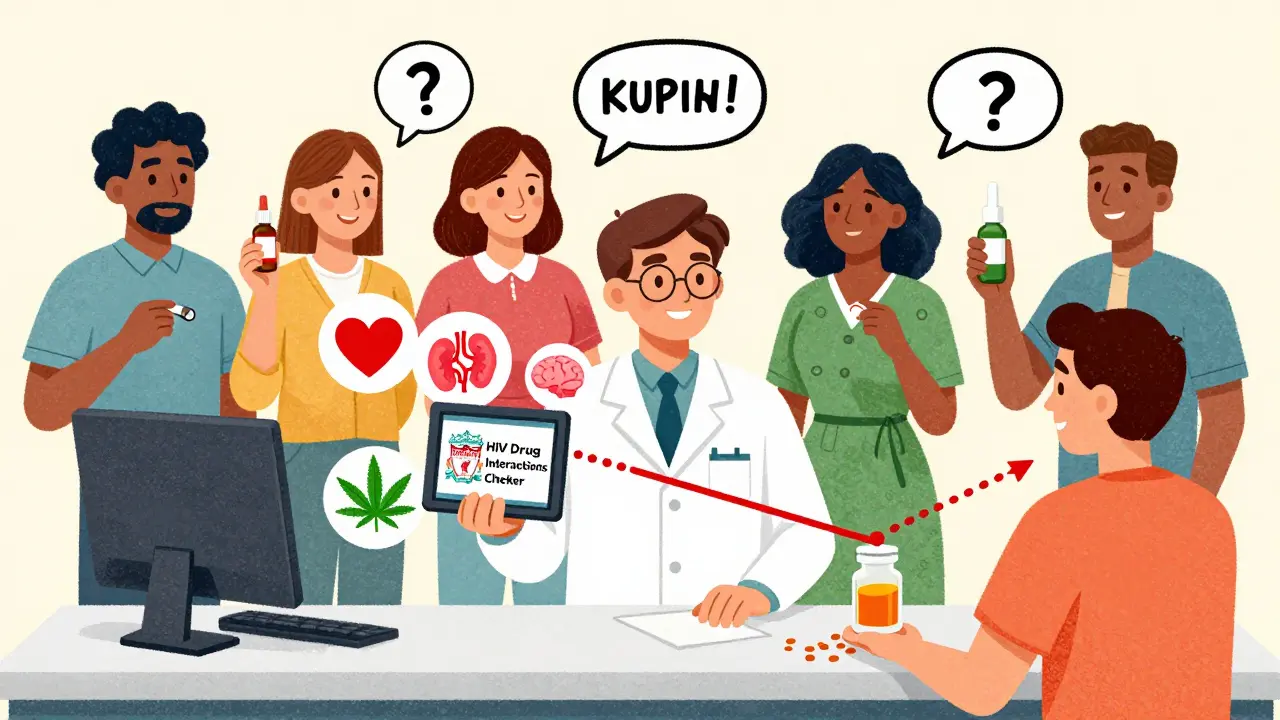
- Ask your pharmacist: "Do any of these interact with my HIV meds?" Don’t assume they know. Many don’t.
- Use the Liverpool HIV Drug Interactions Checker. It’s free. It’s updated monthly. Type in your meds. It tells you what’s safe, what’s risky, and what to avoid. Bookmark it.
- Never stop or start a new drug without checking. Even a new painkiller or cold medicine can be dangerous.
- Know your regimen. If you’re on a boosted PI, you’re in the high-risk group. If you’re on an INSTI, you’re safer-but not risk-free.
The CDC says over half of people with HIV in the U.S. are 50 or older. That’s millions of people taking 5, 6, even 10 different medications. Each one adds risk. The number of medications you take? Each one increases your chance of a dangerous interaction by 18%. Time since diagnosis? Each year adds 7%. This isn’t about age. It’s about complexity.
What’s Changing? What’s Next
The future is better. Lenacapavir, a new long-acting injectable given twice a year, doesn’t rely on CYP enzymes. It’s designed to avoid interactions. The NIH is spending $12.7 million in 2024 to build even cleaner drugs. By 2030, experts predict next-gen ART will have 80% fewer interactions than today’s boosted PIs.But today? Today, you still have to be vigilant. The safest ART is the one you take correctly. And the most important part of taking it correctly? Knowing what else is in your body-and how it might react.
Can I take ibuprofen with my HIV meds?
Yes, ibuprofen is generally safe with most antiretrovirals. It doesn’t rely on the CYP3A4 enzyme, so it doesn’t interfere with boosted PIs or INSTIs. But if you’re on tenofovir (especially the older TDF version), long-term or high-dose ibuprofen can increase kidney stress. Stick to the lowest effective dose for the shortest time. Always check with your provider if you’re using it daily.
Is it safe to use St. John’s Wort for depression while on HIV meds?
No. St. John’s Wort is extremely dangerous with HIV medications. It reduces levels of efavirenz, nevirapine, and some PIs by up to 60%. This can lead to treatment failure and drug resistance. Even if you feel fine, the virus may be replicating. There is no safe dose. Use SSRIs or other antidepressants approved for people with HIV instead.
Why can’t I take Viagra normally if I’m on HIV meds?
If you’re on a ritonavir- or cobicistat-boosted regimen, Viagra (sildenafil) can build up to dangerous levels in your blood. The standard 50mg or 100mg dose can cause severe drops in blood pressure, fainting, or heart problems. The safe dose is 25mg, and you can only take it once every 48 hours. Avanafil (Spedra) is completely off-limits. Always confirm your HIV regimen before using any ED medication.
What should I do if I start a new medication and feel dizzy or weak?
Stop the new medication and contact your HIV provider immediately. Dizziness, muscle pain, unusual fatigue, nausea, or confusion can signal a dangerous interaction-especially if you’re on a boosted PI. Your provider may need to adjust doses, switch medications, or run blood tests. Don’t wait. These symptoms can escalate fast.
Are generic HIV drugs as safe as brand names when it comes to interactions?
Yes. Generic antiretrovirals have the same active ingredients, dosages, and metabolic pathways as brand-name versions. A generic version of dolutegravir interacts the same way as the brand. The same goes for boosted PIs. The risk isn’t in the name-it’s in the drug class. Always confirm the active ingredient, not the brand.




THANGAVEL PARASAKTHI
February 11, 2026 AT 00:02 AMMan I wish more people knew this stuff. I'm from India and we just grab meds off the shelf without thinking. Saw a guy on the bus last week popping St. John’s Wort with his ART pills. I almost asked him if he wanted to die. Not my business but... yeah. Just sayin'.
Pharmacists here don't even ask about HIV meds. They see 'antiretroviral' and zone out. We need better training. Or at least posters in every pharmacy.
Also - ibuprofen? Fine short term. But if you're on TDF? Yeah, kidneys don't like that. My cousin went into renal failure. All because he thought 'natural' meant 'safe'.
Chelsea Deflyss
February 12, 2026 AT 18:50 PMst johns wort is a no go but like... why do people even take it? its not even that good. i tried it for 3 weeks and felt like a zombie with a headache. just get an ssri. they work. and they dont make you a walking time bomb.
also - avanafil is off limits? i didnt even know that drug existed. is that the one that looks like a rocket ship? lol
Marie Fontaine
February 14, 2026 AT 04:22 AMTHIS. THIS. THIS. I’m on Biktarvy and my doc never mentioned metformin until I brought it up. I was like ‘wait... my sugar’s been spiking for months??’
Bookmarking the Liverpool checker right now. Also - if you’re on ART and take melatonin? Yeah. That’s a thing too. Ask your pharmacist. Seriously. I’m not joking.
Also 💬🫶
Lyle Whyatt
February 14, 2026 AT 07:41 AMLook, I’m not a doctor, but I’ve been on ART since 2012. I’ve been on boosted PIs, I’ve been on INSTIs. I’ve been on statins, blood pressure meds, antidepressants, painkillers, even that weird herbal blend my aunt swore by.
The truth? No one’s coming to save you. Not your doctor, not your pharmacist, not the CDC. You have to become your own pharmacist. Write it down. Carry it. Update it. Bring it to every appointment. Even if they roll their eyes. Even if they say ‘we know your meds.’ They don’t. They’re overwhelmed.
And yes - ibuprofen is ‘safe’... until it isn’t. I had a friend who took 800mg daily for his back pain. Two years later, his creatinine was through the roof. He didn’t even know he was on tenofovir. That’s the system we’re stuck in.
Long-term HIV survival isn’t about the virus anymore. It’s about the cocktail. And that cocktail? It’s a minefield with a smiley face on the label.
Be the person who asks. Be the one who reads. Be the one who doesn’t assume.
Because nobody else will.
Susan Kwan
February 14, 2026 AT 22:11 PMOh sweet jesus. Another post where the author pretends they’re the first person to figure out drug interactions.
It’s 2024. We’ve known about ritonavir and statins since 2007. The fact that this is still news? That’s the real tragedy.
Also - ‘bookmark the Liverpool checker’? No. You should be using the HIV Drug Interactions app. It’s on iOS and Android. And it auto-updates. And it has alerts. And it’s free. And it’s better than your browser tab.
Stop being passive. Start being proactive. Or stop pretending you care.
Tori Thenazi
February 15, 2026 AT 22:40 PMSo... let me get this straight. The government is letting Big Pharma push these dangerous combos on us... while quietly funding ‘cleaner’ drugs for 2030?
That’s not progress. That’s a cover-up.
And why is Lenacapavir only twice a year? Why not once a year? Why not once every five years? Why are we still stuck with daily pills? Why are we still forced to manage 10 drugs? Why are we still being treated like lab rats?
Who benefits? Who profits? Why isn’t this in the news? Why isn’t Congress investigating?
Someone’s making billions off our confusion. And we’re too busy Googling ‘is ibuprofen safe’ to notice.
Wake up.
They’re not trying to help us.
They’re trying to keep us alive - just barely - so we keep buying.
Brandon Osborne
February 16, 2026 AT 20:22 PMTHIS IS WHY PEOPLE DIE. Not from HIV. From ignorance. From arrogance. From ‘I’m fine, I’ve been on this for 10 years.’
I had a cousin. Took simvastatin. Took boosted darunavir. Thought ‘I’m young, I’ll be fine.’
He woke up one morning with legs like rubber. Couldn’t walk. Was in the ICU for three weeks. Lost 40% of his muscle mass. His kidneys never recovered.
He’s 32 now. In a wheelchair.
And the worst part? He didn’t even tell his doctor he was taking the statin.
Because he ‘didn’t think it mattered.’
It mattered.
It matters.
And if you’re reading this and you’re on ART? You’re next. Unless you change.
Stop being lazy.
Stop being scared.
Ask. The. Question.
Tricia O'Sullivan
February 18, 2026 AT 02:18 AMThank you for this thorough and meticulously researched post. It is both clinically accurate and deeply human in its approach. I am a nurse in Dublin, and I encounter these interactions daily. The gap between clinical knowledge and patient awareness remains alarming.
I encourage all individuals on ART to maintain a written, updated medication list - not as a suggestion, but as a non-negotiable standard of care. I have personally witnessed lives saved because a patient brought their list to an emergency visit.
Also, I would like to commend the inclusion of the Liverpool HIV Drug Interactions Checker. It is, without question, the most reliable and accessible tool currently available. I distribute its link to every patient I counsel.
With sincere respect,
Tricia
Ryan Vargas
February 18, 2026 AT 19:42 PMLet’s step back from the pharmacology for a moment and consider the metaphysics of pharmaceutical dependency.
We are told that ART is a lifeline. But what if it is also a cage? A system designed not to cure, but to manage - to render us perpetually dependent on a labyrinth of chemical intermediaries.
The CYP3A4 enzyme? It’s not just a metabolic pathway. It’s a metaphor. The body’s natural filter - silenced by synthetic boosters. We are no longer just patients. We are nodes in a pharmacological network. Controlled. Regulated. Monitored.
And yet, we are told to ‘ask our pharmacist.’ As if the pharmacist is the guardian of truth, not a clerk in a system that profits from complexity.
Lenacapavir? A step forward? Or merely a rebranding of control? Will we one day be injected with a chip that logs our adherence? Will our health data be sold to insurers who then raise our premiums for ‘non-compliance’?
The real question isn’t whether ibuprofen interacts with tenofovir.
The real question is: Who built the system that makes us afraid to take ibuprofen at all?
And why are we still surprised when the system breaks us?
MANI V
February 19, 2026 AT 08:31 AMUgh. Another one of these posts where people act like they just discovered that drugs interact. I’ve been on ART since 2015. I know about statins. I know about St. John’s Wort. I know about Viagra. I know about the Liverpool site.
But here’s the thing - most people don’t even know their own regimen. They don’t know if they’re on dolutegravir or darunavir. They don’t know what ‘boosted’ means. They just take the pills.
And then they blame the system.
It’s not the system. It’s you. You didn’t read the pamphlet. You didn’t ask. You didn’t care.
Stop pretending you’re a victim. You’re just lazy.