
Vitamin E & Warfarin Safety Calculator
Understanding the Risk
Vitamin E over 400 IU daily can significantly increase bleeding risk when taking warfarin. This calculator shows your risk level based on your Vitamin E intake.
Your Risk Assessment
Enter your Vitamin E intake to see your risk level.
- Increased bleeding risk
- Unstable INR readings
- Unexpected bruising or bleeding
If you're taking warfarin, you might think vitamin E is just another harmless supplement - something you take for your skin or heart. But here’s the truth: vitamin E can quietly make warfarin more powerful, and that can be dangerous. It doesn’t always cause problems, but when it does, it can lead to serious bleeding - sometimes without warning.
How Vitamin E Interacts with Warfarin
Warfarin works by blocking vitamin K, which your body needs to make clotting factors. Without enough of those factors, your blood takes longer to clot. That’s the whole point - to prevent dangerous clots in people with atrial fibrillation, artificial heart valves, or deep vein thrombosis.
Vitamin E, especially at high doses, doesn’t work the same way. It doesn’t directly block vitamin K. Instead, it interferes with platelets - the tiny blood cells that help clots form. Think of it like this: warfarin slows down the clotting process, and vitamin E makes it harder for your blood to start clotting in the first place. Together, they create a double hit.
This isn’t just theory. A 2013 study in the Journal of the American Heart Association looked at over 1,000 people on warfarin and found that those with higher vitamin E levels in their blood had a much greater risk of bleeding - even after accounting for other risk factors like age, high blood pressure, or kidney disease. The risk jumped significantly when vitamin E levels hit 4.49 μmol/mmol cholesterol. At 5.56 μmol/mmol or higher, the chance of a major bleed, like a brain hemorrhage, went up sharply.
The 400 IU Threshold
Not all vitamin E is risky. Low doses - under 400 IU per day - don’t seem to cause major problems in most people. But once you cross that line, the danger rises. The University of California San Diego Anticoagulation Guidelines and the American College of Chest Physicians both warn that doses above 400 IU daily should be avoided if you’re on warfarin.
Why 400 IU? Because that’s the dose where studies start seeing real effects. One case report described a patient who took 800 IU daily of vitamin E for four weeks. Nothing seemed wrong at first. Then, out of nowhere, they started bleeding internally. Their INR - the test that measures how long it takes blood to clot - had climbed dangerously high. The problem didn’t show up until the fourth week. That’s the scary part: it doesn’t happen right away. It builds up slowly.
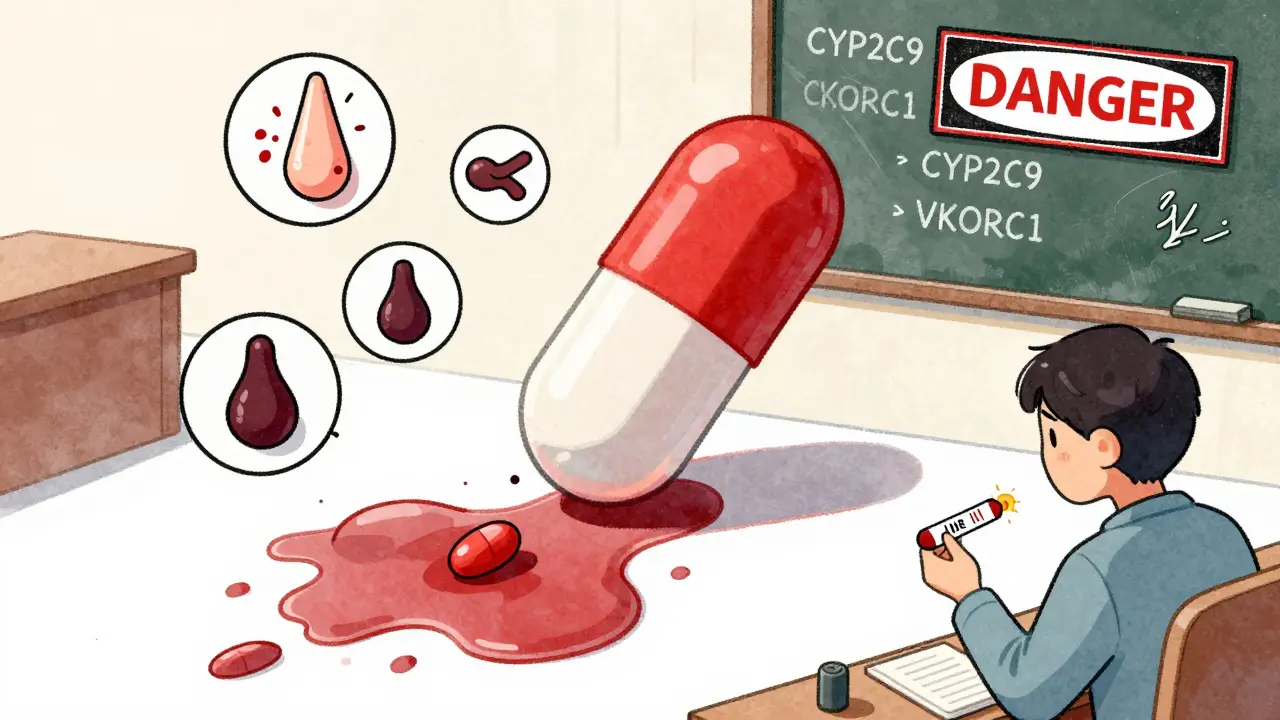
Even more surprising: a small, unpublished study found that just 42 IU of vitamin E daily - less than a typical multivitamin - caused an anticoagulant effect in three volunteers taking a similar drug. This suggests some people are just more sensitive. Genetics may play a role. Variants in the CYP2C9 and VKORC1 genes can change how your body processes both warfarin and vitamin E. Two people can take the same dose, and one might be fine while the other ends up in the ER.
What the Studies Say - And Why They Conflict
You might have heard that vitamin E is safe with warfarin. That comes from a 1996 study by Kim and White, where 21 people on warfarin took up to 800 IU of vitamin E daily for six weeks. Their INR didn’t change. That study got a lot of attention. But here’s what most people don’t tell you: it was short, small, and only looked at INR - not actual bleeding events.
The 2013 study changed the game. It didn’t just measure INR. It tracked real-world outcomes: nosebleeds, bruising, gastrointestinal bleeding, and brain hemorrhages. And it found that even when INR stayed stable, bleeding still happened. That’s because INR only tells part of the story. It doesn’t measure platelet function - which is exactly what vitamin E messes with.
So the conflict isn’t really about right or wrong. It’s about what you’re measuring. If you only check INR, vitamin E looks safe. If you look at actual bleeding, it’s not.
What Clinics Are Doing Right Now
Most anticoagulation clinics in the U.S. take this seriously. A 2017 survey of 250 clinics found that 78% routinely warn patients about vitamin E. Sixty-three percent specifically say: don’t take more than 400 IU a day. Some clinics won’t allow it at all.
If you’re set on taking vitamin E, here’s what your provider will likely ask you to do:
- Get a baseline INR before starting vitamin E.
- Check your INR weekly for the first month.
- Then check every two weeks as long as you keep taking it.
- Report any unusual bruising, bleeding gums, dark stools, or headaches immediately.
That’s three to five extra clinic visits a year - just for one supplement. And if your INR spikes, your warfarin dose may need to be lowered, which adds more complexity to your treatment.
What About Other Supplements?
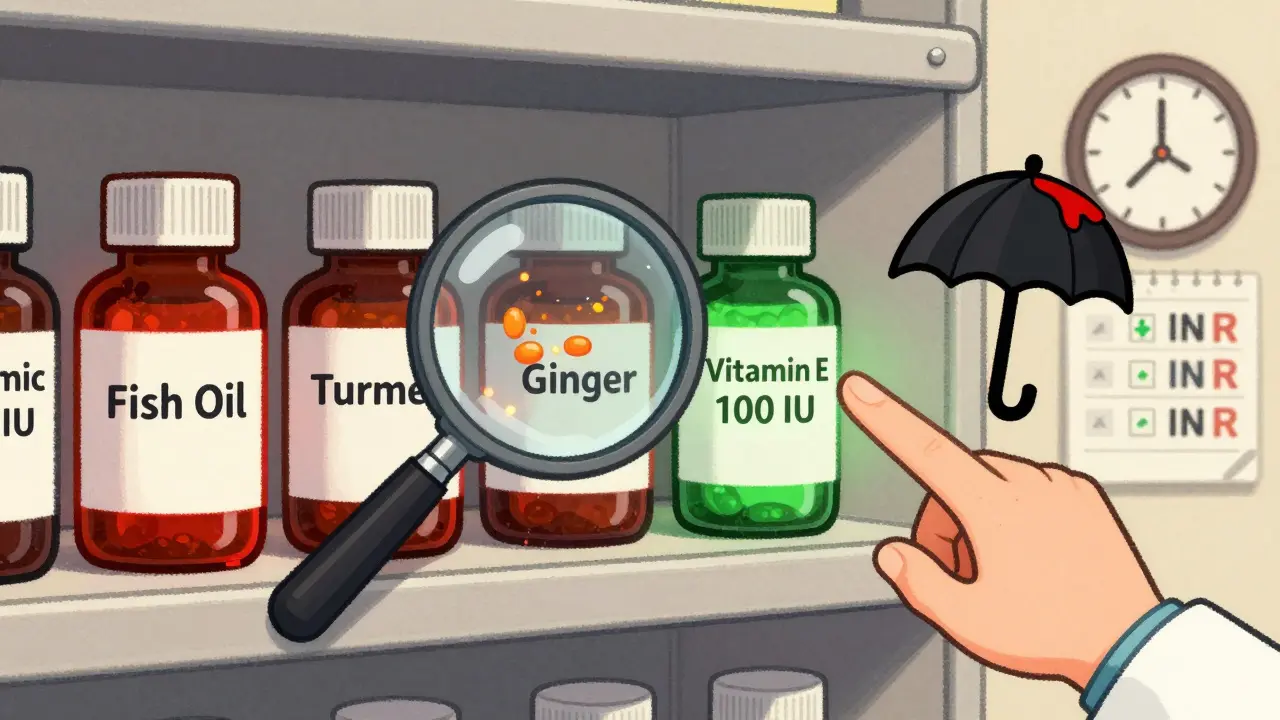
Vitamin E isn’t alone. Fish oil, garlic, ginger, ginkgo, and turmeric all have similar effects. They thin the blood - not by affecting INR, but by messing with platelets. That’s why clinics list them all in the same warning category.
And here’s the kicker: most people don’t realize they’re taking these. A fish oil capsule might have 1,000 mg of omega-3s, but it also contains vitamin E as a preservative. A turmeric supplement? Often includes black pepper and vitamin E. A multivitamin? Might have 100-200 IU of vitamin E - which is usually fine, but adds up if you’re also taking a separate supplement.
Read the labels. Look for “alpha-tocopherol” - that’s the form of vitamin E that matters here. If you’re on warfarin, and you see it listed in the ingredients, you need to count it.
Why This Matters More Than You Think
Over 77% of American adults take dietary supplements. Vitamin E is the third most popular single-ingredient supplement after vitamin D and fish oil. In 2022, Americans spent $287 million on it.
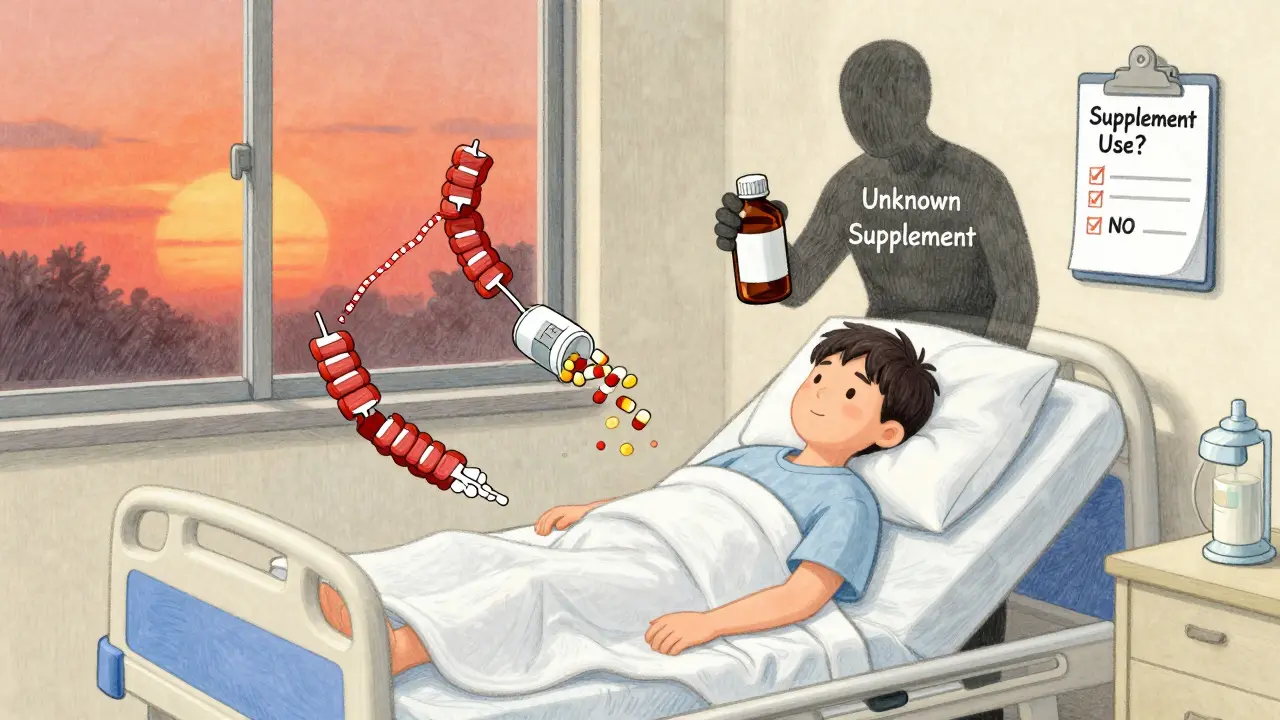
But here’s the problem: supplements aren’t regulated like drugs. The FDA can’t force companies to prove they’re safe with warfarin. They don’t have to list side effects clearly. You can buy 1,200 IU pills online with no warning label. And your doctor might not even know you’re taking them.
That’s why the American Heart Association and the European Society of Cardiology now recommend that doctors ask patients directly about supplement use - not just medications. If you’re on warfarin, your doctor should ask: “Are you taking anything else? Vitamins? Herbs? Supplements?”
And if you’re not sure? Stop. Don’t guess. Call your anticoagulation clinic or pharmacist. Ask them if it’s safe. Better yet, don’t take it at all.
The Bottom Line
There’s no easy answer. Some people take vitamin E with warfarin and never have an issue. Others bleed badly - even at low doses. The safest choice? Avoid high-dose vitamin E entirely if you’re on warfarin. If you’re taking less than 400 IU daily, talk to your provider. Get your INR checked more often. Watch for signs of bleeding.
Don’t assume it’s safe because you read an old study. Don’t assume it’s harmless because it’s a “natural” supplement. Warfarin is a powerful drug. It doesn’t play well with many things - including vitamin E. The risk isn’t worth it.
If you’re thinking about taking vitamin E for heart health, skin, or immunity - know this: there’s no strong evidence it helps in people who already eat a normal diet. And if you’re on warfarin, the risks far outweigh any unproven benefits.



Paul Ong
December 31, 2025 AT 15:52 PMI took 800 IU of vitamin E for months with warfarin and never had an issue. My INR was always stable. Maybe it's just me but I'm not scared off by a study that doesn't even track my actual bleeding events. I'll keep taking it and checking my numbers.
Lee M
January 1, 2026 AT 15:54 PMThe 1996 study was a joke. Small sample. Short duration. Only looked at INR. Meanwhile the 2013 paper tracked real bleeds. Brain hemorrhages. GI bleeds. That's not theory. That's clinical reality. If you're still taking vitamin E above 400 IU you're playing Russian roulette with your blood.
Kristen Russell
January 2, 2026 AT 02:05 AMI get it. You want to feel healthy. But if you're on warfarin, the supplement aisle isn't your friend. I used to take fish oil and turmeric until my doctor said 'stop.' Now I just eat salmon and curry. Safer. Simpler. Less stress.
Bryan Anderson
January 2, 2026 AT 11:17 AMI appreciate the thorough breakdown of the evidence. The distinction between INR stability and actual bleeding risk is critical. Many patients assume normal INR equals safety, but platelet dysfunction from vitamin E can still lead to hemorrhage. This is a nuanced interaction that deserves more clinical attention.
Matthew Hekmatniaz
January 2, 2026 AT 18:27 PMI'm from Iran and we don't talk about supplements like this. But I've seen elderly relatives bleed out after taking 'natural' things. Your point about labels is spot on. In my country, even pharmacies sell 1000 IU vitamin E with no warning. This needs global awareness.
Liam George
January 4, 2026 AT 10:37 AMYou know who benefits from this fear? Big Pharma. They don't want you taking vitamin E because it's cheap and they can't patent it. The FDA is corrupt. The studies that say it's safe? Suppressed. The ones that scare you? Funded by drug companies. Your INR doesn't lie. If it's normal, you're fine. They just want you hooked on their tests and pills.
sharad vyas
January 6, 2026 AT 03:48 AMIn India, we use turmeric and garlic every day. My uncle is on warfarin and eats curry daily. No problems. Maybe it's about how your body is made. Not all people are the same. Maybe the real issue is one-size-fits-all medicine.
Dusty Weeks
January 7, 2026 AT 23:16 PMI take 200 IU of vitamin E in my multivitamin and I'm fine. 🤷♂️ My INR is chill. My bruises are chill. My doctor says chill. Why are we making this a crisis? 🙄
Sally Denham-Vaughan
January 9, 2026 AT 16:39 PMI had a friend who took 800 IU vitamin E and ended up in the ER with a GI bleed. She thought it was just 'natural.' No one told her it could interact. I'm telling you now: if you're on warfarin, skip the high-dose stuff. Seriously. It's not worth it.
Todd Nickel
January 9, 2026 AT 17:38 PMThe real problem here isn't just vitamin E-it's the entire regulatory framework around dietary supplements. Unlike pharmaceuticals, supplements aren't required to demonstrate safety in combination with other drugs before being sold. The FDA doesn't have the authority or resources to monitor every interaction, and manufacturers aren't incentivized to test them. This creates a dangerous gap where patients assume 'natural' equals 'safe' and clinicians are left playing catch-up. The fact that a 2017 survey found 78% of anticoagulation clinics routinely warn patients suggests this is a widespread, under-recognized issue. We need mandatory labeling, standardized dosing, and physician education-not just individual vigilance. Until then, the burden falls on patients who are often unaware they're even taking something risky. And yes, that includes the vitamin E in your fish oil capsule. It's not just the pill you bought for 'heart health'-it's the preservative in the bottle you didn't even know you were taking.