
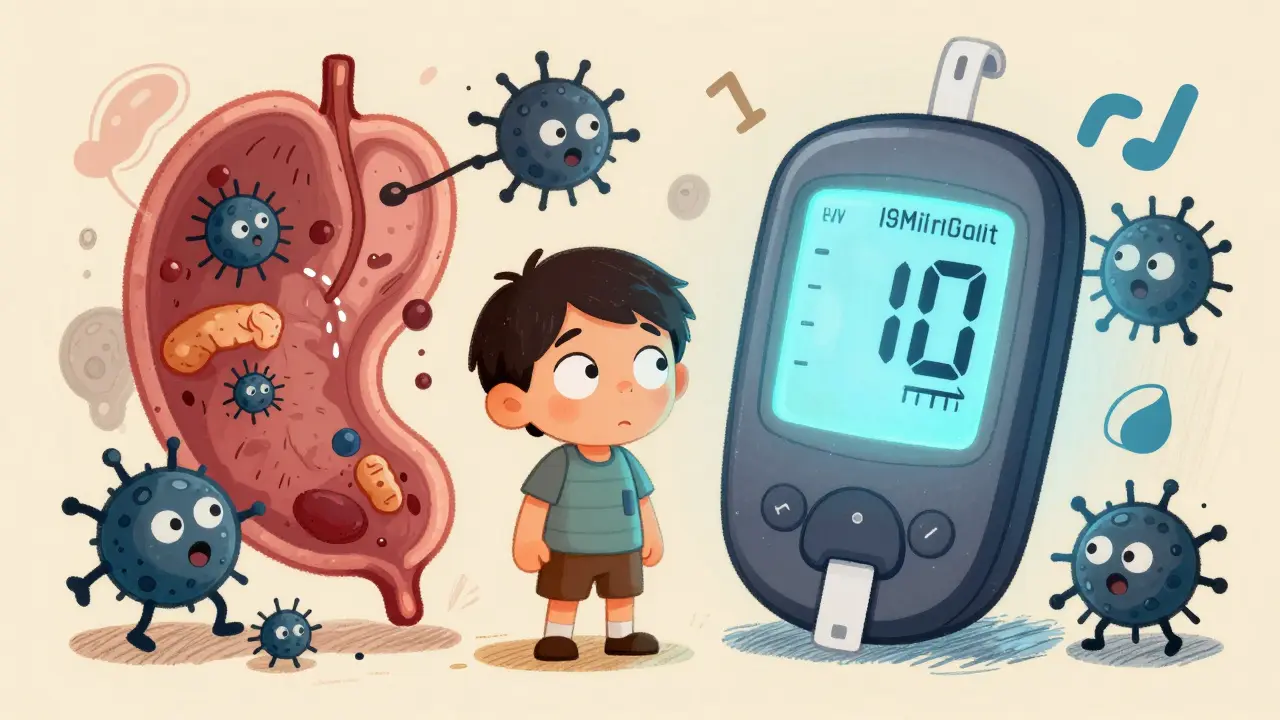
When your body stops making insulin, life changes fast. Type 1 diabetes doesn’t wait for a warning. One day you’re tired all the time, drinking water nonstop, and losing weight even though you’re eating more. The next, you’re in the hospital with diabetic ketoacidosis - a life-threatening condition that can hit in under 24 hours. This isn’t just about sugar. It’s about survival.
What Happens in Type 1 Diabetes?
Type 1 diabetes is an autoimmune disease. Your immune system, which normally fights off viruses and bacteria, turns on your own pancreas. It destroys the beta cells that make insulin - the hormone your body needs to turn sugar from food into energy. Without insulin, glucose builds up in your blood. Your cells starve. Your body starts breaking down fat for fuel, producing toxic acids called ketones. That’s how diabetic ketoacidosis starts.
Unlike type 2 diabetes, which often develops slowly with lifestyle factors, type 1 can strike at any age - though it’s most common in children and teens. About 1.6 million Americans live with it, and roughly 64,000 new cases are diagnosed each year. It’s not caused by eating too much sugar or being overweight. It’s not preventable. And it requires lifelong insulin.
Early Warning Signs You Can’t Ignore
The symptoms of type 1 diabetes don’t creep in. They show up like a storm.
- Extreme thirst - no matter how much you drink, you’re still dry.
- Frequent urination - you’re going every hour, even at night.
- Unexplained weight loss - you’re losing pounds even if you’re eating normally.
- Constant hunger - your body can’t use the food you eat, so it screams for more.
- Blurred vision - high blood sugar swells the lenses in your eyes.
- Extreme fatigue - you’re exhausted even after sleeping.
- Slow-healing cuts or infections - your body can’t repair itself without insulin.
- Fruity-smelling breath - a sign ketones are building up.
These signs can appear over days or weeks. In kids, they might be mistaken for the flu. In adults, they’re often dismissed as stress or aging. But if you see three or more of these together, get tested. Delaying diagnosis can lead to diabetic ketoacidosis - a medical emergency that requires IV fluids, insulin, and hospital care.
How Doctors Diagnose Type 1 Diabetes
There’s no single test. Doctors use a mix of blood work and clinical signs to confirm type 1 diabetes - and rule out type 2.
First, they check your hemoglobin A1C. If it’s 6.5% or higher on two separate tests, you have diabetes. A1C shows your average blood sugar over the past 2-3 months. But that’s not enough. They’ll also measure your fasting blood glucose - if it’s 126 mg/dL or higher after 8 hours without food, that’s another confirmation. Or they might test your random blood glucose - if it’s 200 mg/dL or higher and you have symptoms, that’s diagnostic too.
Here’s what separates type 1 from type 2: autoantibody testing. If you have GAD65, IA2, or ZNT8 antibodies in your blood, your immune system is attacking your pancreas. That’s type 1. If those are negative, it’s more likely type 2 - even if you’re thin or young.
Another key test: C-peptide. This molecule is made at the same time as insulin. Low C-peptide means your body isn’t making insulin. High C-peptide means you still are - typical in type 2. In type 1, C-peptide is almost always low, even when blood sugar is sky-high.
If symptoms are severe, doctors check for diabetic ketoacidosis. They look at blood pH, bicarbonate levels, and ketones in your blood or urine. A pH below 7.3 and ketones above 3 mmol/L means you’re in DKA. This needs immediate treatment.

Insulin Therapy: The Only Lifeline
You can’t live without insulin. Not now. Not ever. But you have choices in how you get it.
Multiple Daily Injections (MDI) - also called basal-bolus therapy - is the most common approach. You take a long-acting insulin once or twice a day to cover your body’s baseline needs. That’s your basal insulin. Then, before every meal, you inject rapid-acting insulin to match the carbs you eat. That’s your bolus.
Common basal insulins include glargine (Lantus, Basaglar), detemir (Levemir), and degludec (Tresiba). Rapid-acting ones are lispro (Humalog), aspart (NovoLog), and glulisine (Apidra). Dosing isn’t one-size-fits-all. Your doctor will start with a guess - maybe 0.5 units per kilogram of body weight per day - then fine-tune it over weeks.
Insulin Pumps - or continuous subcutaneous insulin infusion (CSII) - are growing fast. These small devices, worn like a pager, deliver insulin through a tiny tube under your skin. You program basal rates to change throughout the day - higher in the morning, lower at night. You give yourself meal boluses with a button press.
Modern pumps don’t just deliver insulin. Many connect to continuous glucose monitors (CGMs) like Dexcom G7 or Abbott FreeStyle Libre 3. These sensors track your blood sugar every 5 minutes. Some pumps, like Tandem’s t:slim X2 with Control-IQ or Medtronic’s MiniMed 780G, use that data to automatically adjust insulin delivery. They’re called hybrid closed-loop systems. They don’t replace you - they help you. Studies show people using them spend 70-75% of the day in target blood sugar range, compared to 50% with injections alone.
Insulin isn’t just about numbers. It’s about timing. You need to match your insulin to your food, activity, and stress. A workout might drop your sugar. A cold might spike it. A night out with pizza? You’ll need more insulin than usual. That’s why education matters.
What Good Management Looks Like
Target blood sugar ranges? The American Diabetes Association says:
- Before meals: 80-130 mg/dL
- Two hours after meals: under 180 mg/dL
- A1C goal: under 7% for most adults
But these aren’t rules. They’re starting points. For an older adult with heart disease, an A1C of 7.5-8% might be safer. For a teenager, aiming for 6.5% might be possible with a pump and CGM. Your doctor will help you pick your own target.
Testing frequency? If you’re on injections, you’ll check your blood sugar 4-10 times a day - before meals, at bedtime, after exercise, when you feel off. With a CGM, you still need to check with a fingerstick twice a day to calibrate. But you’ll see trends in real time. You’ll know if your sugar is dropping fast - or rising after a snack you didn’t plan for.
Carb counting is non-negotiable. You need to know how many grams of carbs are in your food - and how much insulin you need per gram. That’s your insulin-to-carb ratio. For most adults, it’s 1 unit per 5-30 grams of carbs. But it changes. You might need 1 unit per 10 grams at breakfast and 1 unit per 20 grams at dinner. Your body’s sensitivity shifts.
And hypoglycemia? That’s the daily fear. If your sugar drops below 70 mg/dL, you’ll shake, sweat, feel dizzy. Left untreated, you can pass out. You must treat it fast: 15 grams of fast-acting sugar - glucose tablets, juice, candy. Wait 15 minutes. Check again. Repeat if needed. Never drive with low blood sugar. Never skip carrying glucose.
The New Frontiers
There’s hope beyond insulin.
In late 2022, the FDA approved teplizumab (Tzield). It’s not a cure. But it’s the first drug that can delay type 1 diabetes in people at high risk - like those with two or more autoantibodies and abnormal blood sugar. Given as a 14-day IV infusion, it delayed diagnosis by nearly two years in clinical trials. This is a game-changer for families with a genetic risk.
Stem cell therapy is next. Vertex Pharmaceuticals’ VX-880, an experimental treatment using lab-grown insulin-producing cells, has shown insulin independence in 89% of patients after 90 days. These aren’t cures yet - patients still need immunosuppressants. But it’s the closest we’ve come to replacing the pancreas.
Cost is a brutal reality. The average person with type 1 diabetes spends over $20,000 a year on care. Insulin alone makes up nearly $5,600 of that. Even with insurance, copays for pumps, CGMs, and insulin can be crushing. That’s why advocacy groups like Breakthrough T1D push for price caps and better coverage.
Living With Type 1 - It’s a Full-Time Job
Managing type 1 diabetes isn’t a hobby. It’s a second job.
You’ll spend 2-4 hours a day on it: checking blood sugar, calculating carbs, bolusing insulin, changing pump sites, refilling CGM sensors, logging meals, adjusting for exercise, dealing with highs and lows. It never stops. Not on vacation. Not on weekends. Not when you’re sick.
But it’s manageable. With the right tools - a pump, a CGM, good education, and a support system - people with type 1 live full, active lives. They run marathons. They have kids. They build businesses. They travel the world. They just do it differently.
Start with a certified diabetes care and education specialist. Take a 10-20 hour training course. Learn how to read your numbers. Understand how stress, sleep, and hormones affect your sugar. Find a community - online or local. You’re not alone. And you don’t have to figure it out alone.
Can type 1 diabetes be cured?
No, there is no cure yet. But treatments like teplizumab can delay diagnosis in high-risk people, and stem cell therapies like VX-880 are showing promise in restoring insulin production. For now, lifelong insulin therapy is required. Research is advancing fast, but no cure is approved or widely available.
Is type 1 diabetes caused by eating too much sugar?
No. Type 1 diabetes is an autoimmune condition, not linked to diet or lifestyle. It happens when the immune system attacks insulin-producing cells in the pancreas. You can’t cause it by eating sweets, and you can’t prevent it by eating healthy. It’s not your fault.
Do I need to stop eating carbs if I have type 1 diabetes?
No. You still need carbs - they’re your body’s main energy source. The key is matching your insulin to the amount you eat. Carbohydrate counting helps you figure out how much insulin to take. Many people with type 1 eat balanced meals with whole grains, fruits, and vegetables. It’s not about cutting carbs - it’s about knowing how much and when.
Can I use an insulin pump instead of injections?
Yes, and many people do. Insulin pumps offer more flexibility than injections. They deliver insulin continuously and allow for precise adjustments. Most modern pumps work with continuous glucose monitors and can automatically adjust insulin based on your readings. They’re not for everyone - some people prefer injections - but they’re a powerful tool for tighter control.
How often should I check my A1C?
If your blood sugar is stable and you’re meeting your goals, check A1C twice a year. If you’re changing insulin, not hitting targets, or have other health issues, test every three months. A1C gives you a 3-month average - it’s the best way to see if your overall management is working.
What’s the difference between basal and bolus insulin?
Basal insulin is long-acting and covers your body’s background need for insulin - between meals and overnight. Bolus insulin is rapid-acting and covers the sugar from meals. Basal keeps your blood sugar steady. Bolus handles spikes. Together, they mimic how a healthy pancreas works.
Can children with type 1 diabetes live normal lives?
Absolutely. With modern tools like CGMs and insulin pumps, kids with type 1 diabetes play sports, go to school, sleep through the night, and grow up healthy. Parents learn to manage it - and schools are legally required to support them. The key is consistent care, education, and emotional support.
What should I do if I forget to take my insulin?
If you miss a bolus (meal) insulin, check your blood sugar. If it’s high, take a correction dose - but be careful not to overdose. If you miss basal insulin, contact your doctor. Missing basal insulin can lead to high blood sugar and ketones within hours. Never skip basal insulin for more than a few hours. Always have a backup plan and emergency contact on hand.



Bryan Anderson
January 2, 2026 AT 23:10 PMThank you for laying this out so clearly. I’ve been managing T1D for 12 years and still learn something new every time I read a breakdown like this. The part about C-peptide being low even when blood sugar is sky-high was a lightbulb moment - I never realized how that distinguishes type 1 so cleanly from type 2.
Also, the mention of teplizumab giving families two extra years before diagnosis? That’s huge. My niece was diagnosed at 8. If this had been available when we first noticed symptoms, it might’ve changed everything.
Liam George
January 4, 2026 AT 16:20 PMThey say it’s autoimmune but never mention the real trigger: glyphosate. The USDA approved it as a ‘safe’ herbicide in the 80s. Now look - beta cell destruction epidemic. Coincidence? Or corporate bioengineering? The FDA doesn’t want you to know insulin isn’t the solution - it’s the Band-Aid on a bullet wound.
And those pumps? Connected to CGMs? That’s surveillance capitalism disguised as care. They’re tracking your glucose, your eating habits, your stress levels - all feeding into Big Pharma’s predictive models. Wake up.
Dusty Weeks
January 5, 2026 AT 05:21 AMfrfr i just got diagnosed last month and this post is literally the only thing that made me feel less alone 😭
also why does insulin cost more than my rent?? 🥲
Sally Denham-Vaughan
January 5, 2026 AT 08:46 AMHey Dusty - I saw your comment and I just want to say you’re not alone. I was diagnosed at 19 and thought I’d never eat pizza again. Now I do - I just bolus smarter. 💪
And yeah, the cost is insane. I’ve been using patient assistance programs from Novo and Lilly - they helped cut my insulin bill in half. DM me if you want the links. We got this.
Bill Medley
January 6, 2026 AT 19:08 PMThe distinction between basal and bolus insulin is clinically essential. Misunderstanding this leads to suboptimal glycemic control and increased risk of complications. Education must precede therapy.
Richard Thomas
January 7, 2026 AT 05:19 AMIt’s strange, isn’t it? We’ve spent centuries trying to control nature - to fix what we think is broken. But here, in type 1 diabetes, we’re not fixing a flaw. We’re replacing a function that was taken from us. Insulin isn’t a cure because the body didn’t fail - it was attacked. And yet, we treat it like a malfunction.
Maybe the real question isn’t how to manage it better, but why our immune systems turned on themselves in the first place. Was it the hygiene hypothesis? The rise of processed foods? The loss of microbial diversity? Or is it simply that our biology can’t keep pace with our environment?
I don’t have answers. But I wonder if the next frontier isn’t just insulin delivery - it’s immune re-education. Can we teach the body to stop fighting itself? That’s the real miracle we’re chasing.
Paul Ong
January 8, 2026 AT 05:46 AMJust got my CGM today and I’m already seeing patterns I never noticed with fingersticks. The graph tells you what your body’s whispering. You just have to listen.
gerard najera
January 9, 2026 AT 22:06 PMTeplizumab delays. Stem cells restore. Neither cures. But both matter.