

When a pharmacist fills a prescription for a brand-name drug like Lipitor, they don’t just grab the same bottle off the shelf. They check something far more important than price or packaging: whether the generic version is truly therapeutically equivalent. This isn’t guesswork. It’s a science-backed, legally required process that keeps millions of patients safe every day.
The Orange Book: The Pharmacist’s Bible for Generic Drugs
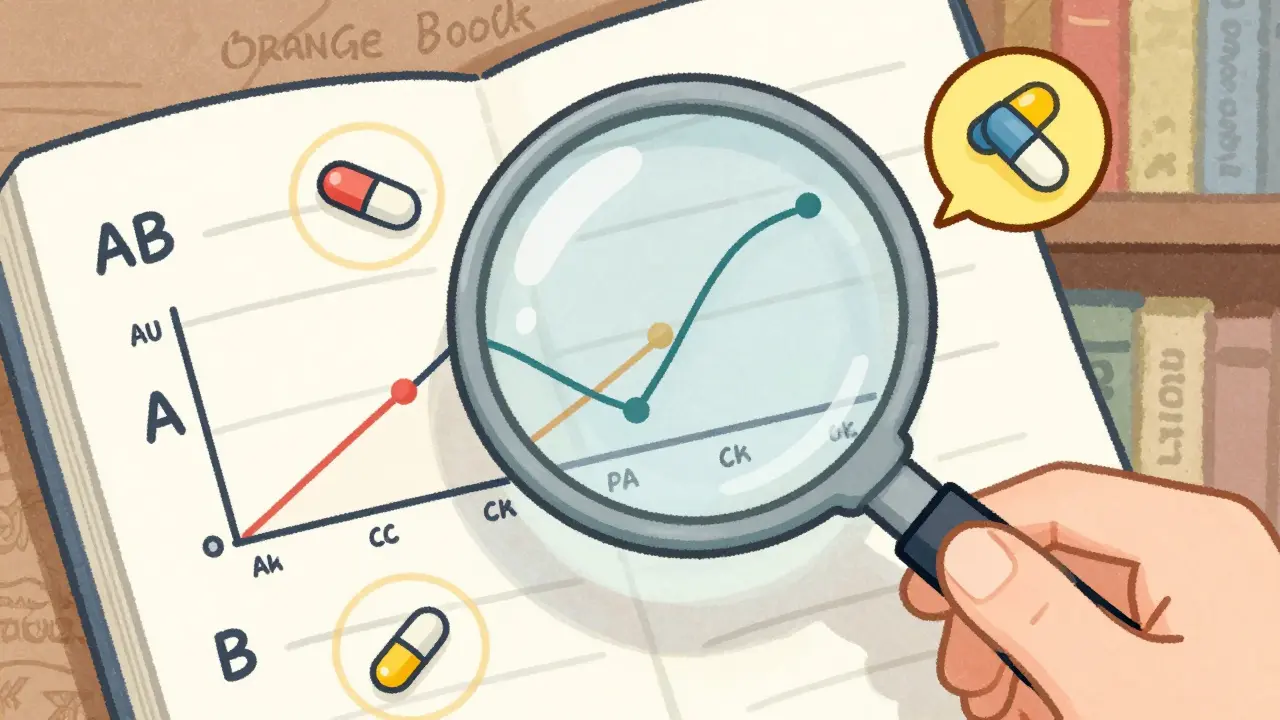
The foundation of every generic drug substitution starts with one document: the FDA’s Approved Drug Products with Therapeutic Equivalence Evaluations-better known as the Orange Book. First published in 1980, it’s updated monthly and contains over 16,500 drug products as of 2024. For pharmacists, it’s not just a reference-it’s the law.Every drug listed in the Orange Book gets a two-letter code that tells pharmacists whether substitution is allowed. The most common rating is AB. That means the generic has the same active ingredient, strength, dosage form, and route of administration as the brand-name drug (pharmaceutical equivalence), and it delivers the same amount of medicine into the bloodstream at the same rate (bioequivalence). In fact, 98.7% of all rated drugs in the 2023 Orange Book carry this AB rating.
Other ratings matter too. An A without a second letter means pharmaceutical equivalence is confirmed, but bioequivalence data isn’t available yet. A B means the product is not considered interchangeable. Some codes like AN (aerosol nasal), AO (oral solution), or AT (topical) indicate the drug’s form. Pharmacists don’t need to memorize all of them-but they do need to know how to read the code before dispensing.
What Makes a Generic Truly Equivalent?
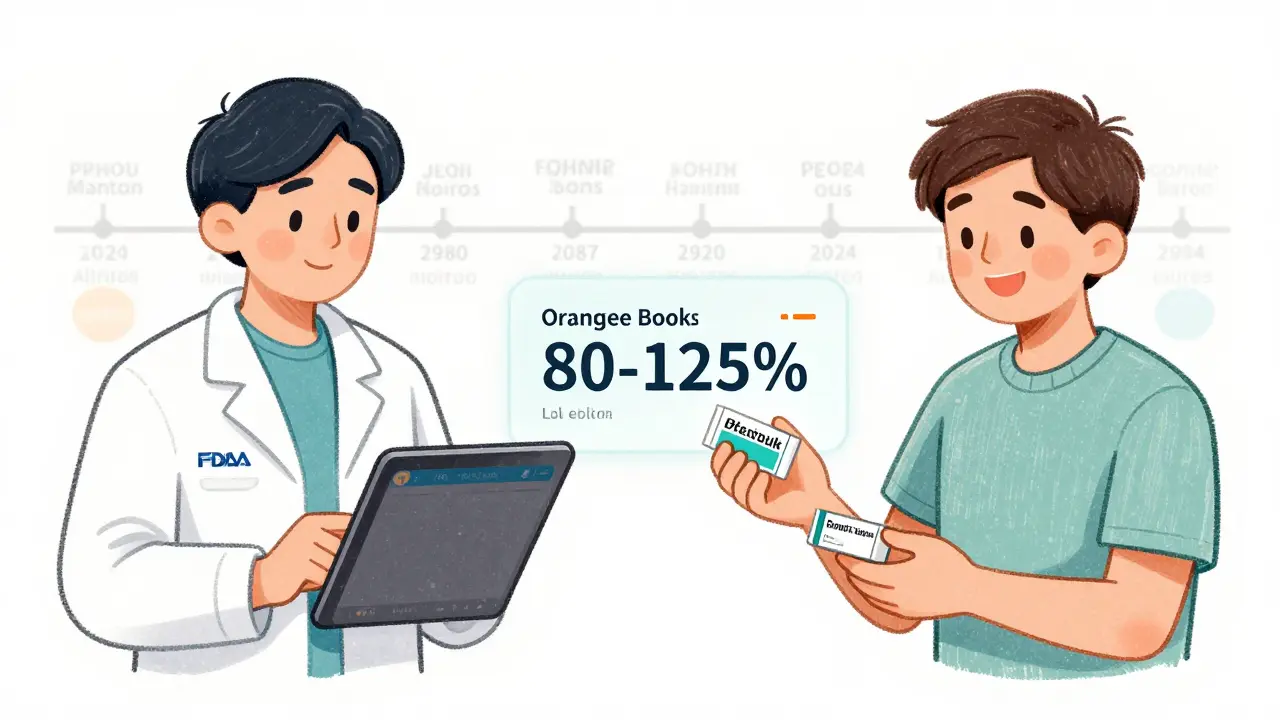
Therapeutic equivalence isn’t just about matching ingredients. It’s about proving the body reacts the same way. That’s where bioequivalence studies come in. To get FDA approval, a generic manufacturer must show that the amount of drug absorbed into the bloodstream (measured as AUC) and the peak concentration (Cmax) fall within 80% to 125% of the brand-name drug’s values. This isn’t a random range-it’s based on decades of clinical data showing that differences outside this window can affect how well the drug works.For most drugs, this works perfectly. But for drugs with a narrow therapeutic index-like warfarin, levothyroxine, or phenytoin-the margin for error is tiny. The FDA applies stricter standards here, sometimes requiring bioequivalence to fall within 90% to 111%. Pharmacists must know which drugs fall into this category. A 5% difference in levothyroxine, for example, can cause symptoms of hyper- or hypothyroidism in sensitive patients.
Studies back this up. A 2023 analysis of over 2,100 bioequivalence studies found that 97.8% of generics showed less than a 5% difference in AUC compared to brand drugs. The FDA’s own 2020 review found no meaningful difference in adverse events between brand and generic versions-0.78% for brands versus 0.81% for generics. That’s not a statistical blip; it’s proof the system works.
How Pharmacists Actually Verify Equivalence in Real Time
At the counter, the process is fast-but never rushed. Most pharmacists follow four steps every time they substitute a generic:- Identify the reference listed drug (RLD) using the Orange Book’s database.
- Confirm the generic matches the RLD in active ingredient, strength, and dosage form.
- Check the therapeutic equivalence (TE) code. Only an “A” rating allows substitution.
- Look for any “Do Not Substitute” notation from the prescriber.
This takes 8 to 12 seconds per prescription, according to time-motion studies. Most pharmacists use the free FDA Orange Book mobile app-downloaded over 450,000 times as of March 2024. Others rely on integrated pharmacy systems like PioneerRx or QS/1, which pull Orange Book data directly into their dispensing software.
But the system isn’t perfect. About 5.7% of generic substitutions involve drugs not yet listed in the Orange Book. These are often newer generics or complex products like inhalers or topical creams. In those cases, pharmacists turn to FDA guidance documents, manufacturer data, and professional judgment. The key rule: never substitute unless you can prove equivalence through an approved source.
State Laws and Legal Protection
All 50 states require pharmacists to use the Orange Book as the official standard for substitution. Texas Administrative Code §309.3(a), for example, says pharmacists “shall use” the Orange Book as the basis for determining equivalence. Forty-nine states allow automatic substitution when a brand is prescribed, unless the doctor writes “dispense as written.” Only Massachusetts requires explicit patient consent for substitution.This legal framework protects pharmacists. If you substitute based on an Orange Book “A” rating, you’re shielded from liability under state substitution laws. That’s why a 2019 Texas case, State Board of Pharmacy v. Smith, ended in sanctions for a pharmacist who substituted a generic not listed in the Orange Book. The court ruled: “The Orange Book is the only legally recognized authority.”
Why Other Databases Aren’t Enough
You might see drug references like Micromedex, Lexicomp, or Medi-Span in pharmacies. They’re useful for drug interactions, dosing, or side effects-but they’re not legal substitutes for the Orange Book. A 2021 study in the Journal of the American Pharmacists Association found that 99.3% of pharmacists rely on the Orange Book as their primary tool. Only 62.7% use commercial databases as a secondary check.Why? Because those databases don’t have the same legal standing. They may list a generic as equivalent-but if it’s not in the Orange Book, you can’t legally substitute it. Relying on them instead of the Orange Book exposes pharmacists to malpractice claims.
Challenges and the Future of Generic Verification
The system works well for pills and capsules. But complex products-like inhalers, nasal sprays, topical creams, and injectables-are harder to measure with traditional bioequivalence methods. A 2021 commentary in JAMA Internal Medicine pointed out that the 80-125% range may not capture clinical differences in these products. That’s why the FDA has developed over 1,850 product-specific guidances for complex generics.Biosimilars are another frontier. These are not traditional generics-they’re highly complex biologic drugs. As of June 2024, only 47 of 350 approved biosimilars are listed in the Purple Book (the biologics equivalent of the Orange Book). Pharmacists are still figuring out how to verify equivalence for these drugs, and the FDA has allocated $28.5 million through GDUFA III to improve evaluation methods.
Still, the system remains remarkably accurate. The American Society of Health-System Pharmacists reports substitution error rates of just 0.03% when pharmacists follow the Orange Book correctly. With 90.7% of all U.S. prescriptions filled with generics in 2023, that’s millions of safe substitutions every day.
Training and Competency
New pharmacists don’t just learn this on the fly. Ninety-two percent of pharmacies provide formal training during onboarding-usually 2 to 4 hours of instruction focused on the Orange Book. Competency tests show 89.3% accuracy after training. But knowledge fades without practice. Many pharmacies now run quarterly refresher quizzes on TE codes and substitution rules.The goal isn’t just compliance. It’s trust. Patients need to know that when they get a cheaper generic, it’s not a compromise. It’s an equal. And pharmacists are the ones who make sure that’s true.
What does an AB rating mean in the Orange Book?
An AB rating means the generic drug is pharmaceutically equivalent (same active ingredient, strength, dosage form) and bioequivalent (absorbed into the bloodstream at the same rate and extent) as the brand-name drug. This is the only rating that allows legal substitution in most states.
Can a pharmacist substitute a generic without the doctor’s permission?
Yes, in 49 states, pharmacists can substitute a generic for a brand-name drug if the prescription doesn’t say “dispense as written” and the generic has an AB rating in the Orange Book. Massachusetts is the only state that requires patient consent for substitution.
Are all generics listed in the Orange Book?
No. Only generics that have completed FDA review and been assigned a therapeutic equivalence rating appear in the Orange Book. New generics or complex products may not be listed yet. Pharmacists must use FDA guidance documents in those cases and avoid substitution unless equivalence is confirmed.
Why can’t pharmacists use Micromedex or Lexicomp instead of the Orange Book?
While those databases are excellent for clinical information, they aren’t legally recognized for substitution decisions. Only the FDA’s Orange Book has the authority to determine therapeutic equivalence under state and federal law. Using other sources instead can lead to liability.
What happens if a pharmacist substitutes a drug not rated AB in the Orange Book?
The pharmacist risks legal action, including disciplinary measures from the state board of pharmacy. In the 2019 Texas case State Board of Pharmacy v. Smith, a pharmacist was sanctioned for substituting a non-Orange Book-listed product. The court ruled that the Orange Book is the only legally valid source for substitution decisions.
What’s Next for Generic Equivalence?
The FDA is working to modernize the Orange Book with better digital access and integration into electronic health records. They’re also expanding product-specific guidances for complex drugs and improving bioequivalence methods for inhalers, topical products, and injectables. As biosimilars grow, the system will need to adapt-but the core principle remains: equivalence isn’t assumed. It’s proven.For pharmacists, the job hasn’t changed: verify, confirm, protect. Every time they check the Orange Book, they’re not just filling a prescription. They’re ensuring that a patient’s health doesn’t depend on the brand on the label-but on the science behind the pill.


Cassie Henriques
December 16, 2025 AT 08:15 AMAB rating = same active ingredient + bioequivalence = legal swap. 🤓 But let’s be real-how many pharmacists actually check the Orange Book on their phone while the patient waits? I’ve seen ‘em just trust the system. Not saying it’s wrong, just… human.
Nupur Vimal
December 16, 2025 AT 15:56 PMIndia makes 40% of the world's generics and nobody cares how they test them. The FDA’s 80-125% range is a joke. My cousin got sick from a generic he bought online. No Orange Book. No oversight. Just profit. 🤷♀️
Michelle M
December 16, 2025 AT 18:59 PMIt’s beautiful, really. A system built on science, not marketing. That little AB code? It’s the quiet hero of affordable healthcare. No fanfare. No ads. Just molecules doing what they’re supposed to do.
And yet-we still treat generics like second-class medicine. We shouldn’t. The data doesn’t lie. The body doesn’t care what the label says.
Maybe the real revolution isn’t in the pill. It’s in our perception of it.
Mike Nordby
December 18, 2025 AT 12:53 PMThe Orange Book is the sole legally recognized authority for therapeutic equivalence determinations under 21 CFR § 314.3. Any deviation from its ratings constitutes a violation of state pharmacy practice acts and exposes the pharmacist to liability. This is not a recommendation-it is a regulatory imperative.
John Samuel
December 20, 2025 AT 10:57 AMLet’s give a standing ovation to the unsung heroes of the pharmacy counter-the ones who cross-reference TE codes like detectives, triple-check for ‘Do Not Substitute’ flags, and still manage to smile while you’re yelling about the price.
They’re not just dispensing pills. They’re dispensing peace of mind. 💪💊
Lisa Davies
December 21, 2025 AT 08:46 AMAs someone who grew up in a family that couldn’t afford brand-name meds, I want to say thank you. Not just to the pharmacists, but to the scientists who proved generics work.
My mom took levothyroxine for 15 years-always generic. Never had an issue. That AB rating? It saved her life. And mine.
Don’t let anyone tell you cheap means worse. Sometimes, it just means smarter.
Melissa Taylor
December 22, 2025 AT 02:32 AMIt’s wild how much trust we place in a two-letter code. AB. That’s it. No signature. No approval form. Just a database update and a pharmacist’s judgment.
And yet-this system works. Better than most things in healthcare. We should be shouting this from the rooftops.
John Brown
December 23, 2025 AT 04:31 AMMy uncle’s a pharmacist in Ohio. He says the hardest part isn’t checking the Orange Book-it’s explaining to patients why their ‘new’ generic looks different. ‘It’s the same medicine, just made by a different company.’
People freak out over color changes. We need better patient education. Like, yesterday.
Jocelyn Lachapelle
December 24, 2025 AT 17:16 PMOrange Book = law. AB = safe. No substitutes without it. Done.
Also, biosimilars are the next frontier. Can’t wait to see how this evolves.
Jake Sinatra
December 26, 2025 AT 13:41 PMWhile the Orange Book remains the definitive legal instrument for therapeutic equivalence determinations, the increasing complexity of drug delivery systems-particularly inhalers and transdermal patches-necessitates a reevaluation of bioequivalence thresholds. The 80–125% interval, derived from oral solid dosage forms, may lack clinical sensitivity for non-oral routes. The FDA’s expansion of product-specific guidances is a necessary evolution, not an exception.
Cassie Henriques
December 27, 2025 AT 18:58 PM^ This. I’ve seen patients switch from brand to generic inhalers and say they ‘don’t work as well.’ Could be perception. Could be formulation differences the 80-125% range misses. We need better tools. The Orange Book’s not enough anymore. 🤔