

You pick up a prescription for a brand-name drug, and the pharmacist hands you a box with a different name but the same active ingredient. It costs a fraction of the price. You might wonder: is it really the same? Does it work just as well? The answer lies in a scientific concept called bioequivalence, which is the absence of a significant difference in the rate and extent to which the active ingredient becomes available at the site of drug action. This isn't just a marketing term; it’s a strict legal and scientific standard enforced by the U.S. Food and Drug Administration (FDA). Understanding how this works demystifies why generic drugs are considered safe and effective alternatives to their branded counterparts.
The foundation of modern generic drug approval rests on the Drug Price Competition and Patent Term Restoration Act of 1984, also known as the Hatch-Waxman Act. Before this law, bringing a new drug to market required massive investments in preclinical and clinical trials. The Hatch-Waxman Act created a streamlined pathway called the Abbreviated New Drug Application (ANDA). Instead of repeating expensive safety studies, generic manufacturers only need to prove that their product is bioequivalent to the already-approved brand-name drug, known as the Reference Listed Drug (RLD). This bridge allows the FDA to rely on the original safety and efficacy data while ensuring the generic performs identically in the body.
What Exactly Is Bioequivalence?
Bioequivalence doesn’t mean the pills look the same or have the same inactive ingredients like dyes or fillers. It means they behave the same way inside your system. When you swallow a tablet, it dissolves, the drug enters your bloodstream, travels to its target, and eventually leaves your body. Bioequivalence studies measure two critical aspects of this journey: the speed and the total amount of drug absorbed.
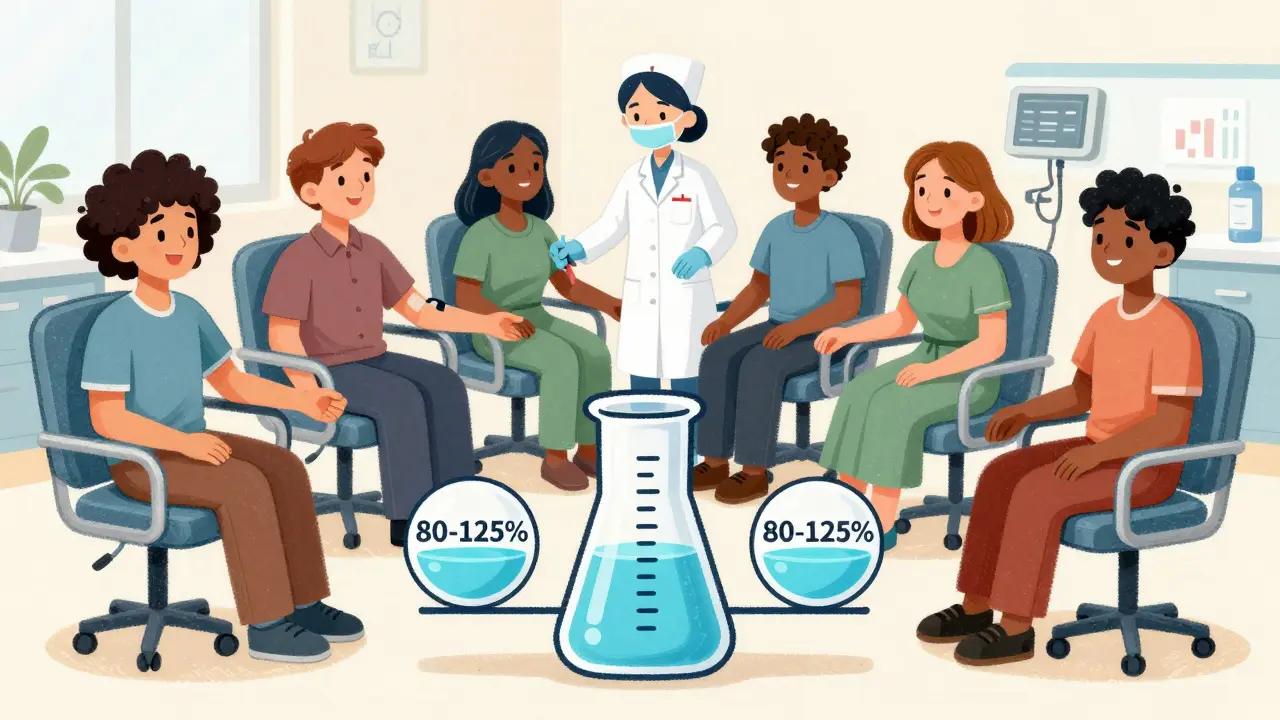
To prove this, manufacturers conduct randomized crossover trials. These studies typically involve 24 to 36 healthy volunteers. Participants receive the brand-name drug in one period and the generic version in another, with a washout period in between to ensure the first drug is completely cleared from their systems. Blood samples are taken at specific intervals to track the drug's concentration over time. This data generates a curve that tells regulators exactly how the drug moves through the body.
The Key Metrics: Cmax and AUC
The FDA evaluates bioequivalence using two primary pharmacokinetic parameters. Think of these as the scorecards for the drug’s performance.
- Cmax (Peak Concentration): This measures the highest level of the drug in your blood. It indicates how fast the drug is absorbed. If Cmax is too low, the drug might not work quickly enough. If it’s too high, it could cause side effects.
- AUC (Area Under the Curve): This represents the total exposure to the drug over time. It combines both the rate and the extent of absorption. Essentially, it answers the question: how much of the drug did your body actually get?
For a generic drug to be approved, its Cmax and AUC must match those of the brand-name drug within a statistically acceptable range. The FDA requires that the 90% confidence interval (CI) of the ratio between the generic and the reference drug falls between 80% and 125% for both parameters. This is the gold standard for systemic drugs intended to be absorbed into the bloodstream.
| Parameter | Definition | Why It Matters |
|---|---|---|
| Cmax | Peak plasma concentration | Determines onset of action and potential for peak-related toxicity |
| AUC(0-t) | Area under the curve from time zero to last measurable concentration | Measures total drug exposure during the dosing interval |
| AUC(0-∞) | Area under the curve extrapolated to infinity | Provides a complete picture of total absorption, including tail end elimination |
The 80-125% Rule: Debunking Myths
A common misconception circulates among patients and even some healthcare providers: that the 80-125% rule means a generic can contain anywhere from 80% to 125% of the active ingredient compared to the brand. This is factually incorrect and creates unnecessary fear. The range applies to the statistical comparison of pharmacokinetic parameters, not the physical weight of the powder in the pill.
Here is how it actually works. Imagine the brand-name drug has an AUC of 100 units. If the generic drug shows a mean AUC of 93 units, the ratio is 93%. However, because individual bodies vary, scientists calculate a 90% confidence interval around that mean. Let’s say the interval is 84% to 110%. Since both the lower bound (84%) and the upper bound (110%) fall within the 80-125% window, the drug passes. The entire interval must fit inside the box. If the upper limit were 130%, even if the average was perfect, the drug would fail because there is a statistical chance that some patients would receive significantly more drug than intended.
This statistical approach ensures that any differences between the generic and the brand are clinically insignificant. Dr. Utpal Munshi, an expert in bioequivalence, notes that the 20% difference threshold is derived from historical data showing that such variations do not impact clinical outcomes for most medications. The goal is to ensure therapeutic equivalence, meaning the same clinical effect and no difference in adverse effects.

In Vivo vs. In Vitro Testing
Not all drugs require blood tests. The FDA determines the appropriate testing method based on the drug’s characteristics. For systemic drugs-those meant to travel through the bloodstream to affect distant parts of the body-in vivo (inside the living body) testing is mandatory. This involves the human trials described earlier.
However, for drugs that act locally, such as topical creams, inhalers, or eye drops, in vitro (test tube or lab bench) testing may suffice. If a drug is not intended to be absorbed systemically, measuring blood levels is irrelevant. Instead, the FDA looks at dissolution profiles, particle size, and other physical properties to ensure the generic delivers the medication to the site of action in the same manner as the brand. The agency publishes over 2,000 product-specific guidances to help manufacturers navigate these nuances, specifying whether in vivo or in vitro approaches are recommended for each unique dosage form.
Narrow Therapeutic Index Drugs
Some medications have a very small margin of error. These are called Narrow Therapeutic Index (NTI) drugs. Examples include warfarin, levothyroxine, and certain anti-seizure medications. For these drugs, a slight change in blood concentration can lead to treatment failure or serious toxicity. While the standard 80-125% range applies to most generics, experts argue that NTI drugs deserve tighter limits, such as 90-111%. The FDA acknowledges this complexity and sometimes recommends stricter criteria or additional monitoring for specific NTI products, though the standard regulatory framework remains the baseline for approval.
The ANDA Process and Transparency
Getting a generic approved is not instantaneous. The FDA reviews approximately 1,000 ANDAs annually. The process typically takes 10-12 months for a standard review. Historically, manufacturers only submitted successful bioequivalence studies. However, to increase transparency, the FDA now requires applicants to submit data from all bioequivalence studies conducted on a formulation, including failed ones. This change, implemented recently, helps the agency identify trends in manufacturing issues and ensures that approvals are based on a complete picture of the drug’s performance.
Common challenges during this phase include formulation issues that affect how quickly the drug dissolves or inconsistencies in manufacturing processes. When a study fails, manufacturers often have to reformulate the product or optimize their production lines. The first-cycle approval rate hovers around 65%, reflecting the rigorous nature of the review. Deficiency letters frequently cite bioequivalence study design or execution errors as the primary reason for delays.
Impact on Healthcare Costs
The success of the bioequivalence framework is evident in the numbers. Generic drugs account for about 90% of prescriptions filled in the United States but represent only about 20% of total drug spending. Over the decade from 2010 to 2019, this system saved the U.S. healthcare system an estimated $1.7 trillion. By allowing multiple manufacturers to produce equivalent versions of a drug once patents expire, competition drives prices down without compromising patient care. This economic benefit is directly tied to the scientific rigor of bioequivalence standards; if patients didn’t trust generics, the market wouldn’t function.
Future Directions in Bioequivalence
The field is evolving. The FDA’s strategic plan for 2022-2026 highlights the use of modeling and simulation to potentially reduce the need for clinical studies for certain complex products. Advances in technology allow scientists to predict drug behavior with greater accuracy, possibly streamlining approvals for difficult-to-formulate drugs like inhalers or transdermal patches. The Generic Pharmaceutical Association forecasts continued growth in complex generic approvals as methodologies improve, suggesting that the future of bioequivalence will be even more precise and efficient.
Does bioequivalence mean generic drugs are identical to brand-name drugs?
No, they are not identical in every way. They must contain the same active ingredient in the same strength and dosage form, but they can differ in inactive ingredients like colors, flavors, or preservatives. Bioequivalence ensures that these differences do not affect how the drug is absorbed or how it works in the body.
Why does the FDA use an 80-125% range instead of requiring a perfect 100% match?
A perfect 100% match is statistically impossible due to natural biological variability between individuals. The 80-125% range is a statistical confidence interval that accounts for this variation while ensuring that any differences are clinically insignificant. It guarantees that the generic performs within an acceptable boundary relative to the brand.
Are generic drugs tested for safety and efficacy?
Generic manufacturers do not repeat the large-scale clinical trials for safety and efficacy that were done for the brand-name drug. Instead, they rely on the FDA’s previous determination that the brand-name drug is safe and effective. Their responsibility is to prove bioequivalence, which acts as a bridge to apply the original safety data to the generic product.
What happens if a bioequivalence study fails?
If a study fails, the generic manufacturer cannot obtain approval for that specific formulation. They must investigate the cause, which might involve reformulating the drug to change how it dissolves or adjusting the manufacturing process. They then conduct new studies until the data meets the FDA’s strict bioequivalence criteria.
Do all generic drugs undergo human testing?
Most systemic drugs do, but not all. Drugs that act locally, such as some topical creams or inhalers, may be evaluated using in vitro tests that measure physical properties like dissolution rate rather than blood concentrations in humans. The FDA determines the appropriate method based on the drug’s route of administration and site of action.





Terrence spry
I'm a pharmaceutical scientist specializing in clinical pharmacology and drug safety. I publish concise, evidence-based articles that unpack disease mechanisms and compare medications with viable alternatives to help readers have informed conversations with their clinicians. In my day job, I lead cross-functional teams advancing small-molecule therapies from IND through late-stage trials.
view all posts