

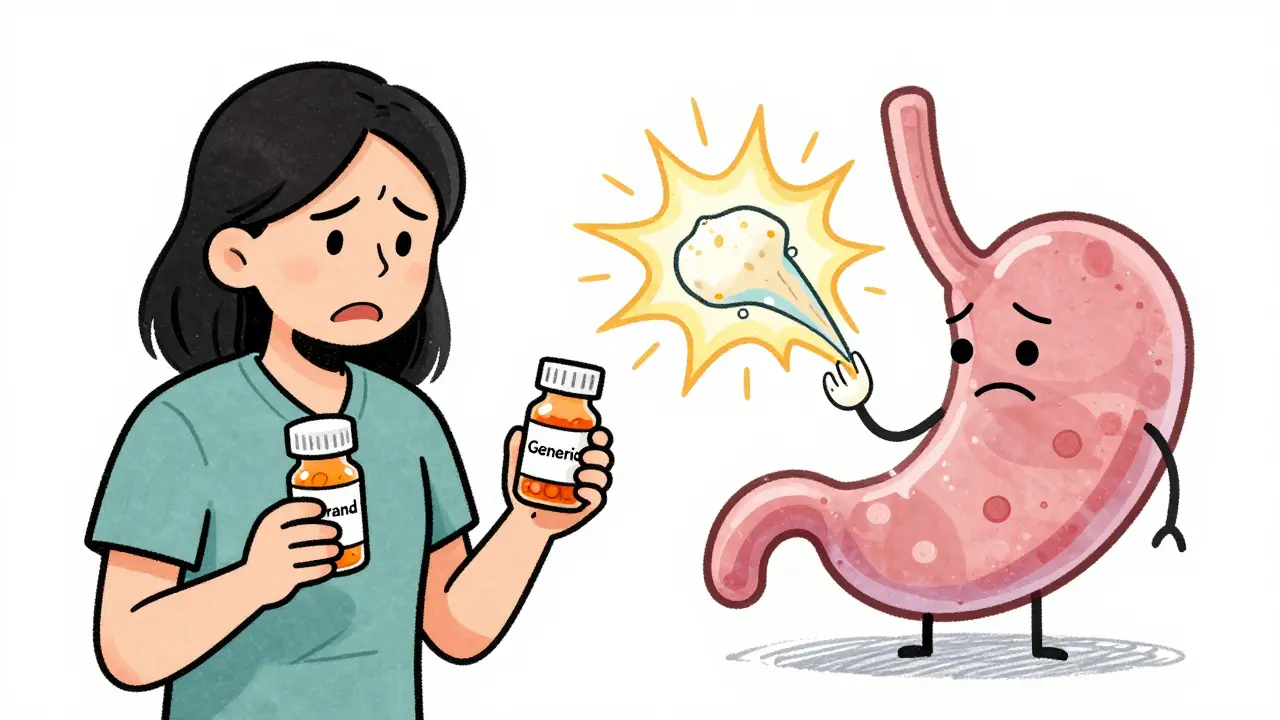
You switched to the generic version of your blood pressure pill and now you feel weird. Maybe it’s nausea. Maybe it’s fatigue. Or maybe you just can’t shake the feeling that it’s not working the same. You’re not imagining it. And you’re not alone.
Generic drugs are required by the FDA to have the same active ingredient, strength, and dosage as their brand-name cousins. That part is non-negotiable. But what’s inside the pill besides the medicine? That’s where things get messy.
The stuff that’s not the medicine - the fillers, coatings, dyes, and preservatives - are called inactive ingredients. They don’t treat your condition. But they can change how you feel.
What exactly are inactive ingredients?
Inactive ingredients, or excipients, are the unsung (and often unseen) workers in your pill. They do the heavy lifting behind the scenes: holding tablets together, helping them dissolve in your stomach, making them easier to swallow, or keeping them from going bad.
Common ones include:
- Lactose - a milk sugar used as a filler in about 40% of oral medications
- Microcrystalline cellulose - a plant-based binder found in most tablets
- Starch - often corn or potato, used to help pills break apart
- FD&C dyes - artificial colors like Red 40 or Blue 1 that make pills look different
- Sodium benzoate - a preservative in liquids and chewables
- Soym lecithin - an emulsifier in some capsules
- Aspartame - an artificial sweetener in chewable tablets
These aren’t random choices. Manufacturers pick them based on cost, stability, and how well they work with the active drug. But here’s the catch: the brand-name drug uses one set. Your generic? It might use a completely different one.
Why does that matter?
For most people, it doesn’t. About 95% of patients switch to generics without noticing anything different. But for the other 5%, the change in inactive ingredients can cause real, measurable effects.
Take lactose. About 36% of Americans have some level of lactose intolerance. If your brand-name pill used cornstarch as a filler, but the generic uses lactose, you might get bloating, gas, or diarrhea. Not because the medicine isn’t working - but because your gut is reacting to the filler.
Same with dyes. Some people report headaches or rashes after switching to a generic that uses Red 40 or Yellow 5. These aren’t allergies in the classic sense - they’re sensitivities. And they’re real.
Even small differences in how a pill dissolves can change how fast the medicine enters your bloodstream. That’s why some people on thyroid meds like levothyroxine or blood thinners like warfarin report feeling off after switching. Their bodies are sensitive to tiny shifts in absorption.
A 2021 study in JAMA Internal Medicine looked at 2,000 people who switched from brand to generic. 94.7% had no issues. But 4.3% had minor side effects - mostly stomach upset or dizziness. And 1% had problems serious enough to switch back. That’s not a lot. But if you’re in that 1%, it’s everything.
Why don’t generics match the brand exactly?
It’s not about cutting corners. It’s about patents and profit.
Brand-name companies spend billions developing a drug. Once the patent expires, other companies can make copies. But they can’t copy the look. Trademark laws force generics to be different in color, shape, or size. That means they need different coatings, dyes, and binders to make a pill that’s visually distinct.
Also, generic manufacturers don’t have to prove their inactive ingredients are identical - just that the final product works the same. The FDA allows a 20% variation in how the drug is absorbed, but in practice, most generics are within 3.5% of the brand. That’s safe for most people. But for those with narrow therapeutic windows - like heart failure patients on digoxin or epilepsy patients on phenytoin - even that small difference can matter.
And then there’s cost. Lactose is cheap. Cornstarch is cheaper. A dye that costs $500 per kilogram? They’ll skip it if they can. That’s why two different generics of the same drug might have different fillers - because two different companies made them with different budgets.
Who’s most at risk?
You’re more likely to notice a difference if:
- You take a drug with a narrow therapeutic index (like levothyroxine, warfarin, digoxin, or lithium)
- You have a known food allergy or intolerance (lactose, gluten, soy, sulfites)
- You’re sensitive to artificial dyes or preservatives
- You’ve had bad reactions to generics before
- You’re on multiple medications - interactions can multiply small changes
For example, if you’re allergic to sulfites (about 3-10% of asthmatics are), and your generic version of a liquid antibiotic uses sodium bisulfite as a preservative, you could have a reaction - even though the active ingredient is identical.
And yes, it happens. A patient on Reddit reported switching from brand-name Synthroid to a generic and saw their TSH levels jump from 2.1 to 8.7 - enough to cause fatigue, weight gain, and brain fog. They switched back. Their levels normalized in weeks.
What should you do if you feel different?
Don’t ignore it. Don’t assume it’s all in your head. Don’t just stop taking it.
Here’s what to do:
- Track your symptoms. Write down when you started the new pill, what you’re feeling, and when it started. Do it for at least two weeks. Mood changes, sleep, digestion, energy levels - note everything.
- Check the ingredient list. Look at the packaging. Most pharmacies now list inactive ingredients on the bottle or in the patient information leaflet. If you can’t find it, ask your pharmacist. They have access to the full drug monograph.
- Compare the old and new. If you still have the old bottle, look at the inactive ingredients side by side. Are there new fillers? Different dyes? Lactose where there wasn’t any before?
- Ask your pharmacist to check for alternatives. There might be another generic made by a different company that uses a filler you tolerate better. Or ask if an authorized generic is available - it’s made by the brand company but sold as a generic, so the ingredients are identical.
- Talk to your doctor. If symptoms persist, they may need to order a blood test (like TSH for thyroid meds) to confirm if the drug’s absorption changed.
Pharmacists can usually spot the issue in 5-10 minutes. They’ve seen this before.

What’s changing in the industry?
Things are improving. In 2023, the FDA issued new draft guidance specifically targeting generics for high-risk drugs like levothyroxine and warfarin. They’re asking manufacturers to do stricter bioequivalence testing.
Also, the CARES Act now requires clearer labeling of common allergens in medications - lactose, soy, sulfites - on packaging. That’s new. And long overdue.
More companies are launching “clean label” generics - no artificial dyes, no lactose, no aspartame. These aren’t fancy. They’re just safer for people who need them. By 2025, experts predict 70% of generic manufacturers will offer at least one allergen-free version of common drugs.
And the FDA is building a public Inactive Ingredient Database - scheduled for launch in early 2024 - that will list every excipient approved in every drug. You’ll be able to look up your pill and see exactly what’s inside.
Bottom line: Generics are safe - but not always identical
For 9 out of 10 people, generics work just as well. They save money. They save lives. You should take them.
But for the rest of us - the ones who feel different - it’s not weakness. It’s biology. Your body reacts to the whole pill, not just the active ingredient.
Don’t be afraid to speak up. Don’t assume your doctor will know. Ask your pharmacist. Check the label. Track your symptoms. And if something feels off - switch back, or switch to a different generic. Your health isn’t a cost-saving experiment.
Generics are a win for the system. But your body? It’s your own.





Siobhan Goggin
January 4, 2026 AT 19:46 PMIt’s wild how something so small can make such a big difference. I switched generics last year for my thyroid med and felt like I was dragging through mud for weeks. Turned out the new one had lactose-I’m mildly intolerant and had no idea. Pharmacist caught it right away. Never thought to check the label until I was desperate.
Now I always ask for the ingredient list. It’s not paranoia-it’s just smart.
John Ross
January 6, 2026 AT 02:30 AMLet’s be clear: the FDA’s 20% bioequivalence window is a regulatory loophole dressed up as patient safety. For drugs with narrow therapeutic indices-warfarin, levothyroxine, phenytoin-this isn’t just ‘minor variation,’ it’s pharmacokinetic roulette. The fact that manufacturers aren’t required to match excipient profiles is a systemic failure masked as cost-efficiency.
And don’t get me started on the ‘color and shape’ trademark nonsense forcing formulation changes. It’s corporate theater. If the active ingredient is identical, why does the pill need to look different? Because patents are still being monetized through aesthetic arbitrage. This isn’t science-it’s legal fiction.
Dee Humprey
January 7, 2026 AT 11:44 AMHey, if you’ve ever felt off after switching generics-trust that feeling. I’m a nurse and I’ve seen this too many times. One patient switched from brand Synthroid to a generic and her TSH went from 2.5 to 10. She was exhausted, gaining weight, crying for no reason. We checked the label-lactose, cornstarch, FD&C Yellow 6. She’d never had those before.
Pharmacist found an authorized generic made by the same company as the brand. Switched back. Two weeks later, she was herself again. Don’t suffer in silence. Ask for the monograph. Ask for alternatives. You deserve to feel normal.
Also-here’s a pro tip: some pharmacies stock multiple generics. Don’t settle for the first one they hand you. Ask for options. 💪
melissa cucic
January 7, 2026 AT 16:46 PMIt is, indeed, a matter of considerable scientific and regulatory significance that the inactive ingredients-often dismissed as inert-are, in fact, pharmacologically and physiologically consequential in susceptible populations. The FDA’s current framework, while adequate for the majority, fails to account for inter-individual variability in excipient tolerance, particularly among those with comorbidities, allergies, or metabolic sensitivities.
Moreover, the absence of mandatory excipient harmonization across generic manufacturers introduces a form of pharmacological unpredictability that is ethically indefensible when applied to chronic, life-sustaining medications. A standardized, publicly accessible excipient registry-such as the proposed FDA database-is not merely convenient; it is a necessary safeguard for patient autonomy and safety.
It is not unreasonable to expect, in a modern healthcare system, that the full composition of a prescribed medication be transparent, accessible, and comparable across formulations.
Akshaya Gandra _ Student - EastCaryMS
January 9, 2026 AT 01:43 AMi read this and i was like wait so my stomach issues after switching my bp med wasnt just me?? i thought i was being dramatic lol
also i have soy allergy and i never knew meds had soy in them?? this is wild. i need to check my pills now 😅
en Max
January 11, 2026 AT 00:19 AMThe clinical relevance of excipient variability cannot be overstated, particularly in the context of polypharmacy and age-related pharmacokinetic alterations. The 20% bioequivalence range, while statistically acceptable for population-level outcomes, is not clinically neutral for individuals with compromised hepatic metabolism, altered gastric motility, or compromised mucosal integrity.
Furthermore, the lack of mandatory disclosure of excipient sources-especially allergenic ones such as lactose derived from bovine sources or soy lecithin processed with hexane-represents a significant gap in informed consent. Pharmacists, as medication experts, must be empowered-not merely permitted-to advocate for excipient-matched alternatives. This is not advocacy; it is standard of care.
Angie Rehe
January 12, 2026 AT 01:01 AMStop being so dramatic. If you can’t tell the difference between a brand and a generic, you’re probably not taking it right. I’ve been on generics for 15 years. No issues. You’re just looking for an excuse to get the expensive brand again. The FDA says they’re the same. End of story.
And if you’re sensitive to dyes, then maybe don’t take pills. Or switch to injections. I’m tired of people treating medication like a spa day.
Jacob Milano
January 12, 2026 AT 17:59 PMI used to think this was all in people’s heads-until my mom, who’s on digoxin, switched generics and started having heart palpitations. We didn’t think twice until her cardiologist asked, ‘Did you change pills?’
Turns out the new generic used a different starch that slowed absorption. Her levels dropped just enough to be dangerous. She switched back to the same generic from a different batch-same company, different supplier-and boom, stable again.
So yeah, it’s not just ‘feeling weird.’ It’s chemistry. And your body knows when the formula changes, even if your doctor doesn’t. Don’t let anyone tell you it’s all in your head. You’re not crazy-you’re just paying attention.