
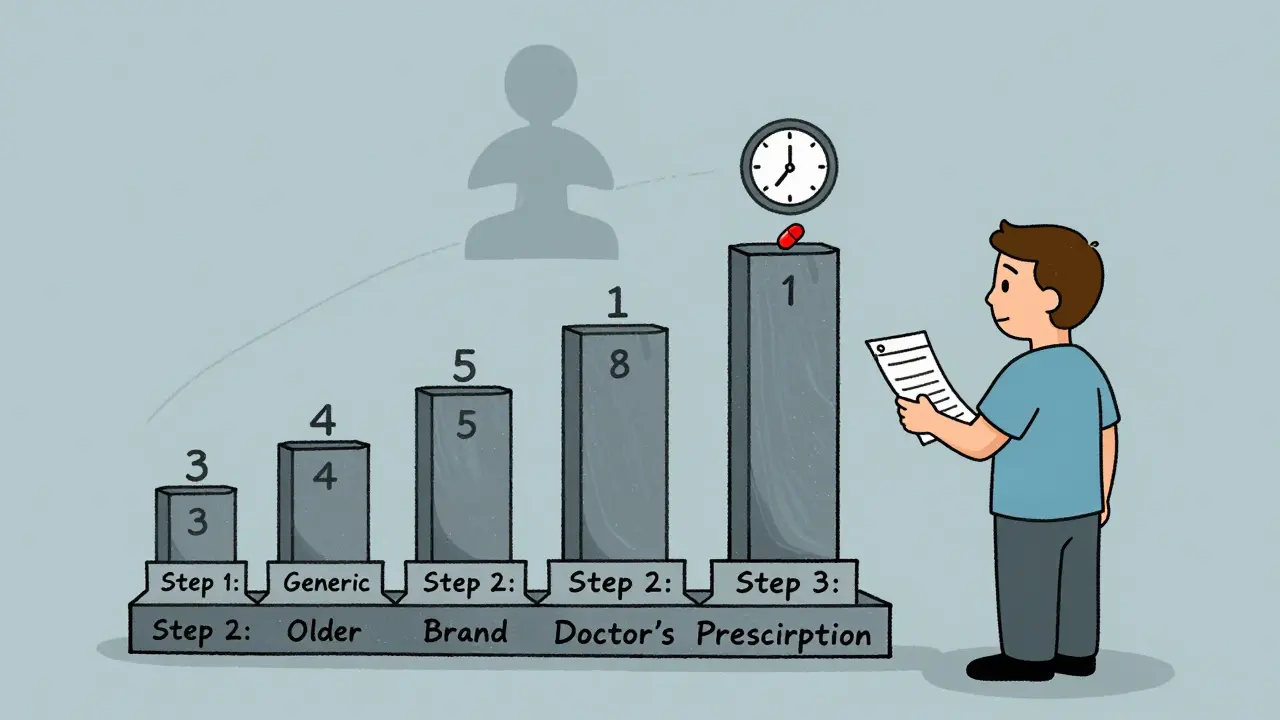
When your doctor prescribes a brand-name medication, but your insurance says you have to try a cheaper generic first-this isn't a suggestion. It's a rule. This is step therapy, and it’s now part of how nearly half of all U.S. health plans handle prescription drugs. You might not have heard the term, but if you’ve ever been denied coverage for a medication until you tried something else first, you’ve experienced it.
What Exactly Is Step Therapy?
Step therapy, sometimes called a "fail-first" policy, is a cost-control tool used by insurance companies. It forces patients to try lower-cost medications-usually generics-before the insurer will pay for the drug your doctor originally recommended. The idea is simple: if a cheaper drug works just as well, why pay more? But here’s the catch: not all drugs work the same for everyone. A generic arthritis medication might help one person but do nothing for another. Still, insurers require you to go through a sequence: Step 1 (generic), Step 2 (another generic or older brand), Step 3 (the drug your doctor wanted). Only after failing the first two steps do you get approval for the original prescription. This isn’t just paperwork. It’s a process that can take weeks. In some cases, patients with conditions like rheumatoid arthritis, multiple sclerosis, or severe depression have waited months just to get the right medication. By then, their condition may have worsened.Why Do Insurers Use Step Therapy?
The numbers tell the story. About 40% of U.S. health plans now include step therapy in their formularies, according to a 2021 analysis from the National Institutes of Health. That’s up from 25% in 2018. Employers, Medicaid plans, and private insurers are all using it. Why? Drug prices. Brand-name biologics for conditions like Crohn’s disease or psoriasis can cost over $10,000 a month. Generics? Often under $50. The Congressional Budget Office found that step therapy can cut drug spending by 5% to 15% in some therapeutic areas. For insurers, that’s real savings. But the real driver isn’t just cost-it’s the lack of government action. When lawmakers don’t cap drug prices, insurers step in. They’re not trying to be cruel. They’re trying to manage costs in a broken system. Still, that burden falls on patients.When Step Therapy Makes Sense
Let’s be fair: sometimes it works. For many conditions, generics are just as effective as brand-name drugs. Take high blood pressure. Lisinopril, a generic ACE inhibitor, works just as well as the more expensive brand versions. For asthma, albuterol inhalers are widely available as generics. In these cases, step therapy saves money without hurting outcomes. A 2023 GoodRx survey found that 17% of patients who went through step therapy ended up doing better on the cheaper drug. They avoided side effects, saved money, and didn’t need the pricier option at all. But this only works if the first drug actually fits the patient. That’s where the system breaks down.
When Step Therapy Hurts
The American College of Rheumatology doesn’t support step therapy. Why? Because it delays effective treatment. In their 2022 patient survey, 68% of people with autoimmune diseases reported negative health effects from being forced to try cheaper drugs first. Over 40% said their disease got worse during the waiting period. One Reddit user, "ChronicPainWarrior," shared their story: they had rheumatoid arthritis. Their doctor prescribed a biologic. Insurance said no-try three NSAIDs first. Six months later, after the third drug failed, they finally got approval. By then, joint damage was irreversible. It’s not just physical harm. The administrative burden is crushing. Physicians spend an average of 18.3 hours a week just handling step therapy appeals and prior authorizations. That’s nearly half a workday. Patients, meanwhile, are stuck in limbo-calling insurers, filling out forms, waiting for decisions that can take four to eight weeks. And if you switch jobs or insurance plans? You might have to start the whole process over-even if you’ve been on the same medication for years.What Are the Exceptions?
You’re not powerless. Federal and state laws require insurers to offer exceptions. The Safe Step Act, introduced multiple times in Congress since 2017, would make these rules uniform across all plans. But even without federal law, 29 states have passed their own protections. Insurers must grant exceptions in five clear situations:- The drug they want you to try has already failed you in the past.
- Delaying treatment could cause serious or permanent harm.
- The required drug is medically contraindicated for you.
- The drug would stop you from doing basic daily tasks like walking, dressing, or working.
- You’re already stable on your current medication and have had prior approval.
How to Fight a Step Therapy Denial
If your insurance denies your prescription, here’s what to do:- Ask your doctor for a letter of medical necessity. This isn’t optional. It needs to clearly state why the step therapy drug won’t work for you-cite your medical history, past failures, side effects, or risk of harm.
- Submit the request through your insurer’s formal appeals process. Most have online portals or fax numbers listed on your member handbook.
- Call your insurer’s customer service. Ask for the exact reason for denial and the expected timeline. Insurers are required to respond within 72 hours for standard requests and 24 hours for urgent cases (like those involving cancer or neurological conditions).
- If denied, file a formal appeal. Your doctor must re-submit with additional documentation. Some insurers require a second opinion.
- If still denied, escalate to your state’s insurance commissioner. Many have consumer advocacy offices that can intervene.

What About Self-Insured Plans?
Here’s the biggest gap in protection: self-insured employer plans. These are run directly by companies (like Walmart, Apple, or your local hospital system), not insurance companies. They’re regulated by federal law (ERISA), not state laws. That means even if your state requires step therapy exceptions, your employer’s plan might not follow them. About 61% of Americans get coverage through self-insured plans-meaning most people are still vulnerable. The Safe Step Act would fix this by applying the same rules to self-insured plans. But as of 2025, it hasn’t passed. Until it does, patients in these plans have fewer legal protections.What You Can Do Right Now
- Know your plan’s formulary. Log into your insurer’s website and search for your medication. If it’s in Tier 3 or higher, step therapy is likely required. - Ask your pharmacist. They often know which drugs trigger step therapy before you even get to the doctor. - Use patient assistance programs. Many drugmakers offer co-pay cards or free samples that can bypass step therapy. Check the manufacturer’s website. - Keep records. Save every denial letter, email, and phone call. You’ll need them if you appeal. - Connect with patient advocacy groups. Organizations like the Arthritis Foundation or Step Therapy Awareness offer templates for appeals and direct support.The Future of Step Therapy
By 2025, analysts at Avalere Health predict step therapy will cover 55% of specialty drug prescriptions-up from 40% today. That means more people will face this hurdle. But pressure is growing. Patient groups are pushing for mandatory response times. Some states are now requiring insurers to respond within 10 business days. Others are banning step therapy for life-threatening conditions entirely. The system isn’t going away. But it’s changing. More people are speaking up. More doctors are refusing to play along. And slowly, insurers are being forced to listen. You’re not alone. And you don’t have to accept a denial without a fight.Is step therapy the same as prior authorization?
No. Prior authorization is a one-time approval for a specific drug. Step therapy is a sequence-you must try and fail multiple drugs before getting approval for the one your doctor prescribed. It’s a multi-step process, not a single gate.
Can I skip step therapy if I’ve already tried the generic before?
Yes-if you have documentation. If you previously tried the required generic and it didn’t work, your doctor can submit that history as part of your exception request. Insurers must honor prior treatment failures under federal and state exception rules.
Do all insurance plans use step therapy?
No. Most Medicare Part D plans, Medicaid, and some small employer plans don’t use it. But 40% of commercial plans do-and the number is rising. Check your plan’s formulary or call customer service to confirm.
What if my doctor refuses to file an appeal?
Your doctor is not legally required to file appeals, but they’re the best person to do it. If they refuse, ask for a referral to another provider or contact your state’s medical association. Some patient advocacy groups can connect you with doctors who specialize in helping with insurance appeals.
Can I switch to a different insurance plan to avoid step therapy?
Possibly-but it’s risky. If you switch during open enrollment or due to a qualifying life event, your new plan may still require you to restart step therapy-even if you’ve been on the same drug for years. Always check the new plan’s formulary before switching.





Frank Drewery
December 18, 2025 AT 17:08 PMBeen through this with my RA meds. Took 5 months to get my biologic approved. By then, my hands were already stiffening up. I wish I’d known about the exception rules earlier-would’ve saved me so much pain. Don’t let them bully you into waiting. Fight back.
Also, shoutout to pharmacists-they’re the real MVPs. Mine flagged the step therapy trap before my doctor even wrote the script.
Danielle Stewart
December 18, 2025 AT 23:17 PMIf you're getting denied, don’t panic-just document everything. I had a patient last week who got denied for her MS drug. We pulled her 3 years of medical records, wrote a 2-page letter from her neurologist, and submitted it with a certified mail receipt. Got approved in 11 days.
Insurers hate paperwork. Give them more than they can ignore. And always, always ask for the denial code. It’s in the fine print, but it’s your secret weapon.
mary lizardo
December 19, 2025 AT 05:32 AMThis entire article is a gross misrepresentation of cost-containment measures. Step therapy is not a ‘rule’-it is a clinically responsible, economically rational protocol designed to prevent the reckless overprescription of high-margin pharmaceuticals. The anecdotal horror stories are emotionally manipulative and statistically insignificant.
Moreover, the notion that generics are ‘inferior’ is a myth perpetuated by Big Pharma marketing. The FDA requires bioequivalence. If your body doesn’t respond to a generic, the issue lies in your physiology-not the system.
Furthermore, the suggestion that insurers are ‘cruel’ ignores the fact that they are fiduciaries to millions of policyholders. Without step therapy, premiums would rise across the board, harming the very people this article claims to protect.
Andrew Kelly
December 19, 2025 AT 13:31 PMStep therapy? More like step to the left while the real criminals get richer.
Did you know the same companies that push step therapy also own the generic manufacturers? It’s all one big loop. Insurers don’t care about cost-they care about profit margins. And the ‘exceptions’? They’re just there to make you feel like you have a voice while they quietly deny 90% of them.
Also, the Safe Step Act? It’s dead on arrival. Congress is owned by pharma lobbyists. The whole system is rigged. You think your appeal matters? Nah. You’re just a number in a spreadsheet.
Dev Sawner
December 21, 2025 AT 08:52 AMThe structural inefficiencies of the U.S. healthcare system are not mitigated by step therapy-they are exacerbated. The absence of centralized pharmacoeconomic oversight leads to fragmented, inconsistent, and often contradictory protocols across state lines.
Furthermore, the reliance on physician discretion for exception requests places an undue administrative burden on clinical staff, which is antithetical to evidence-based practice. The optimal solution lies in a national formulary with algorithm-driven tiering, not reactive appeals.
Additionally, the assertion that generics are ‘equivalent’ is empirically flawed in 18% of cases involving polymorphic metabolism-particularly in CYP2D6 poor metabolizers. This is not anecdotal; it is pharmacogenomic fact.
Moses Odumbe
December 21, 2025 AT 15:40 PMbro i literally had to beg my dr to write a letter just to get my zoloft approved 😭
insurance said try 3 other SSRIs first. i tried one and it made me feel like a zombie. they still said no. i had to call them 7 times. finally got approved after my mom emailed their CEO. 😤
why is this even a thing??
bhushan telavane
December 23, 2025 AT 11:18 AMIn India, we don’t have this problem. Brand-name drugs are expensive, but there’s no step therapy-just direct access. Doctors prescribe what they think works, and patients pay out of pocket if they can.
But here’s the twist: we also don’t have insurance covering most meds. So maybe step therapy is just America’s way of pretending it has healthcare.
Still, I feel for you guys. This sounds like a nightmare.
Mahammad Muradov
December 24, 2025 AT 00:38 AMThe article fails to acknowledge that step therapy reduces polypharmacy and drug interactions. Unnecessary prescriptions lead to increased ER visits and hospitalizations. The data is clear: step therapy lowers adverse event rates by 12% in chronic disease populations.
Furthermore, the notion that patients are ‘victims’ ignores personal responsibility. If you cannot navigate a 4-week appeals process, you are not prepared for modern healthcare.
Additionally, the claim that self-insured plans are ‘unregulated’ is misleading. ERISA preemption is a federal statute, not a loophole. It is the law.
holly Sinclair
December 24, 2025 AT 10:05 AMIt’s fascinating how step therapy reflects a deeper philosophical tension in American medicine: the conflict between individual autonomy and systemic efficiency. We are told that medicine is a science, yet we allow economic incentives to dictate clinical pathways. This is not evidence-based care-it’s algorithmic paternalism.
Moreover, the reliance on physician advocacy as a corrective mechanism reveals a fundamental flaw: healthcare should not depend on the charisma, time, or willingness of a doctor to fight bureaucracy on your behalf. If a treatment is medically necessary, it should be accessible without a legal battle.
And yet, we praise the ‘heroic’ doctor who submits a 20-page appeal. We should be ashamed that such heroism is required at all. The system is broken when compassion becomes an exception, not the standard.
Perhaps the real question isn’t how to fix step therapy-but whether we should be allowing insurers to determine therapeutic sequences at all. Is this medicine, or is this insurance arbitrage disguised as care?
Emily P
December 24, 2025 AT 19:44 PMI had to go through this for my son’s ADHD med. We got denied three times. I called the insurance company every day for two weeks. They finally approved it after I threatened to go to the state attorney general. I’m not proud of it-but I’m not sorry either.
Doctors should be required to file appeals. It’s part of their job.
Jedidiah Massey
December 25, 2025 AT 01:45 AMStep therapy is just Tier 1 of the Pharma-Insurance Complex™. The real villain? PBMs. They’re the middlemen who negotiate rebates with drugmakers-and they get paid more when you take the cheaper drug, even if it doesn’t work.
It’s not about cost-it’s about kickbacks. The entire system is a Ponzi scheme built on opaque contracts and regulatory capture.
Also, if you’re not using a copay card from the manufacturer, you’re leaving $$$ on the table. Most of these drugs have $0 copay programs. Just sayin’.