

Statin Interaction Risk Checker
Select a statin you are taking or considering, then choose any additional medications to see the interaction risk profile.
Step 1: Select Your Statin
Step 2: Select Additional Medications (Optional)
Imagine taking a daily pill that slashes your risk of heart attack and stroke. For millions of people, Statins are a class of lipid-lowering medications that reduce illness and mortality in those with cardiovascular disease and those at high risk for cardiovascular disease. They are the gold standard for managing cholesterol. But here is the catch: statins do not work in isolation. You likely take other medications-antibiotics, blood pressure pills, or supplements-that can clash with your statin. Some combinations are harmless. Others can lead to severe muscle damage or liver stress.
The good news? Not all statins behave the same way. While they all lower low-density lipoprotein cholesterol (LDL-C) by 30-60%, their chemical fingerprints differ significantly. Understanding these differences is not just academic; it is critical for safe prescribing practices. With approximately 32 million Americans using statins, knowing which specific agent fits your medication regimen can mean the difference between effective protection and dangerous side effects.
How Statins Work and Why Interactions Happen
To understand why some drugs clash with statins, you first need to know how your body processes them. Statins, formally known as HMG-CoA reductase inhibitors, are medications that block an enzyme in the liver responsible for producing cholesterol. The first statin, lovastatin, was discovered in 1978 by Akira Endo at Sankyo Co. in Japan and approved by the FDA in 1987. Today, seven statins are approved for clinical use in the United States: atorvastatin (Lipitor), simvastatin (Zocor), pravastatin (Pravachol), lovastatin (Mevacor), fluvastatin (Lescol), rosuvastatin (Crestor), and pitavastatin (Livalo).
The core value proposition of statins lies in their ability to reduce LDL-C with corresponding reductions in cardiovascular events by 25-35% in clinical trials. However, once you swallow a statin, it must travel through your bloodstream and be processed by your liver and kidneys. This journey involves two main gatekeepers: enzymes and transporters.
- Cytochrome P450 (CYP) Enzymes: These liver enzymes break down many drugs. If another medication slows down these enzymes, the statin builds up in your system.
- OATP1B1 Transporter: This protein moves statins from your blood into your liver cells. If this transporter is blocked, statin levels in the blood rise, increasing the risk of side effects.
Five statins (atorvastatin, simvastatin, lovastatin, fluvastatin, and the withdrawn cerivastatin) are heavily reliant on CYP enzymes. In contrast, pravastatin, rosuvastatin, and pitavastatin undergo minimal CYP metabolism. This distinction is the single most important factor in predicting drug interactions.
The High-Risk Group: CYP3A4 Metabolized Statins
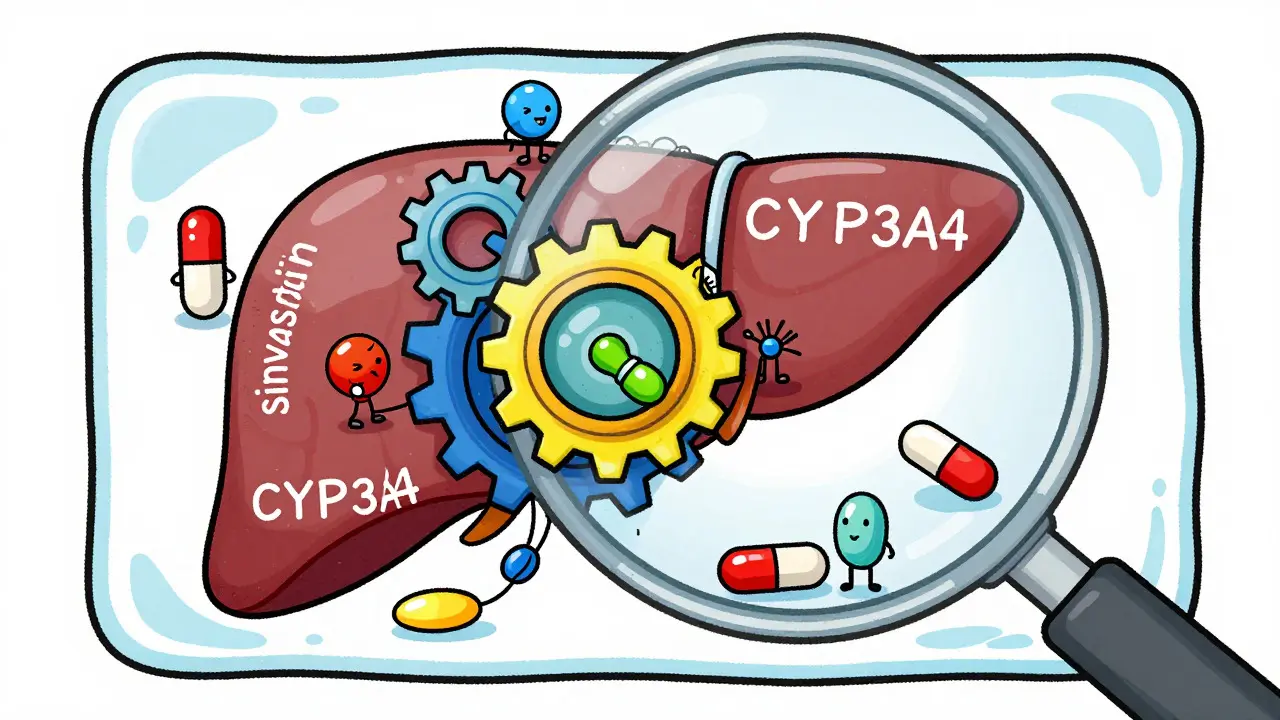
Simvastatin, lovastatin, and atorvastatin are primarily metabolized by CYP3A4, which is a liver enzyme responsible for breaking down many common medications. Because CYP3A4 handles so many different drugs, these three statins are prone to significant interactions. When you take a strong CYP3A4 inhibitor alongside these statins, the enzyme gets busy with the other drug, leaving the statin unprocessed. This causes statin concentrations in your blood to skyrocket.
Consider the case of antibiotics. Clarithromycin and erythromycin are common prescriptions for infections. According to the American Heart Association's 2016 Scientific Statement, clarithromycin increases simvastatin exposure by 10-fold and lovastatin by 16-fold. Atorvastatin shows moderate interaction risk, with exposure increasing by 4-fold. This isn't just a number on a chart; it translates to a much higher risk of myopathy (muscle pain) and rhabdomyolysis (severe muscle breakdown).
HIV medications present another major challenge. Protease inhibitors like atazanavir, darunavir, and ritonavir are potent CYP3A4 inhibitors. The AHA Statement specifically notes that lovastatin and simvastatin are most likely to interact with these HIV medications. In fact, the FDA-approved prescribing information contraindicates certain combinations entirely. If you are on HIV therapy, your doctor will likely steer you away from simvastatin and lovastatin.
The Moderate and Low-Risk Options
If you are on multiple medications, switching to a statin with a different metabolic pathway might be safer. Rosuvastatin and pravastatin offer distinct advantages here.
Rosuvastatin is primarily metabolized by CYP2C9, which is a less commonly targeted enzyme compared to CYP3A4. This gives it a lower interaction potential with CYP3A4 inhibitors. However, rosuvastatin has its own vulnerability: the OATP1B1 transporter. Inhibitors like cyclosporine can increase rosuvastatin plasma concentrations by up to 4.9-fold. Similarly, pitavastatin, while primarily metabolized by glucuronidation, shows a significant 7.1-fold increase in exposure when taken with cyclosporine.
Pravastatin stands out as having the lowest overall interaction potential. It undergoes minimal CYP metabolism and is largely excreted by the kidneys. Its hydrophilic nature (log P value of -0.58) means it does not easily cross cell membranes, reducing tissue distribution issues. For patients on complex regimens, including those with HIV or transplant recipients on immunosuppressants, pravastatin is often the preferred choice. The FDA allows pravastatin at doses up to 40 mg daily with cyclosporine, whereas lovastatin, simvastatin, and pitavastatin are absolutely contraindicated.
| Statin | Primary Metabolism | Key Interaction Risk | Lipophilicity |
|---|---|---|---|
| Simvastatin | CYP3A4 | High (Clarithromycin, HIV meds) | High (4.4) |
| Lovastatin | CYP3A4 | Very High (Clarithromycin) | High (4.2) |
| Atorvastatin | CYP3A4 | Moderate | High |
| Rosuvastatin | Minimal CYP / OATP1B1 | Low CYP, High OATP1B1 (Cyclosporine) | Low |
| Pravastatin | Renal / Minimal CYP | Lowest Overall | Hydrophilic (-0.58) |
| Pitavastatin | Glucuronidation | High with Cyclosporine | Intermediate |
Common Medications That Clash with Statins
Beyond antibiotics and HIV drugs, several everyday medications require caution. Let’s look at specific scenarios where interactions matter most.
Calcium Channel Blockers
Drugs like diltiazem and verapamil are used for high blood pressure and angina. They inhibit CYP3A4. Dr. Michael Miller, Director of the Center for Preventive Cardiology at University of Maryland, cautions that rhabdomyolysis is reported in patients taking atorvastatin after diltiazem administration. Verapamil and diltiazem increase simvastatin and lovastatin area under the curve (AUC) by 3- to 8-fold. If you are on these blood pressure meds, your doctor may cap your simvastatin dose at 20 mg or switch you to pravastatin or rosuvastatin.
Ticagrelor
Fibrates
Sometimes doctors prescribe fibrates alongside statins to lower triglycerides. Here, the choice of fibrate matters immensely. Gemfibrozil inhibits both CYP2C8 and glucuronidation, increasing statin levels by up to 2-fold. The Clinician's Guide to Statin Drug-Drug Interactions recommends avoiding gemfibrozil with all statins except pravastatin. Fenofibrate, on the other hand, has minimal interaction potential and is the safer alternative when combination therapy is necessary.
Colchicine
Used for gout flares and familial Mediterranean fever, colchicine can cause muscle toxicity when combined with statins. GoodRx notes that you may not need to avoid a statin if you're taking colchicine, but your healthcare provider may monitor you more closely for muscle-related side effects. Dose reduction of the statin is often required.
Genetics and Individual Variability
Even with perfect knowledge of drug interactions, individual patient variations play a huge role. Dr. Salima Brill-Edwards, co-author of the Clinician's Guide to Statin Drug-Drug Interactions, notes that polymorphisms in metabolizing enzymes confound predictions. Specifically, the SLCO1B1 c.521T>C polymorphism affects the OATP1B1 transporter. Patients with this genetic variant have a 4.5-fold increased risk of simvastatin-induced myopathy. The FDA added pharmacogenetic information to simvastatin labeling in 2011 to reflect this. While routine genetic testing is not yet standard for everyone, it is becoming more relevant for patients who experience unexplained muscle pain despite low doses.

Monitoring and Safety Tips
You don’t have to navigate this alone. Your healthcare team has tools to keep you safe. Here is what you should expect and ask for:
- Baseline Tests: Before starting any statin, get baseline creatine kinase (CK) measurement and liver function tests. This establishes your normal range.
- Symptom Awareness: Report any unexplained muscle pain, tenderness, or weakness immediately. Do not wait for your next appointment. Early detection prevents rhabdomyolysis.
- Medication Review: Bring a complete list of all prescriptions, over-the-counter drugs, and supplements to every visit. Even herbal supplements like St. John’s Wort can induce CYP3A4, potentially lowering statin effectiveness.
- Dose Adjustments: Accept that you may need a lower dose of your statin if you are on interacting drugs. Lowering the dose maintains benefit while reducing risk.
- Consider Alternatives: If interactions are too complex, ask about bempedoic acid (Nexletol). It demonstrated a 17% reduction in major adverse cardiac events in the CLEAR Outcomes trial (2023) with minimal drug interaction potential.
The Choosing Wisely campaign by the American Board of Internal Medicine specifically recommends avoiding simvastatin 80 mg due to increased risk of myopathy without additional cardiovascular benefit. This highlights a broader principle: more drug is not always better.
Conclusion: Balancing Benefit and Risk
Despite the complexity of drug interactions, the cardiovascular benefits of statins generally outweigh the risks for most patients when appropriate monitoring and dose adjustments are implemented. The key is personalization. There is no single "best" statin for everyone. The best statin is the one that lowers your cholesterol effectively while fitting safely into your unique medication profile.
If you are on multiple medications, do not assume your current statin is the safest option. Ask your doctor: "Given my other prescriptions, is there a statin with fewer interactions?" Switching from simvastatin to pravastatin or rosuvastatin might be a simple change that dramatically improves your safety profile. Knowledge is power, and understanding these class effects empowers you to have a more informed conversation with your healthcare provider.
Which statin has the fewest drug interactions?
Pravastatin generally has the fewest drug interactions because it undergoes minimal cytochrome P450 (CYP) metabolism and is largely excreted by the kidneys. Rosuvastatin is also a good option for patients on multiple medications, though it interacts with OATP1B1 inhibitors like cyclosporine.
Can I take simvastatin with antibiotics?
It depends on the antibiotic. Strong CYP3A4 inhibitors like clarithromycin and erythromycin can increase simvastatin levels by 10-fold, significantly raising the risk of muscle damage. Your doctor may temporarily stop your statin or switch you to pravastatin during the course of antibiotics.
What are the signs of a serious statin interaction?
The most serious sign is myopathy or rhabdomyolysis, characterized by unexplained muscle pain, tenderness, weakness, or dark urine. Liver toxicity is another risk, indicated by fatigue, loss of appetite, upper abdominal pain, or jaundice. Seek medical attention immediately if these symptoms occur.
Is atorvastatin safer than simvastatin regarding interactions?
Yes, atorvastatin has a moderate interaction risk compared to simvastatin's high risk. Both are metabolized by CYP3A4, but simvastatin is more susceptible to large increases in blood concentration when combined with CYP3A4 inhibitors. However, neither is as safe as pravastatin or rosuvastatin in terms of CYP interactions.
Can I take fenofibrate with any statin?
Fenofibrate is generally safer to combine with statins than gemfibrozil. Gemfibrozil significantly increases the risk of muscle toxicity with all statins except pravastatin. Fenofibrate has minimal interaction potential and is the preferred fibrate if combination therapy is needed.
Does grapefruit juice interact with statins?
Yes, grapefruit juice contains compounds that inhibit CYP3A4. This can increase blood levels of simvastatin, lovastatin, and atorvastatin. The effect is usually mild with small amounts, but consuming large quantities (more than one quart daily) can lead to significant interactions. Pravastatin and rosuvastatin are not affected by grapefruit juice.


Terrence spry
I'm a pharmaceutical scientist specializing in clinical pharmacology and drug safety. I publish concise, evidence-based articles that unpack disease mechanisms and compare medications with viable alternatives to help readers have informed conversations with their clinicians. In my day job, I lead cross-functional teams advancing small-molecule therapies from IND through late-stage trials.
view all posts