
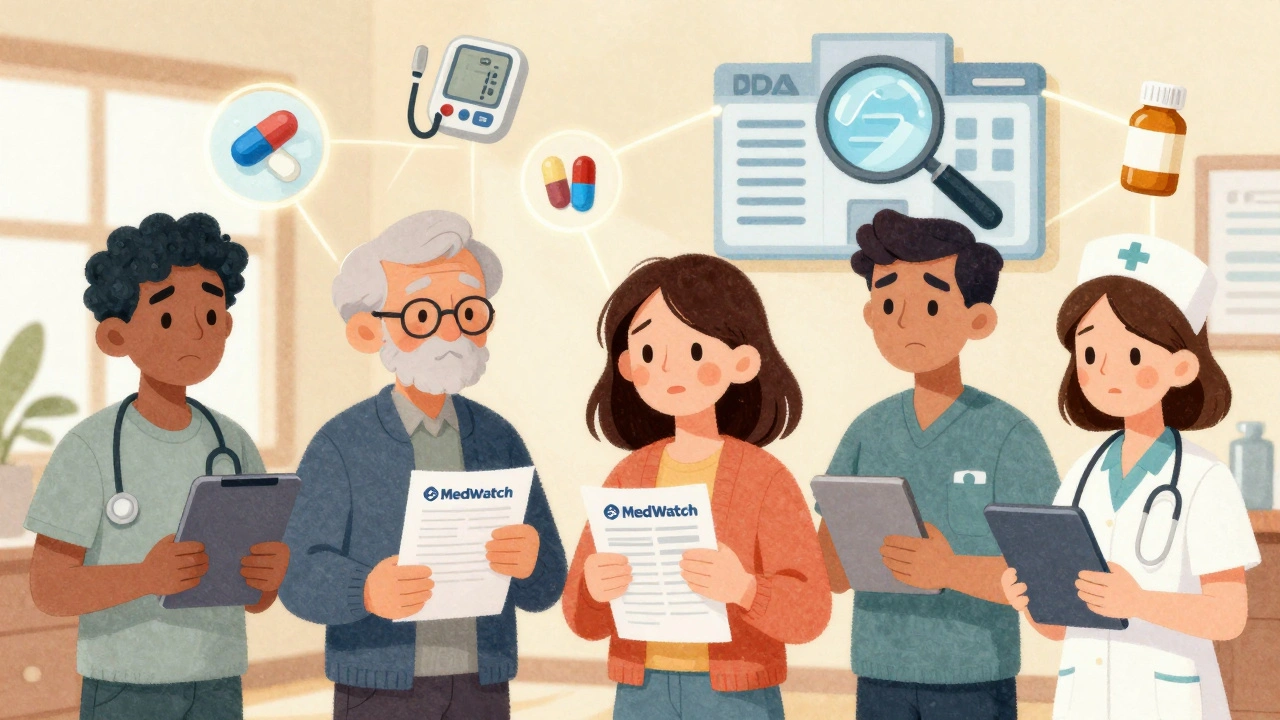
Every year, millions of people take medications that work exactly as they should. But for some, a drug that’s safe for most can cause a serious reaction-something no clinical trial ever caught. That’s where MedWatch comes in. It’s not a hotline for emergencies. It’s not a customer service line for complaints. It’s the U.S. Food and Drug Administration’s official system for collecting real-world reports about dangerous side effects, product failures, and用药错误. And if you’ve ever wondered whether your experience with a medication matters, the answer is yes-your report could help prevent someone else’s hospitalization or even save a life.
What Exactly Is MedWatch?
MedWatch is the FDA’s program for tracking problems with medicines, medical devices, vaccines, dietary supplements, cosmetics, and even infant formula after they’ve hit the market. It started in 1993, but it wasn’t built for bureaucracy-it was built for safety. Before MedWatch, there was no easy way for doctors, pharmacists, patients, or families to tell the FDA when something went wrong. Now, anyone can report a serious side effect, a broken device, or a product that didn’t work as promised.
The FDA doesn’t test every drug on every person before approval. Clinical trials involve thousands, not millions. Rare reactions-like a heart rhythm problem that only shows up in people over 70 with kidney disease-can slip through. That’s why MedWatch is critical. It catches what labs miss. In 2021 alone, MedWatch data helped trigger 18 label changes, 7 public safety alerts, and 3 drug withdrawals. One of the most famous examples? Rosiglitazone, a diabetes drug linked to heart attacks. It was MedWatch reports that first raised the alarm, leading to major restrictions.
Who Can Report to MedWatch?
You don’t need to be a doctor. You don’t need to be a pharmacist. You don’t even need to be a U.S. citizen. If you’re a patient, a caregiver, a family member, or a healthcare worker who saw something concerning, you can report it.
There are three types of reporters:
- Healthcare professionals (doctors, nurses, pharmacists) use Form FDA 3500.
- Patients and consumers use the simpler Form FDA 3500B-available in English and Spanish since 2022.
- Manufacturers must report serious events within 15 days by law. They use Form FDA 3500A or submit electronically.
That’s the key difference: professionals report voluntarily, but companies are legally required to report. That’s why manufacturers’ reports are often more complete-but patient reports are often the first sign something’s wrong.
What Should You Report?
Not every mild headache or upset stomach needs a report. MedWatch focuses on serious events. The FDA defines these as any problem that results in:
- Death
- Hospitalization (or prolonging an existing hospital stay)
- Permanent disability or damage
- Birth defects or complications during pregnancy
- Life-threatening reactions
- Need for medical or surgical intervention to prevent harm
For example:
- Your mother developed sudden liver failure after starting a new cholesterol drug-report it.
- Your child had a severe allergic reaction to a new antibiotic-report it.
- A blood pressure monitor gave incorrect readings and nearly caused a stroke-report it.
- A dietary supplement labeled as “natural” caused seizures-report it.
Even if you’re not 100% sure the product caused the problem, report it anyway. The FDA’s job is to sort out the connections. If you’re unsure, ask yourself: “Could this have been prevented if someone else had reported it earlier?” If the answer is yes, then report it.
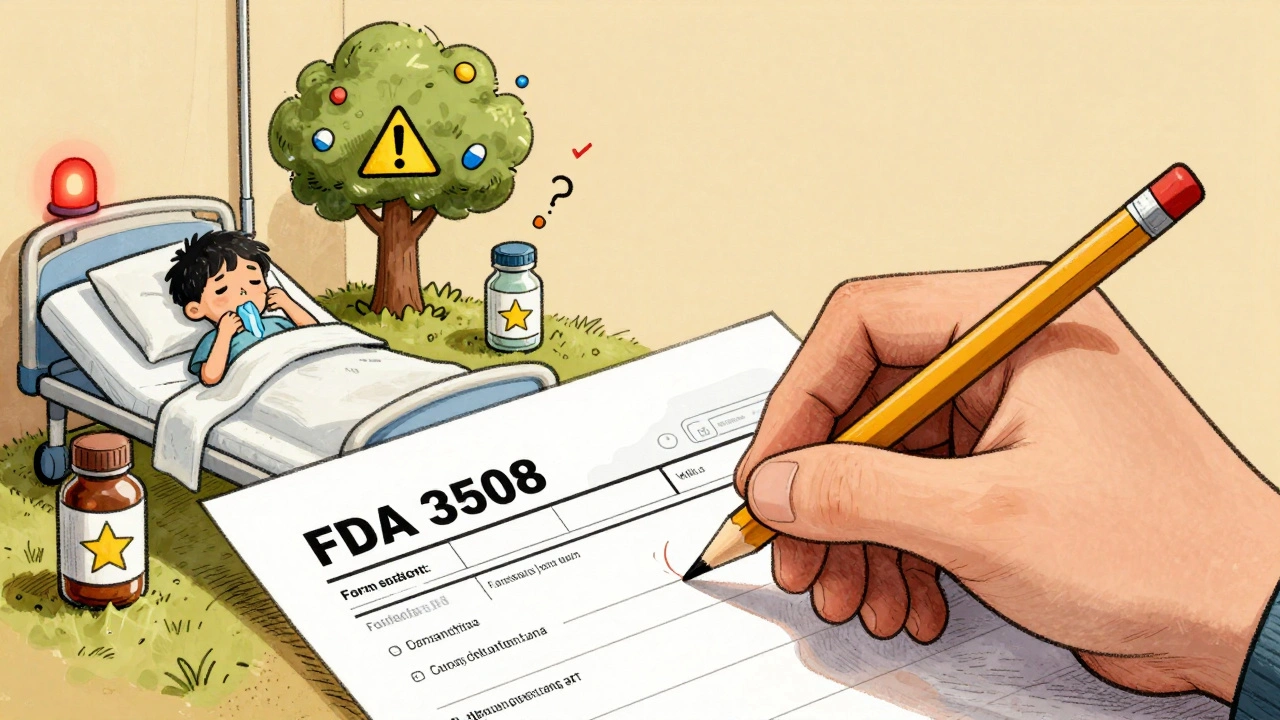
How to Report: Step-by-Step
Reporting takes 15 to 20 minutes. Here’s how:
- Go to fda.gov/MedWatch. This is the only official site.
- Choose the correct form: 3500 if you’re a professional, 3500B if you’re a patient or caregiver.
- Fill in the basics: product name, brand, lot number (if available), and the event description.
- Include key details: when the reaction started, how long it lasted, what treatments were given, and the outcome.
- Provide your contact info. You can report anonymously, but if you want a follow-up, leave your name and phone or email.
- Submit online, print and mail, or fax. Online is fastest.
Pro tip: If you’re reporting for someone else, like an elderly parent, you can still submit. Just write “reporting on behalf of” and include their name and age. The FDA doesn’t need your Social Security number or full medical records-just enough to understand what happened.
What Happens After You Report?
You won’t get a confirmation email. You won’t get a case number. You won’t get a call back. That’s the biggest complaint from people who’ve used MedWatch.
Here’s what actually happens:
- Your report goes into a database with over 1.4 million reports per year.
- FDA scientists look for patterns-do 10 other people report the same reaction to the same drug?
- If a trend emerges, the FDA may issue a safety alert, update the drug label, require new warnings, or even pull the product.
- Most reports are reviewed within 30 days. High-priority cases (like deaths) get reviewed within 72 hours.
It’s not personal. It’s statistical. One report might not change anything. But 50 reports about the same problem? That’s a signal.
According to a 2022 FDA internal review, about 30% of reports are incomplete or unclear. That’s why details matter. The more specific you are-dates, dosages, symptoms, other medications-the more useful your report becomes.
Why So Many People Don’t Report (And Why You Should Anyway)
Only 1% to 10% of serious adverse events ever get reported to MedWatch. Why?
- People don’t know it exists. A 2022 survey found 78% of Americans had never heard of MedWatch.
- They think it’s not their job. “That’s the doctor’s job,” they say. But doctors are overwhelmed. They don’t always have time to file reports.
- They’re afraid of being ignored. And yes, you probably won’t hear back.
- They think it’s too complicated. But the form is designed to be simple. The FDA even has video tutorials with over 150,000 views.
Here’s the truth: if you don’t report, the FDA can’t act. You’re not just sharing your story-you’re helping protect others. A 2021 JAMA Internal Medicine study showed that consumer reports often identify problems that healthcare professionals miss, especially with over-the-counter drugs and supplements.
Think of it like this: MedWatch is a public health early warning system. You’re not reporting because you want a reward. You’re reporting because someone else might be next.

How MedWatch Compares to Other Countries
The U.S. isn’t the only country with a safety reporting system. Europe has EudraVigilance. Canada has the Canada Vigilance Program. Japan only allows healthcare professionals to report.
MedWatch stands out because it lets everyone report. That’s a strength. Patients notice things doctors don’t-like a new rash that appeared after taking a supplement, or confusion after switching pill brands. But it’s also a weakness. Without mandatory reporting from patients, the system relies on people who are motivated enough to take the time. And too often, they’re not.
Still, MedWatch gets more reports than any other system in the world-over 1.4 million a year. That’s because of its reach, not its perfection.
What’s Next for MedWatch?
The FDA is working to make MedWatch faster and smarter.
- In 2023, they launched a new online portal with real-time error checking-cuts mistakes by 27%.
- They’re testing AI to sort through reports faster. Early results show a 35% drop in review time for urgent cases.
- By 2025, they plan to let EHR systems (like Epic and Cerner) send reports directly from the doctor’s computer.
- By 2026, they want to standardize medical terms using SNOMED CT-so “heart attack” and “myocardial infarction” are treated as the same thing.
These upgrades matter. Better data means faster decisions. Faster decisions mean fewer preventable injuries.
Final Thoughts: Your Report Matters
MedWatch isn’t flashy. It doesn’t make headlines. But it’s one of the quietest, most powerful tools in public health. Every report adds a piece to a giant puzzle. You might never know if your report led to a warning label or a drug recall. But someone else might be alive because of it.
Next time you or someone you care about has a bad reaction to a medication, don’t assume it’s “just one case.” Don’t assume someone else will report it. Don’t assume the FDA already knows. They don’t. And you’re the only one who can tell them.
Go to fda.gov/MedWatch. Take 20 minutes. Report it. You might not hear back. But you’ll have done something few people ever do-protected someone you’ll never meet.
Can I report a side effect if I’m not sure it was caused by the medication?
Yes. You don’t need to be certain. The FDA’s job is to analyze patterns across many reports. Even if you’re unsure, describe what happened, when, and what else the person was taking. The FDA looks for connections you might not see.
Do I need to provide my name when reporting?
No, you can report anonymously. But if you want the FDA to contact you for more information, leave your name and contact details. Most reports are processed without follow-up, but in rare cases, they may need clarification.
Is there a cost to report to MedWatch?
No. Reporting to MedWatch is completely free. There are no fees, no subscriptions, and no hidden charges. The FDA covers all costs.
Can I report a problem with a dietary supplement?
Yes. MedWatch accepts reports on all FDA-regulated products-including vitamins, herbal supplements, protein powders, and weight-loss products. If a supplement caused a serious reaction, report it. Many dangerous supplements aren’t caught until someone files a report.
How long does it take for the FDA to act on a report?
There’s no fixed timeline. A single report won’t trigger action. But if the FDA sees a pattern-like 20 reports of the same rare reaction to a drug-they may investigate within weeks. High-priority reports (like deaths) are reviewed in 72 hours. Changes to labels or recalls can take months or years, depending on the evidence.
What if I made a mistake on my report?
You can submit a new report with updated information. Include the original date and product name, and write “updated report” in the notes section. The FDA combines duplicate reports automatically, so don’t worry about sending multiple versions.
Can I report a problem with a medical device like a pacemaker or insulin pump?
Yes. MedWatch covers all FDA-regulated medical devices-including implants, diagnostic tools, monitors, and wearable tech. If a device failed, gave incorrect readings, or caused injury, report it. Device reports make up about 30% of all submissions.
Are MedWatch reports confidential?
Yes. The FDA protects personal information. Names, addresses, and contact details are not made public. Reports are anonymized before being shared with researchers or published in safety alerts.

Lynette Myles
December 5, 2025 AT 16:43 PMThey’re not just collecting reports. They’re building a database to justify future drug bans. You think they don’t know what’s happening? They just need enough data to make it look like it was the drug’s fault, not the system’s. And don’t get me started on the EHR integration-more surveillance disguised as safety.
Annie Grajewski
December 7, 2025 AT 02:56 AMso like... medwatch is basically the FDA’s version of a diary entry from a guy who thinks his coffee made him hallucinate? i mean, i get it, but like... 1.4 MILLION reports? half of them are probably people who took ibuprofen and then sneezed. also, why do they still use forms? why not just a tiktok video with a #MedWatchFail? 🤔
Jimmy Jude
December 7, 2025 AT 20:23 PMWe’ve turned healthcare into a numbers game. A single human suffering is now just a data point in a spreadsheet. The FDA doesn’t care about your mother’s liver failure-they care about whether it’s statistically significant. We’ve lost the soul of medicine. We’re not healing people anymore. We’re optimizing risk matrices.
Rupa DasGupta
December 9, 2025 AT 19:16 PMi reported my cousin's seizure after that 'natural' weight loss pill and got ZERO response. zero. like, i spent 3 hours filling that form and they just buried it. 😭 now i don't trust ANYTHING. if you're not rich or connected, your pain doesn't count. #medwatchisaripoff
ashlie perry
December 10, 2025 AT 00:38 AMThey’ll take your report but never tell you what they did with it. That’s the point. Keep people believing they’re helping while the real decisions are made behind closed doors with pharmaceutical lobbyists. Don’t waste your time.
Juliet Morgan
December 10, 2025 AT 14:35 PMi know it feels like shouting into the void but i did it last year after my dad’s reaction to the new blood pressure med. i didn’t hear back, but i felt better knowing i tried. you never know-your report could be the one that finally makes them listen. you’re not alone in this.
Katie Allan
December 11, 2025 AT 14:57 PMIt’s easy to dismiss MedWatch as bureaucratic noise, but think of it this way: every report is a silent act of solidarity. You’re saying, 'I see you. I won’t let your suffering be erased.' That matters-even if the system is slow, even if it’s imperfect. Your voice adds weight to the scale.
Deborah Jacobs
December 12, 2025 AT 18:03 PMI once reported a weird tingling after a new supplement-felt like my nerves were dancing. No one believed me. But then two months later, the FDA issued a warning. Turns out, three others had the same thing. Turns out, I wasn’t crazy. Turns out, reporting isn’t about being heard-it’s about being part of the chorus.
Krishan Patel
December 13, 2025 AT 00:17 AMYou people treat this like a charity. It’s not. This is a legal obligation disguised as altruism. The FDA is not your friend. They are the regulatory arm of a trillion-dollar industry. Your report is a tool they use to deflect blame. If you report, you are aiding the very system that enables these tragedies.
Carole Nkosi
December 13, 2025 AT 22:32 PMYou think reporting matters? Tell that to the 12,000 people who died last year from drugs that were flagged in MedWatch but never pulled. The system is broken. It’s not about awareness-it’s about power. The pharmaceutical companies own the FDA. Your form is a placebo for your conscience.
Manish Shankar
December 14, 2025 AT 19:17 PMI respectfully submit that the procedural framework of MedWatch, while commendable in intent, suffers from structural inefficiencies that impede its efficacy. The absence of standardized feedback mechanisms and the lack of mandatory reporting by patients constitute significant lacunae in the system’s capacity to fulfill its public health mandate.
luke newton
December 16, 2025 AT 13:29 PMI reported my son’s anaphylaxis from a generic drug. Got a form letter back saying ‘thank you for your concern.’ Meanwhile, the same drug is still on shelves. The FDA doesn’t protect you. They protect profits. You’re a fool if you think otherwise.
Ali Bradshaw
December 17, 2025 AT 09:10 AMI used to think reporting was pointless too. Then I found out a woman in Ohio had the same reaction as my sister-and because of that report, the label got updated. You don’t have to fix the whole system. Just drop one stone in the pond. Ripple effects are real.
an mo
December 18, 2025 AT 00:57 AMMedWatch is a distraction. Real safety comes from eliminating corporate influence over regulators. The FDA’s ‘AI improvements’? More PR spin. They’re not fixing the system-they’re automating the cover-up. This isn’t public health. It’s corporate damage control dressed in a lab coat.