
Medication Side Effect Checker
What medications are you taking?
Select all that apply (up to 5 medications)
What side effects are you experiencing?
Check all that apply
Results
When Medications Go Wrong, Teams Step In
Imagine taking five pills a day for high blood pressure, diabetes, and arthritis. One of them gives you dizziness. Another makes your stomach churn. A third lowers your potassium too much. You don’t know which one is causing what - and your doctor is busy. Your pharmacist? They’re the one who actually knows how every drug interacts, what side effects are dangerous, and which ones you can live with. But if they’re working alone, they can’t change your prescription. That’s where teamwork isn’t just nice - it’s life-saving.
In 2025, the old model of doctors prescribing and pharmacists dispensing is gone. The new standard? Teams. Pharmacists, physicians, specialists, and nurses talking daily, sharing notes in real time, and making decisions together. This isn’t theory. It’s happening in clinics from Bristol to Boston. And it’s cutting hospital readmissions, preventing dangerous side effects, and saving lives.
Why Pharmacists Are the Missing Link
Doctors train for years to diagnose diseases. Pharmacists train for years to understand drugs - all of them. Every interaction, every side effect, every warning label. In a typical patient taking five or more medications, nearly half (43%) are at risk for dangerous drug interactions. Most doctors don’t have the time to memorize all 10,000+ drug combinations. Pharmacists do.
Take anticoagulants like warfarin. A small mistake in dosing can lead to internal bleeding. In a 2022 study, when pharmacists worked side-by-side with cardiologists to manage these drugs, bleeding events dropped by 31%. How? They checked labs daily, adjusted doses based on diet and other meds, and called patients weekly. That’s not dispensing. That’s clinical care.
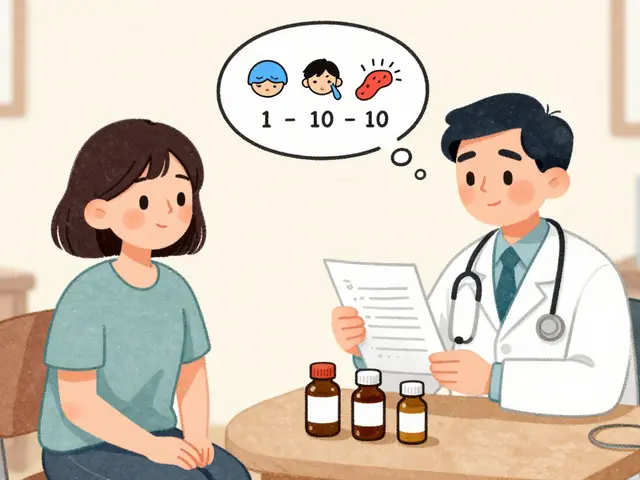
And they’re everywhere. Over 90% of Americans live within five miles of a pharmacy. That’s more accessible than any specialist’s office. In community clinics, pharmacists now do full medication reviews - asking patients, “What are you taking? When? Why? What side effects are you getting?” They document it. They flag problems. And then they talk to the doctor.
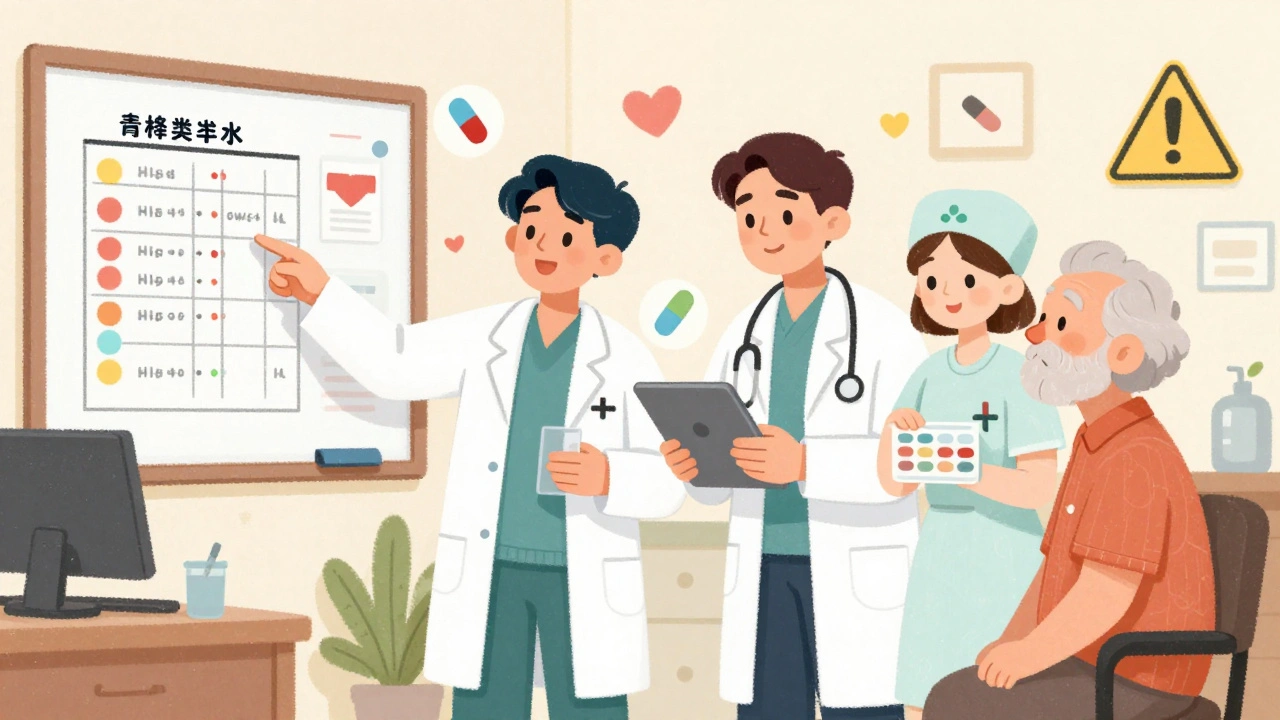
How the Team Actually Works - Day to Day
This isn’t magic. It’s structure.
- Daily huddles: In hospitals and clinics with strong teams, pharmacists join morning rounds. They speak up: “This patient’s creatinine just spiked - metformin might be unsafe.”
- Shared EHRs: Electronic health records now use HL7 FHIR standards so a pharmacist in a community pharmacy can see a cardiologist’s latest note - and vice versa.
- Collaborative Practice Agreements: These are legal documents that give pharmacists authority to adjust doses, order labs, or switch meds - under a doctor’s supervision. In 48 U.S. states, these exist. In the UK, similar roles are expanding under the NHS.
- Structured communication: Teams use tools like SBAR (Situation, Background, Assessment, Recommendation) to make sure nothing gets lost. “Patient is dizzy after starting lisinopril. BP dropped from 160 to 108. Suggest reducing dose from 20mg to 10mg.” Clear. Fast. Actionable.
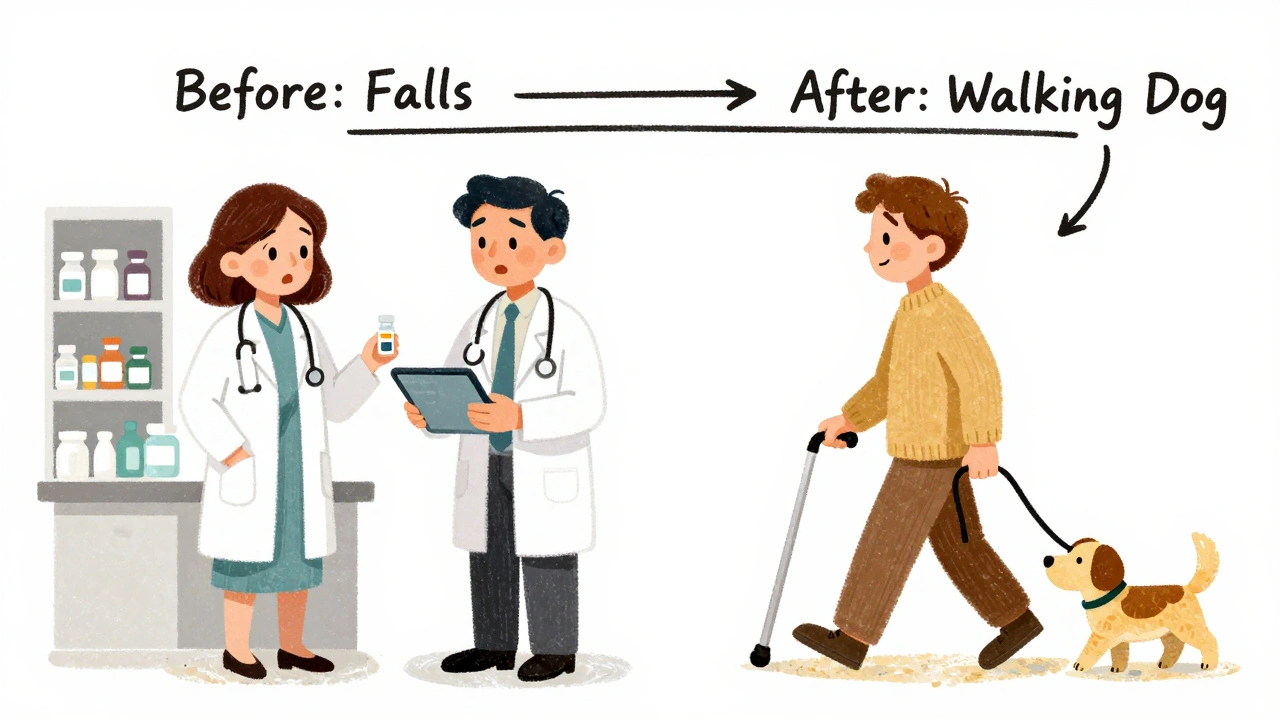
One real example: A 72-year-old woman with heart failure, diabetes, and depression was on seven medications. She was falling. Her doctor thought it was aging. Her pharmacist noticed she was taking three drugs that lowered blood pressure - and two that caused drowsiness. Together, they removed one, reduced two others, and added a morning balance check. Three weeks later, she stopped falling. No new tests. No new scans. Just better teamwork.
Doctors Don’t Have to Give Up Control
Some physicians worry this model means losing authority. It doesn’t. It means gaining support.
Pharmacists don’t replace doctors. They extend them. A 2019 study in the New England Journal of Medicine showed that when pharmacists managed blood pressure in African-American men - a group historically underserved - control rates jumped from 29% to 94%. The doctor still signed off. But the pharmacist did the heavy lifting: monitoring, educating, adjusting. The result? Fewer strokes. Fewer ER visits. More trust.
Dr. Michael Dulin from the American Academy of Family Physicians put it bluntly: “Successful collaboration requires physicians to let go of sole decision-making.” But he didn’t say “give up.” He said “let go.” That’s the difference. You’re not losing control. You’re sharing the load so you can focus on what only you can do - diagnosing, imaging, surgery.
Where This Model Falls Short
It’s not perfect. And it’s not everywhere.
Reimbursement is a mess. In the U.S., only 28 states reimburse Medicaid for pharmacist services. Medicare only started paying for comprehensive medication reviews in 2022 - and even then, only in certain settings. Many small practices can’t afford to hire a pharmacist full-time.
Then there’s culture. Some doctors still see pharmacists as “pill counters.” Some pharmacists feel nervous speaking up in front of a senior physician. It takes time. One clinic in Michigan took eight months to get everyone comfortable. They started with weekly coffee meetings. No agendas. Just talking. Now, their medication error rate is 67% lower than the state average.
And documentation? It’s brutal. Pharmacists report spending 2.5 hours a day just entering notes into systems that weren’t built for team care. That’s time taken away from patients.
What Patients Notice - And Why They Care
Patients don’t care about EHRs or collaborative agreements. They care about feeling heard.
One survey found 89% of patients in team-based care models were satisfied - far higher than in traditional settings. Why? Because someone finally asked, “Are you having trouble taking all these pills?” or “Does this medicine make you too tired to work?”
One man in Bristol, on statins and metformin, was too tired to get out of bed. His pharmacist asked if he’d tried splitting his metformin dose. The doctor hadn’t thought of it. They switched him to extended-release and split the dose. Within two weeks, he was walking his dog again.
That’s not a miracle drug. That’s a team paying attention.
The Future Is Already Here
By 2026, 92% of academic medical centers plan to expand pharmacist roles. CMS is preparing to reimburse pharmacists directly for medication management in 2025 - a game-changer for Medicare patients.
Community pharmacies like CVS and Walgreens now have embedded pharmacists in over 1,200 primary care clinics. These aren’t just retail spots - they’re care centers. You can walk in, get your blood pressure checked, have your meds reviewed, and talk to a pharmacist who knows your full history - all before lunch.
And the data? It’s overwhelming. Teams reduce hospital readmissions by 23%. They cut ER visits by 16%. They improve medication adherence by 22%. They save $28.7 billion a year in avoidable costs.
This isn’t the future. It’s the new normal. And it’s working.
What You Can Do - As a Patient or Provider
If you’re a patient: Ask your pharmacist. Not just “Do I need this?” but “Could any of these be causing my side effects?” Bring a list - every pill, supplement, OTC. Don’t assume your doctor knows it all.
If you’re a provider: Start small. Have coffee with the pharmacist next door. Ask them to review your top five patients on polypharmacy. See what they find.
If you’re a system leader: Fund the EHR integration. Train your staff in SBAR. Create collaborative agreements. It’s not a cost. It’s an investment in fewer readmissions, fewer deaths, and more trust.
The best care doesn’t come from one expert. It comes from many experts working as one.
Can pharmacists really change my medication without my doctor’s approval?
In many places, yes - but only under a formal Collaborative Practice Agreement. These are legal documents that give pharmacists authority to adjust doses, order labs, or switch medications under a doctor’s supervision. They can’t prescribe new drugs for new conditions, but they can fine-tune what’s already prescribed - especially for chronic conditions like hypertension or diabetes. Always ask your pharmacist if they have this authority in your clinic or pharmacy.
Why don’t all doctors work with pharmacists?
It’s often about time, training, and tradition. Many doctors weren’t trained to work in teams. Some fear losing control. Others don’t know how to integrate pharmacists into their workflow. Reimbursement is also a barrier - if insurers don’t pay for pharmacist time, clinics can’t afford to hire them. But this is changing fast. In 2023, 41% of U.S. primary care practices had pharmacists embedded - up from 22% in 2018. The trend is clear: teamwork works.
How do I know if my care team is working well together?
Ask these questions: Do you get a call from your pharmacist when your meds change? Do they ask about side effects you didn’t mention? Do they know what other doctors are prescribing you? If your pharmacist knows your full medication list - including what you buy over the counter - and they’re actively checking for interactions, that’s a good sign. If your doctor says, “I’ll talk to the pharmacist,” and then does, that’s even better.
Are pharmacist-led teams only for chronic diseases?
They’re most effective for chronic conditions like diabetes, heart failure, and anticoagulation - where medication management is ongoing and complex. But they’re also helping in acute settings. For example, in emergency departments, pharmacists now help reduce dangerous drug interactions in elderly patients admitted with falls or infections. The goal isn’t to replace specialists - it’s to prevent mistakes before they happen.
What if my pharmacist and doctor disagree on my meds?
That’s actually a good thing - it means they’re both paying attention. The team should discuss it, review the evidence, and decide together. You should be part of that conversation. No decision should be made without your input. If there’s conflict, ask for a meeting with both the pharmacist and doctor. Good teams welcome healthy debate - it leads to better outcomes.
Can I ask for a pharmacist to be part of my care team?
Absolutely. Just say, “I’m taking several medications and I’m worried about side effects. Is there a pharmacist on your team I can talk to?” Many clinics now have pharmacists on staff - even if they’re not listed on the website. If they don’t, ask if they can refer you to a community pharmacy with a collaborative practice agreement. You’re not asking for a favor - you’re asking for safer care.

Aidan Stacey
December 10, 2025 AT 19:20 PMThis is the kind of system that actually saves lives, not just paperwork. I’ve seen it firsthand-my grandma was on seven meds, dizzy all the time, and no one ever asked her if she could even open the bottles. Then the pharmacist showed up at her clinic, sat down with her for 45 minutes, and found two drugs that were basically fighting each other. She stopped falling. She started gardening again. That’s not a ‘service.’ That’s family.
And don’t get me started on how pharmacies are the only place where someone actually looks you in the eye and says, ‘Hey, this pill’s making you tired?’ Doctors? They’re in and out in six minutes. Pharmacists? They remember your dog’s name and your coffee habit. That’s care.
We need this everywhere. Not just in Boston or Bristol. In every town, every strip mall, every rural corner where people are just trying to survive their prescriptions. This isn’t innovation-it’s basic human decency.
Jimmy Kärnfeldt
December 11, 2025 AT 03:44 AMIt’s wild to think that we’ve been treating pharmacists like glorified cashiers for decades. Like they’re just the people who hand you the bottle and say ‘Take twice daily.’ But they’re the ones who know that mixing warfarin with garlic supplements can turn you into a human pincushion.
Doctors are brilliant at diagnosing. Pharmacists are brilliant at preventing disasters. And when they talk to each other? Magic happens. I’ve been on a combo of meds for years-no one ever asked me about the OTC painkillers I took daily. My pharmacist did. Changed my whole life.
This isn’t just about efficiency. It’s about dignity. People deserve to be seen, not just dosed.
Ariel Nichole
December 11, 2025 AT 10:20 AMI love how this post doesn’t just hype it up-it shows the real structure. Daily huddles? SBAR? Collaborative agreements? That’s the stuff that actually works. I work in a clinic that just added a pharmacist last year and our med error rate dropped by half. No drama. No fanfare. Just better communication.
And honestly? The best part is how patients respond. They feel less alone. Like someone’s actually watching out for them. That’s huge when you’re juggling five prescriptions and a chronic illness.
Let’s not make this a luxury. Let’s make it standard.
matthew dendle
December 12, 2025 AT 09:52 AMlol so now pharmacists are doctors but we dont pay em like it? sure. i get it. doctors do all the hard stuff and now the pill guy gets to tweak doses? cool story. when the guy behind the counter starts doing MRIs ill believe he’s a clinician. until then, its just rebranding.
Eddie Bennett
December 13, 2025 AT 00:07 AMMatthrew’s comment is classic. The same people who scream ‘socialized medicine!’ when a pharmacist adjusts a dose are fine when a doctor prescribes a $500 pill with zero follow-up.
I’ve been on the other side-worked in a pharmacy where we had to call doctors 3x a day just to get a dose changed because the system didn’t trust us. We weren’t overstepping. We were preventing ER visits.
It’s not about replacing anyone. It’s about not letting patients fall through the cracks because everyone’s too busy to talk.
Sylvia Frenzel
December 13, 2025 AT 13:20 PMThis is just another way for the government to expand bureaucracy. We don’t need more people touching our meds. We need fewer prescriptions. Stop overmedicating people and this whole ‘team’ nonsense goes away.
Vivian Amadi
December 14, 2025 AT 17:56 PMYou think pharmacists are the solution? They’re the ones who gave my aunt 300mg of gabapentin because she ‘felt anxious.’ She ended up in the ER. They don’t diagnose. They don’t know history. They’re just glorified clerks with a title.
Jim Irish
December 16, 2025 AT 02:47 AMThere is merit in this model. The data supports it. The outcomes are measurable. What is lacking is consistent implementation and funding. In many regions, pharmacists remain underutilized due to outdated regulatory frameworks.
It is not a question of whether this works-it is a question of when we will scale it equitably.
Patients deserve integrated care. Providers deserve support. Systems must adapt.
Courtney Blake
December 17, 2025 AT 02:16 AMI’m tired of this ‘team-based care’ nonsense. It’s just another way to shift blame. If your doctor doesn’t know your meds, that’s on them. Don’t make the pharmacist the babysitter for lazy medicine. And why are we always talking about Medicare? What about the people who don’t have insurance? This whole thing feels like a PR stunt.