

Imagine trying to see clearly when your cornea - the clear front surface of your eye - slowly begins to bulge outward like a cone. That’s what happens in keratoconus, a condition that quietly steals sharp vision from millions worldwide. It doesn’t happen overnight. It starts in the teens or early twenties, often unnoticed until driving at night becomes a blur or reading fine print feels impossible. By the time many realize something’s wrong, their cornea has already thinned and distorted, making glasses useless. This isn’t just about blurry vision. It’s about losing the ability to do everyday things without struggle. And for most people, the solution isn’t surgery - it’s a thin, rigid contact lens.
What Keratoconus Really Does to Your Eye
Keratoconus isn’t a disease you catch. It’s a structural failure. Your cornea normally holds its dome shape thanks to collagen fibers that act like internal support beams. In keratoconus, those fibers break down. Enzymes in the cornea go into overdrive, eating away at the structure while the body’s natural repair system slows down. The result? The center of the cornea starts to bulge, becoming thinner and steeper. This isn’t uniform. One eye might be worse than the other. The distortion creates irregular astigmatism - meaning light doesn’t focus properly on your retina. That’s why your glasses don’t work anymore. Glasses sit too far from the eye to correct this kind of irregularity. Only a rigid lens, placed directly on the cornea, can fix it.Why Rigid Lenses Work When Glasses Fail
Think of your cornea like a warped basketball. If you put a soft, flexible ball on top of it, the ball just conforms to the bumps. That’s what soft contact lenses do - they follow the shape of your cornea, so your vision stays blurry. Rigid lenses, on the other hand, are like a perfectly smooth glass marble. When you place it on your eye, it doesn’t bend. It floats just above the cornea, creating a new, smooth optical surface. Tears fill the tiny gap between the lens and your cornea. That tear layer becomes the new, even surface that light passes through. Suddenly, your vision snaps into focus.This isn’t theory. Studies show patients with moderate keratoconus go from seeing 20/400 - barely able to count fingers - to 20/200 or better after fitting. For many, it’s the difference between not being able to drive and driving safely. The key is rigidity. Only a lens that holds its shape can override the cornea’s irregularity. Soft lenses simply can’t do that.
The Three Types of Rigid Lenses Used Today
Not all rigid lenses are the same. There are three main types, each suited to different stages of the disease:- Rigid Gas Permeable (RGP) Lenses: These are the classic option. Usually 9-10mm wide, they sit right on the cornea. Made from materials with oxygen permeability ratings (Dk) between 50 and 150, they let your cornea breathe. They’re affordable, widely available, and often the first choice for early to moderate keratoconus. But they can feel foreign at first.
- Hybrid Lenses: These combine a rigid center with a soft, flexible skirt around the edges. The rigid part gives clear vision. The soft edge improves comfort. They’re a good middle ground for people who can’t tolerate full RGP lenses but don’t need the full coverage of a scleral lens.
- Scleral Lenses: These are larger - 15 to 22mm wide. They don’t touch the cornea at all. Instead, they vault over it and rest on the white part of the eye (the sclera). A reservoir of saline sits between the lens and your cornea, protecting it and smoothing out irregularities. They’re the go-to for advanced cases, scarring, or extreme dryness. They’re more expensive and require expert fitting, but success rates hit 85% in stage III-IV keratoconus.
Most patients start with RGPs. If they struggle with comfort or vision, they move to hybrids or sclerals. The fitting process isn’t quick. It usually takes 3 to 5 visits over 4 to 6 weeks. Each adjustment is small - changing the curve, thickness, or diameter - until the lens sits perfectly. There’s no one-size-fits-all.
How Long Does It Take to Adapt?
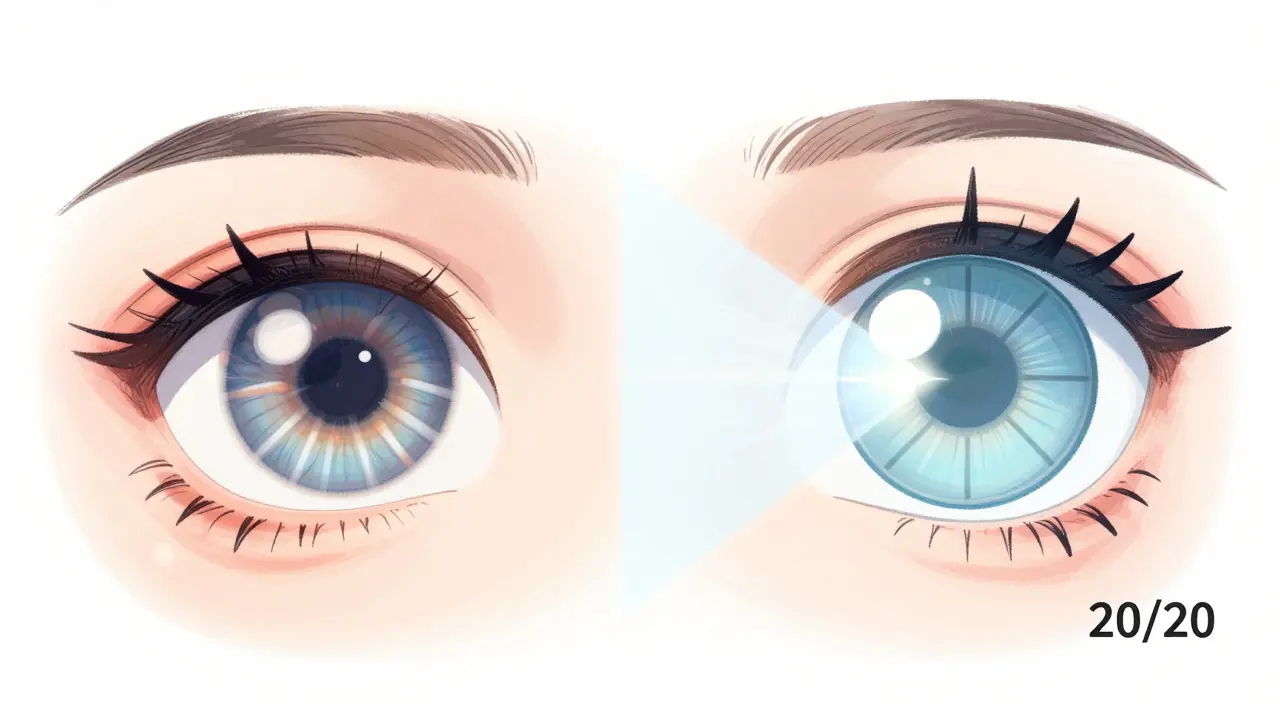
The first week is rough. About 45% of new wearers feel like there’s a grain of sand in their eye. Thirty-eight percent are constantly aware of the lens. Thirty-two percent struggle to insert or remove it. That’s normal. The adaptation period isn’t a sign of failure - it’s part of the process.Most people build up slowly: 2 hours on day one, adding an hour each day. Within 2 to 4 weeks, 85% are wearing them full-time. The breakthrough comes when they realize they can read street signs without squinting, see their child’s face clearly across the room, or watch TV without headaches. Long-term users report vision improvements from 20/80 to 20/25 - close to perfect. That’s not magic. It’s physics.
What Doesn’t Work - And Why
Some people try to skip the lenses. They think surgery is the answer. But here’s the truth: no treatment fixes keratoconus by itself.- Corneal Cross-Linking (CXL): This procedure strengthens the cornea with UV light and riboflavin. It stops progression - but doesn’t improve vision. You still need lenses afterward. Studies show it works in 90-95% of cases over five years.
- INTACS: These are tiny plastic rings inserted into the cornea to flatten it. They help, but 35-40% of patients still need rigid lenses after surgery.
- Corneal Transplant: This is the last resort. About 10-20% of patients need it. But recovery takes over a year. And even after surgery, 60% still need some form of rigid lens for clear vision.
Rigid lenses aren’t a temporary fix. They’re the mainstay. Even after CXL or INTACS, most people keep wearing them. They’re the tool that gives back daily vision.
Common Problems and How to Solve Them
Even with the right lens, problems pop up:- Lens fogging: 25% of users report blurry vision midday. Usually caused by debris or protein buildup. Switching to preservative-free cleaning solutions helps.
- Lens decentration: The lens shifts off-center. This causes glare or double vision. A slight redesign - adjusting the curve or edge profile - fixes it in most cases.
- Solution sensitivity: 10% react to preservatives. Switching to preservative-free rewetting drops or saline solutions eliminates the irritation.
Most issues aren’t about the lens being wrong - they’re about fit, care, or environment. A good specialist will adjust, not replace.
Who Gets Keratoconus - And How Common Is It?
About 1 in 2,000 people have keratoconus. It’s more common in teenagers and young adults. People with allergies, eczema, or a habit of rubbing their eyes are at higher risk. It’s not inherited in a simple way, but family history increases chances. It’s not caused by screen time or reading too much. It’s a biological process - one that’s getting diagnosed more often now because of better imaging.Today, rigid lenses are the primary solution for 60-70% of diagnosed cases. That’s over 1.5 million people worldwide relying on them daily. The global market for these specialty lenses is growing fast - expected to hit $2.78 billion by 2027. Why? Because they work. And because new materials are making them more comfortable.

New Tech Making Lenses Better
In 2022, manufacturers started releasing scleral lenses with oxygen permeability ratings over 200 - meaning your cornea gets more air than ever before. In January 2023, the FDA approved the first fully digital manufacturing process for scleral lenses. Now, instead of guessing the shape, doctors scan your cornea and build a lens that matches it exactly. This cuts fitting time and improves comfort dramatically.And the trend is clear: 78% of cornea specialists now recommend combining CXL with rigid lenses. The procedure stops the disease. The lens restores vision. Together, they’re the gold standard.
What Happens If You Don’t Treat It?
Left untreated, keratoconus can lead to permanent vision loss. Scarring can form on the cornea. The shape keeps worsening. You might eventually need a transplant. But that’s rare. Most people who get diagnosed and fitted with the right lens never reach that point. The key is early detection. If you’re under 30 and suddenly can’t see well with glasses, get a corneal topography scan. It’s quick, painless, and tells you everything.Can glasses fix keratoconus?
No. Glasses can’t correct the irregular shape of the cornea in keratoconus because they sit too far from the eye. They only work for mild cases. Once the cornea starts to bulge and thin, rigid contact lenses are needed to restore clear vision.
Are rigid contact lenses uncomfortable?
Initially, yes - about 30% of patients feel discomfort during the first few weeks. But most adapt within 2 to 4 weeks. Scleral lenses, which rest on the white of the eye, are often more comfortable than traditional RGP lenses, especially for advanced cases.
Do rigid lenses stop keratoconus from getting worse?
No. Rigid lenses improve vision but don’t treat the underlying disease. To stop progression, corneal cross-linking (CXL) is required. Many patients use both: CXL to halt worsening and rigid lenses to see clearly.
How long do rigid contact lenses last?
RGP lenses typically last 1-2 years with proper care. Scleral lenses can last up to 3 years. But lifespan depends on wear habits, cleaning routines, and changes in your cornea. Regular check-ups every 6-12 months are essential.
Is surgery better than rigid lenses for keratoconus?
Surgery like CXL or INTACS can help slow progression or reshape the cornea, but most patients still need rigid lenses afterward. Corneal transplants are only needed in 10-20% of cases. Rigid lenses remain the most effective, non-invasive way to restore vision for the majority of people.




Terrence spry
I'm a pharmaceutical scientist specializing in clinical pharmacology and drug safety. I publish concise, evidence-based articles that unpack disease mechanisms and compare medications with viable alternatives to help readers have informed conversations with their clinicians. In my day job, I lead cross-functional teams advancing small-molecule therapies from IND through late-stage trials.
view all posts