
When you hear "ACA plans," you might think of government handouts or confusing paperwork. But here’s the real deal: if you’re buying health insurance on your own in 2026, the Affordable Care Act is probably the reason you can even afford it. Without it, millions of Americans would be priced out of care-especially those with chronic conditions, low incomes, or jobs that don’t offer insurance. The law didn’t just change rules. It changed lives.
What the ACA Actually Covers
The Affordable Care Act didn’t just create a new website to buy insurance. It forced insurers to cover ten essential health benefits, no matter what plan you pick. That means every Bronze, Silver, Gold, or Platinum plan sold on HealthCare.gov must include:- Ambulatory patient services (doctor visits)
- Emergency care
- Hospitalization
- Pregnancy, maternity, and newborn care
- Mental health and substance use disorder services
- Prescription drugs
- Rehabilitative services and devices
- Laboratory services
- Preventive and wellness services
- Pediatric services, including dental and vision
Before the ACA, insurers could sell you a plan that excluded mental health care or maternity coverage. You’d pay extra-or get denied-if you needed those services. Now, they’re built in. No fine print. No loopholes.
How Premium Tax Credits Make ACA Plans Affordable
The biggest reason people can actually afford ACA plans? Tax credits. If your household income is between 100% and 400% of the Federal Poverty Level (FPL), you qualify for monthly subsidies that lower your premium. In 2024, a 40-year-old earning $50,000 a year paid about $247 a month for a Silver plan with these credits. Without them? $534. That’s more than double.Here’s the catch: those enhanced credits were supposed to expire at the end of 2025. If Congress doesn’t act, average premiums will jump 114%-that’s over $1,000 more per year for the typical enrollee. Older adults will get hit hardest. A 60-year-old in some states could see their premiums rise nearly 200%.
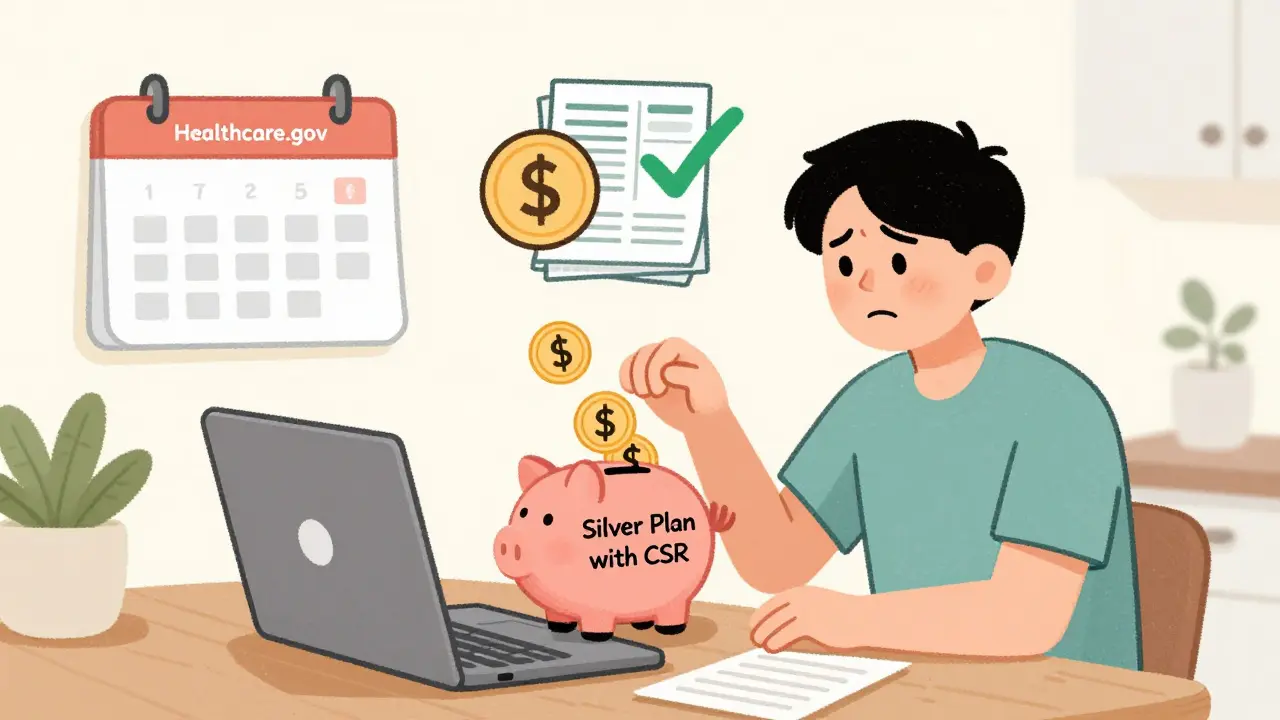
But here’s the good news: for now, those credits are still active. That means if you’re making under $60,000 as a single person (or $120,000 as a family of four), you’re likely paying far less than you think. Use the HealthCare.gov calculator. Enter your income, age, and zip code. You might be shocked at how low your monthly bill could be.
Plan Tiers: Bronze, Silver, Gold, Platinum
ACA plans are grouped into metal tiers based on how much of your medical costs they cover, on average:- Bronze: Covers 60% of costs. Lowest monthly premium, highest out-of-pocket if you get sick.
- Silver: Covers 70%. Best value for most people-especially if you qualify for extra cost-sharing reductions.
- Gold: Covers 80%. Higher premiums, lower deductibles. Good if you use care often.
- Platinum: Covers 90%. Highest premiums, lowest out-of-pocket. Only makes sense for people with chronic conditions or frequent hospital visits.
Most people pick Silver. Why? Because if your income is below 250% of the FPL, you get extra help cutting your deductible and copays. That’s called Cost-Sharing Reductions (CSR). For example, a Silver plan with CSR might have a $500 deductible instead of $3,000. That’s huge if you need surgery or have diabetes.
What the ACA Doesn’t Let Insurers Do
Before 2010, insurance companies could deny you coverage just because you had asthma, diabetes, or cancer. They could cap how much they’d pay you in a year-or cancel your plan if you got sick. The ACA banned all of that.Now, insurers can’t:
- Deny you because of a pre-existing condition
- Charge you more because you’re a woman or older
- Set annual or lifetime dollar limits on essential health benefits
- Cancel your plan because you made a paperwork mistake
That last one matters. A lot. In 2023, a woman in Ohio got her plan canceled because she wrote her address wrong on a form. She needed chemotherapy. Under the ACA, that’s illegal. Today, insurers must give you 30 days to fix errors before dropping you.
The Family Glitch Fix
Before 2023, if your employer offered you affordable insurance, your spouse and kids couldn’t get subsidies-even if the family plan was unaffordable. That was called the "family glitch." Millions were stuck paying thousands for coverage they couldn’t afford.In 2023, the rule changed. Now, if your employer’s family plan costs more than 9.12% of your household income, your spouse and kids can shop on the Marketplace and get subsidies. That opened up affordable coverage for over 2 million people in 2024 alone.
Who’s Left Out?
The ACA isn’t perfect. Here’s who still struggles:- DACA recipients: As of November 2025, they’re no longer eligible for Marketplace plans. About 550,000 people lost coverage.
- People above 400% FPL: Without the enhanced credits, they pay full price. A 55-year-old earning $70,000 might pay $800+ a month.
- People in non-expansion states: In states that didn’t expand Medicaid, adults without kids and no disability can still be stuck in the "coverage gap"-earning too much for Medicaid, too little for subsidies.
That’s why enrollment is dropping fastest in Texas, Florida, and Georgia. Those states have 42% of enrollees who’d face premium hikes over 150% if the tax credits expire.
Real Stories, Real Costs
Sarah K., a freelance writer in Ohio, earns $32,000 a year. She used to pay $600 a month for a plan that didn’t cover her asthma medication. In 2025, she got a Silver plan with CSR-$0 premium, $0 copays for her inhaler, and $100 deductible. "I didn’t know I qualified," she said. "I thought I made too much. I didn’t even know what CSR meant." Then there’s Jamal from Chicago. He’s self-employed. His income fluctuates. He got a $0 premium plan in 2024. But when he had a big client payout in November, his subsidy was recalculated. He got a $2,800 tax bill. "I didn’t know I had to report income changes during the year," he said. "I thought the government figured it out." That’s the hidden cost of ACA: complexity. If your income changes, you have to update it. Otherwise, you owe money at tax time. Starting in 2026, you’ll need to report income every quarter. That should cut those surprises by 40%.What’s Changing in 2026
The CMS 2025 Final Rule, effective November 2025, is reshaping the Marketplace:- Monthly Special Enrollment Periods for people under 150% FPL are gone. That means if you lose a job, you might wait months to get coverage.
- Insurers must now use net percentage-based thresholds for payments-no more fixed-dollar limits. This makes billing clearer but harder to predict.
- Income verification will use IRS data in real time. If you’re self-employed, you’ll need to submit quarterly profit/loss statements.
- Subsidies will be recalculated using 2026 IRS caps, which are lower than current ones.
These changes are meant to reduce fraud. But advocates warn they’ll also reduce enrollment. The Urban Institute estimates a 12-15% drop in 2026 if subsidies expire. That’s 2 million people losing coverage.
Is the ACA Worth It?
Look at the numbers. In 2024, 17.3 million people signed up for Marketplace plans. That’s up 20% from 2023. People are choosing it-even with the headaches.Why? Because it works for people who need it most:
- People with cancer, diabetes, or heart disease-92% say the pre-existing condition protection saved them.
- Young adults under 26-still on their parents’ plan.
- Self-employed people and gig workers-no employer, no problem.
- Families who were locked out before 2023.
The ACA isn’t flawless. It’s complicated. It’s fragile. But it’s the only system that gives real, affordable coverage to people who aren’t lucky enough to get insurance through a job.
If you’re eligible, don’t wait. Use HealthCare.gov. Enter your income. See what you qualify for. Even if you think you make too much, you might be surprised. And if you’re worried about tax time? Set aside a little each month. It’s not perfect-but it’s better than nothing.
Do I qualify for ACA subsidies if I’m self-employed?
Yes. If your Modified Adjusted Gross Income (MAGI) is between 100% and 400% of the Federal Poverty Level, you qualify for premium tax credits. Self-employed people must report income using IRS Form 1040 and Schedule C. Quarterly income updates will be required starting in 2026 to avoid large tax bills.
Can I get ACA coverage if I have DACA status?
No. As of November 2025, DACA recipients are no longer eligible for Marketplace plans or premium tax credits under the CMS 2025 Final Rule. About 550,000 people lost coverage as a result.
What’s the difference between Bronze and Silver plans?
Bronze plans have lower monthly premiums but higher out-of-pocket costs-you pay 40% of medical expenses. Silver plans cost more each month but cover 70% of costs. If your income is below 250% of the FPL, Silver plans come with extra help lowering your deductible and copays-making them the best value for most people.
Why do some people owe money at tax time for ACA plans?
If your income increases during the year and you didn’t update your subsidy, you got more help than you qualified for. The government pays the difference upfront, but you repay it when you file taxes. Starting in 2026, quarterly income updates will reduce this problem.
Are ACA plans better than employer insurance?
It depends. Employer plans usually have lower premiums and broader networks. But ACA plans offer more flexibility if you’re self-employed, between jobs, or if your employer’s plan doesn’t cover your family. The 2023 "family glitch" fix means you can now get subsidies even if your employer offers you coverage-just not your family.





Randall Little
January 14, 2026 AT 03:46 AMSo let me get this straight - the government forces insurers to cover maternity care, but if you’re a DACA recipient, you’re out of luck? That’s not healthcare policy, that’s political theater with a side of human suffering. And we wonder why people don’t trust institutions.
Also, the ‘family glitch’ fix was a win - but now they’re making quarterly income updates mandatory? Cool. So now self-employed folks have to become accountants just to keep their insulin covered. Brilliant.
Meanwhile, my cousin in Texas still can’t get Medicaid because she makes $1,000 over the cutoff. She’s not rich. She’s just unlucky. And the ACA’s got a whole section on how it helps people like her - except it doesn’t. Not there. Not yet.
Rosalee Vanness
January 16, 2026 AT 01:58 AMI just want to say - if you’re reading this and you’re scared to check your eligibility because you think you make too much, or you’re worried about the tax bill later, or you’ve been burned by paperwork before - please, just go to HealthCare.gov for five minutes. Don’t think. Don’t overanalyze. Just type in your zip code, your age, your income. I did it last year thinking I’d get nothing - and I got a Silver plan with $0 premium and $50 copays for my thyroid meds. I cried. Not because it was perfect - it’s not - but because for the first time in ten years, I didn’t have to choose between eating and breathing.
And if you’re one of those people who says ‘it’s all just government handouts’ - have you ever had a kid with asthma? Have you ever sat in a waiting room wondering if you’ll get a bill you can’t pay? This isn’t charity. It’s survival. And it’s working - even if it’s messy.
Don’t let the noise drown out the quiet victories. Your life matters. Your health matters. Go check. You might be surprised.
mike swinchoski
January 16, 2026 AT 14:54 PMEveryone’s acting like the ACA is some miracle. Newsflash: it’s not. It’s a mess. People are getting tax bills because they didn’t report their side gig income. That’s not a feature - that’s a bug. And now they want us to file quarterly? What’s next, mandatory meditation to lower blood pressure?
And don’t get me started on the ‘essential benefits.’ Why should I pay for someone’s prenatal care if I’m a 30-year-old guy who’s never even held a baby? It’s forced socialism. I’d rather pay cash for care when I need it. No one’s forcing me to buy insurance - so why should I pay for other people’s kids?
Also, ‘pre-existing conditions’? That’s just a buzzword. If you’re sick, you should’ve planned better. That’s life.
Trevor Whipple
January 18, 2026 AT 14:40 PMyo so i just got my 2025 aca bill and it’s like 120 bucks a month but i thought i was gonna pay 500??
turns out i qualified for csr because i’m under 250% fpl but i didn’t even know what csr stood for lmao
also i forgot to update my income when i got that freelance gig and now i owe 3k at tax time 😭
but still better than before
also why do they keep changing the rules?? i feel like i’m playing a video game with no save points
Lethabo Phalafala
January 19, 2026 AT 06:49 AMLet me tell you something - I’m from South Africa, and I’ve watched my cousin in Georgia struggle for years. She’s a single mom, works two jobs, makes $38,000 - too much for Medicaid, too little for real coverage. She pays $700 a month for a Bronze plan that won’t cover her daughter’s asthma inhaler unless she hits a $6,000 deductible.
And you know what? She still chooses it. Because she’s got no other choice. And that’s not freedom. That’s cruelty dressed up as policy.
When I saw the part about DACA recipients losing coverage - I cried. Not because I’m emotional - because I know what it’s like to be told you don’t belong in the system. And if you think this doesn’t matter to you - you’re wrong. It matters to everyone who’s ever been told their life isn’t worth protecting.
Damario Brown
January 19, 2026 AT 10:50 AMHere’s the truth no one wants to say: the ACA is a bandaid on a hemorrhage. It’s a bureaucratic nightmare built on subsidies that are one election away from oblivion. The ‘essential benefits’? Great. But they’re funded by premiums that are rising faster than inflation. The tax credits? Temporary. The cost-sharing reductions? Only for Silver plans. The system is designed to look functional until the next political crisis.
And the quarterly reporting? That’s not efficiency - that’s surveillance. You think the government’s gonna use this data to help you? No. They’re gonna use it to punish you when you miss a deadline.
And don’t even get me started on the ‘family glitch’ fix - it’s just a loophole that lets insurers off the hook while pretending they care. Real reform would’ve been universal coverage. But that’s too radical for this country.
John Pope
January 19, 2026 AT 21:37 PMThere’s a metaphysical tension here - the ACA promises dignity through bureaucracy. We are told: ‘You are worthy of care.’ But the mechanism? A labyrinth of forms, income thresholds, and bureaucratic whims. It’s like being told you’re allowed to breathe - but only if you submit the right color of paper by the third Tuesday of the month.
And yet - people still show up. They still fill out the forms. They still pay the premiums. They still take the inhalers. Why? Because the alternative - death by neglect - is more terrifying than the system itself.
So we cling to this fragile architecture not because we believe in it - but because we believe in each other. Even when the state fails, we don’t stop trying. That’s the real miracle. Not the subsidies. Not the metal tiers. The persistence.
Adam Vella
January 21, 2026 AT 16:31 PMIt is imperative to clarify that the Affordable Care Act, while imperfect, represents the most significant structural advancement in American healthcare access since the establishment of Medicare and Medicaid. The inclusion of essential health benefits eliminates discriminatory underwriting practices that were historically pervasive. Furthermore, the premium tax credits, though subject to legislative expiration, have demonstrably reduced financial toxicity among low- and middle-income households.
However, the proposed implementation of quarterly income reporting, while administratively sound, introduces an undue burden on the self-employed and gig economy participants. This is not a flaw in the policy’s intent, but rather a misalignment in execution. A more robust integration with IRS data systems - rather than manual submissions - would mitigate compliance fatigue.
It is also noteworthy that the 12–15% projected enrollment decline, if subsidies lapse, would constitute a humanitarian crisis. Policy decisions must be grounded in empirical outcomes, not political expediency.
Alan Lin
January 22, 2026 AT 09:49 AMLet me be clear: if you’re eligible for an ACA plan and you’re not signing up, you’re not just hurting yourself - you’re weakening the entire system. Premiums rise when healthy people opt out. That means the people who need it most - the ones with diabetes, cancer, asthma - pay more. That’s not just unfair. It’s immoral.
I’ve worked in public health for 20 years. I’ve seen people die because they waited too long to enroll. I’ve seen families choose between rent and insulin. I’ve seen the numbers. And I’m telling you - this is the best system we’ve got. It’s not perfect. But it’s the only one that doesn’t treat health like a luxury.
If you think it’s too complicated - get help. Call 211. Go to a community center. Ask a friend. Don’t let pride cost you your life. This isn’t politics. This is survival. And you’re not alone.
Robin Williams
January 22, 2026 AT 21:19 PMbro the aca is like that one friend who’s always late but always shows up with pizza when you’re broke
yeah it’s messy
yeah you gotta update your income every 3 months or you get a tax surprise
yeah your cousin in texas still can’t get coverage
but when you’re 28 and freelance and your knee blows out and your plan covers the surgery with a $200 copay?
you don’t care about the bureaucracy
you just care that you’re alive
so go check healthcare.gov
even if you think you’re too rich
you might be shocked
and if you’re mad about the system?
good
now fight for it
don’t just complain
use it
and help someone else use it too