
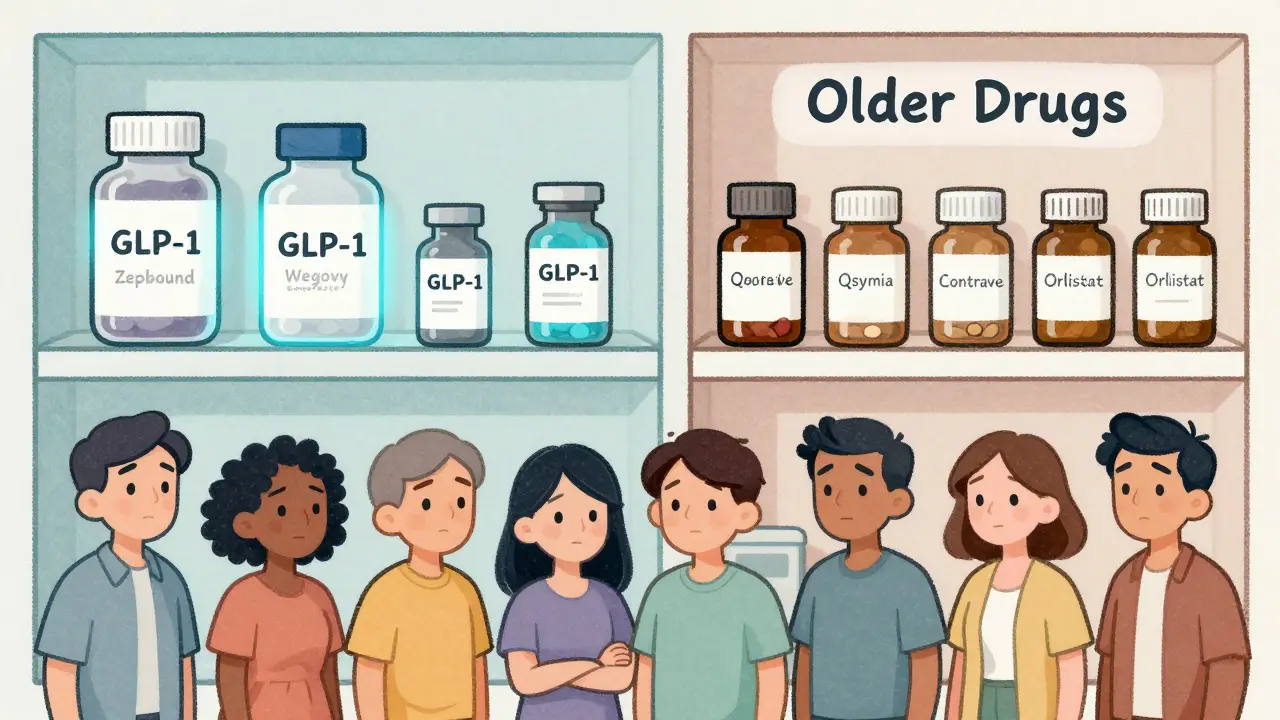
Have you ever looked at the pharmacy shelf or scrolled through social media and felt overwhelmed by the sheer number of options for losing weight? You are not alone. The landscape of weight management has changed dramatically in recent years. On one side, we have the new wave of GLP-1 agonists, drugs like Wegovy (semaglutide) and Zepbound (tirzepatide), which promise massive results. On the other side sit the "older" medications-Qsymia (phentermine-topiramate), Contrave (naltrexone-bupropion), and Orlistat (Xenical/Alli)-that have been around for decades.
The question isn't just about which drug works best; it is about which approach fits your life, budget, and body. While GLP-1s are the current stars, older drugs still hold significant value for many patients. Let's break down exactly how they differ, what you can realistically expect, and why one might be the right choice for you while the other is not.
How They Work: Hormones vs. Brain Chemistry
To understand why these drugs produce different results, you first need to look at their mechanisms. They operate on entirely different biological systems.
GLP-1 receptor agonists are medications that mimic natural incretin hormones involved in appetite regulation and glucose metabolism. Think of them as message carriers. In a healthy body, when you eat, your gut releases glucagon-like peptide-1 (GLP-1). This hormone tells your brain, "I am full," and slows down how fast your stomach empties. It also helps regulate blood sugar. Drugs like semaglutide and liraglutide (Saxenda) artificially boost this signal. Your brain receives a constant, strong message of satiety, even when you haven't eaten much. Tirzepatide goes a step further by targeting both GLP-1 and GIP receptors, amplifying the effect.
In contrast, older medications take a more direct, often stimulant-based approach to the central nervous system.
- Phentermine-topiramate (Qsymia): This combines a mild stimulant (phentermine) with an anti-seizure medication (topiramate). Phentermine increases norepinephrine release, which suppresses appetite by stimulating the sympathetic nervous system. Topiramate enhances the feeling of fullness and may make food taste less appealing.
- Naltrexone-bupropion (Contrave): This targets the brain's reward pathways. Bupropion stimulates dopamine and norepinephrine, while naltrexone blocks opioid receptors. Together, they reduce cravings and the pleasure associated with eating, particularly for sugary or fatty foods.
- Orlistat (Xenical/Alli): This drug doesn't touch your brain at all. It works in the digestive tract by inhibiting lipase enzymes, preventing about 25% of the fat you eat from being absorbed. Instead, that fat passes through your system unchanged.
The fundamental difference is that GLP-1s work with your body's natural hormonal signals to create a sustained state of reduced hunger, whereas older drugs often rely on stimulating alertness, blocking rewards, or physically blocking nutrient absorption.
Efficacy: The Numbers Don't Lie
If raw weight loss percentage is your primary goal, the data heavily favors the newer class of drugs. Clinical trials consistently show a wide gap between GLP-1 agonists and older alternatives.
According to data from the Obesity Medicine Association (2024), Wegovy (semaglutide 2.4 mg) achieved approximately 14.7% body weight loss over 68 weeks in clinical settings. Zepbound (tirzepatide) performed even better, with some participants losing up to 20.9% of their body weight over 72 weeks. Even the older GLP-1, Saxenda (liraglutide), showed superior results compared to non-GLP-1 options, averaging around 8% weight loss.
Now, look at the older generation:
- Qsymia: Typically yields about 10% weight loss.
- Contrave: Generally results in 5-8% weight loss.
- Orlistat: Averages only 3-5% additional weight loss compared to placebo and lifestyle changes alone.
A head-to-head study cited by GoodRx (2024) highlighted this disparity clearly: Wegovy demonstrated 16% weight loss versus Saxenda's 6% in a direct comparison, showing that even within the same drug class, newer formulations are significantly more potent. For context, losing 15% of your body weight is a clinically significant amount that often resolves comorbidities like type 2 diabetes and hypertension. Losing 5% is beneficial but often insufficient for severe obesity cases.
| Medication | Class | Avg. Weight Loss | Administration | Primary Mechanism |
|---|---|---|---|---|
| Zepbound (Tirzepatide) | Dual GIP/GLP-1 Agonist | Up to 20.9% | Weekly Injection | Hormonal Satiety Signal |
| Wegovy (Semaglutide) | GLP-1 Agonist | ~14.7% | Weekly Injection | Hormonal Satiety Signal |
| Saxenda (Liraglutide) | GLP-1 Agonist | ~8% | Daily Injection | Hormonal Satiety Signal |
| Qsymia | Stimulant/Anticonvulsant | ~10% | Daily Pill | CNS Stimulation/Appetite Block |
| Contrave | Reward Pathway Modulator | 5-8% | Daily Pill | Craving Reduction |
| Orlistat | Lipase Inhibitor | 3-5% | Daily Pill | Fat Absorption Blocker |
The Real-World Gap: Trials vs. Reality
Here is where things get complicated. Clinical trials are controlled environments. Participants are monitored closely, doses are optimized, and adherence is high. Real life is messier.
A study published by NYU Langone Health and NYC Health + Hospitals in May 2024 revealed a stark reality check. In a real-world setting involving over 51,000 patients, those on GLP-1 therapy lost only 4.7% of their body weight after six months and 7% after one year. Compare this to bariatric surgery patients in the same study, who lost 24% over two years. Why the drop-off?
Discontinuation rates are sky-high. Up to 70% of patients stop taking GLP-1 medications within the first year. Reasons include intolerable side effects, exorbitant costs, and insurance hurdles. When people stop the medication, the hormonal signal disappears, hunger returns, and weight regain is common. Studies indicate that 50-100% of lost weight can return after discontinuation if lifestyle habits aren't permanently altered.
Older drugs like phentermine have been used for decades, and while their efficacy is lower, their long-term usage patterns are well understood. Orlistat, for instance, has no systemic side effects because it stays in the gut, making it easier for some to tolerate long-term, despite the modest results.
Cost and Insurance: The Biggest Barrier
If efficacy were the only factor, everyone would choose Zepbound or Wegovy. But cost is a major determinant of access.
According to the KFF Health Tracking Poll (May 2024), GLP-1 agonists cost between $1,000 and $1,400 per month without insurance coverage. With insurance, the out-of-pocket cost varies wildly. Many commercial plans restrict coverage to patients with a BMI ≥40 or ≥35 with comorbidities, and even then, prior authorization denials affect nearly 45% of users. Only 28% of commercial insurance plans cover these drugs for weight loss without restrictive criteria.
In contrast, older medications are significantly cheaper:
- Phentermine: Can cost as little as $10-$50 monthly, especially with generic availability.
- Qsymia and Contrave: Typically range from $50-$150 monthly, with broader insurance acceptance for chronic weight management due to their longer history on the market.
- Orlistat: Available over-the-counter (Alli) for roughly $50-$100 monthly, or prescription-strength (Xenical) at similar prices.
For many patients, the math simply doesn't add up for GLP-1s. If you lose $1,200 a month for a year ($14,400 total) but only achieve 7% weight loss in the real world, the cost-per-pound lost is astronomical. Older drugs offer a more affordable entry point, albeit with less dramatic results.
Side Effects: What Your Body Will Endure
Every medication comes with a trade-off. The side effect profiles of these two classes are distinct.
GLP-1 Agonists: The most common complaints are gastrointestinal. Nausea affects 20-50% of users, particularly during dose escalation. Other issues include vomiting, diarrhea, constipation, and heartburn. Some users report severe gastroparesis-like symptoms (delayed stomach emptying), leading to food intolerance or even surgical complications later in life. There is also a rare but serious risk of pancreatitis and gallbladder disease. Muscle mass loss is another concern; rapid weight loss often includes lean tissue, which can impact metabolic rate and strength if not countered with resistance training.
Older Medications:
- Qsymia: Can cause tingling in fingers/toes (paresthesia), dizziness, increased heart rate, and mood changes. Topiramate carries a risk of cognitive slowing or memory issues in some users.
- Contrave: May cause nausea, headaches, insomnia, and elevated blood pressure. Because it contains bupropion, it lowers the seizure threshold, making it unsuitable for those with eating disorders or seizure histories.
- Orlistat: The side effects are localized to the digestive tract. Expect oily spotting, gas with discharge, and urgent bowel movements if you eat too much fat. These are inconvenient and socially embarrassing, but they do not affect your brain or heart.
Many patients find the GI distress of GLP-1s harder to manage than the cognitive or social side effects of older drugs. However, GLP-1s generally have a safer cardiovascular profile, with semaglutide showing proven heart benefits in the SELECT trial (NEJM, 2023).
Who Should Choose Which?
There is no single "best" drug. The right choice depends on your specific health profile, financial situation, and tolerance for administration methods.
Choose a GLP-1 Agonist if:
- You have severe obesity (BMI ≥30) or overweight with comorbidities (BMI ≥27) and have failed other treatments.
- You have type 2 diabetes or cardiovascular disease, as these drugs offer dual benefits beyond weight loss.
- You can afford the high monthly cost or have robust insurance coverage.
- You are comfortable with weekly injections (or daily for Saxenda).
- You can tolerate potential gastrointestinal side effects.
Choose an Older Medication if:
- Budget is a primary constraint.
- You prefer oral pills over injections.
- You have a history of severe GI issues that might be exacerbated by GLP-1s.
- You struggle with specific cravings (Contrave) or need a mild stimulant effect for energy/appetite suppression (Qsymia).
- You want a medication with a long-established safety record for long-term use.
The Future of Weight Loss Treatment
The market is evolving rapidly. The global obesity drug market was valued at $3.5 billion in 2023 and is projected to reach $100 billion by 2030. Newer agents like retatrutide (a triple agonist) and MariTide (a monoclonal antibody) are in late-stage trials, promising even greater efficacy. Retatrutide showed up to 24.2% weight loss in Phase 2 trials.
However, experts caution against viewing medication as a cure. Dr. Ann M. Rogers, President of the American Society for Metabolic and Bariatric Surgery, noted that surgery remains the gold standard for durability and magnitude of weight loss. Medications are tools, not magic bullets. They work best when combined with sustainable lifestyle changes, including dietary adjustments and physical activity.
As patents for semaglutide begin to expire post-2030, we may see generic versions and lower costs, potentially democratizing access. Until then, patients must navigate a complex landscape of high hopes, high costs, and realistic expectations.
Are GLP-1 agonists safe for long-term use?
Current data suggests they are safe for long-term use, with cardiovascular benefits observed in trials like SELECT. However, long-term data beyond 5-10 years is still limited. Common risks include gastrointestinal issues, potential muscle mass loss, and rare cases of pancreatitis or gallbladder disease. Regular monitoring by a healthcare provider is essential.
Will I gain the weight back if I stop taking GLP-1s?
Yes, weight regain is common. Studies show that 50-100% of lost weight can return after discontinuation if lifestyle habits are not permanently maintained. Obesity is considered a chronic condition, and like hypertension, it often requires ongoing management. Combining medication with durable lifestyle changes improves long-term outcomes.
Can I take older weight loss drugs alongside GLP-1s?
Combination therapy is possible but should only be done under strict medical supervision. For example, some doctors may prescribe low-dose phentermine alongside GLP-1s to enhance appetite suppression, but this increases the risk of side effects like elevated heart rate and blood pressure. Always consult your physician before combining medications.
Which weight loss drug is covered by insurance?
Coverage varies widely. Older drugs like phentermine and Orlistat are more likely to be covered or available OTC. GLP-1s like Wegovy are increasingly covered but often require prior authorization, proof of failure with other treatments, and specific BMI criteria. Qsymia and Contrave have moderate coverage rates. Check with your specific insurer for the most accurate information.
Is bariatric surgery better than GLP-1 medications?
For severe obesity, surgery generally produces greater and more durable weight loss. A 2024 study showed surgery patients lost 24% of body weight over two years, compared to 4.7% for GLP-1 users in the first six months. Surgery is invasive and carries surgical risks, while GLP-1s are non-invasive but require lifelong commitment and have high costs. The best option depends on individual health status, risk tolerance, and personal preference.

Terrence spry
I'm a pharmaceutical scientist specializing in clinical pharmacology and drug safety. I publish concise, evidence-based articles that unpack disease mechanisms and compare medications with viable alternatives to help readers have informed conversations with their clinicians. In my day job, I lead cross-functional teams advancing small-molecule therapies from IND through late-stage trials.
view all posts