
Daptomycin CK Monitoring Calculator
This tool helps determine your risk of daptomycin muscle toxicity based on CK levels and your clinical factors. Follow guidelines from University of Nebraska Medical Center.
When you’re fighting a serious bacterial infection like MRSA or infective endocarditis, daptomycin can be a lifesaver. But there’s a hidden risk that many patients and even some doctors don’t talk about enough: daptomycin muscle toxicity. It doesn’t show up in fever charts or blood cultures. It sneaks in through muscle pain, weakness, and a rising number on a lab report called CK-or creatine phosphokinase. And if you miss it, the damage can be serious.
What Is Daptomycin, and Why Does It Hurt Muscles?
Daptomycin is an antibiotic made to kill tough Gram-positive bacteria-especially those that won’t respond to vancomycin or other common drugs. It’s used for skin infections, blood infections, and even heart valve infections. But unlike most antibiotics that target bacterial cell walls, daptomycin attacks the membrane of human muscle cells too. In lab studies, it literally punches holes in muscle tissue, especially when oxygen levels are low. That’s why patients with heart disease, poor circulation, or severe sepsis are at higher risk.
This isn’t just a theory. In 2020, researchers exposed human muscle cells to daptomycin and watched them die. The damage got worse when they lowered oxygen levels-exactly what happens in patients with heart failure or shock. The drug doesn’t just irritate muscles. It breaks them down.
How Do You Know If Daptomycin Is Harming Your Muscles?
Most people don’t feel anything at first. That’s the problem. By the time you notice muscle soreness or weakness, the damage might already be advanced. Here’s what to watch for:
- Unexplained muscle pain, especially in the thighs, shoulders, or lower back
- Weakness that makes it hard to climb stairs or stand up from a chair
- Tenderness when you press on your arms or legs
- Dark urine-this can mean muscle breakdown products are flooding your kidneys
These symptoms usually show up after 5-10 days of treatment, but they can appear earlier in high-risk patients. And here’s the catch: some people never feel pain at all. That’s why checking your CK levels isn’t optional-it’s mandatory.
What Is CK, and Why Should You Care?
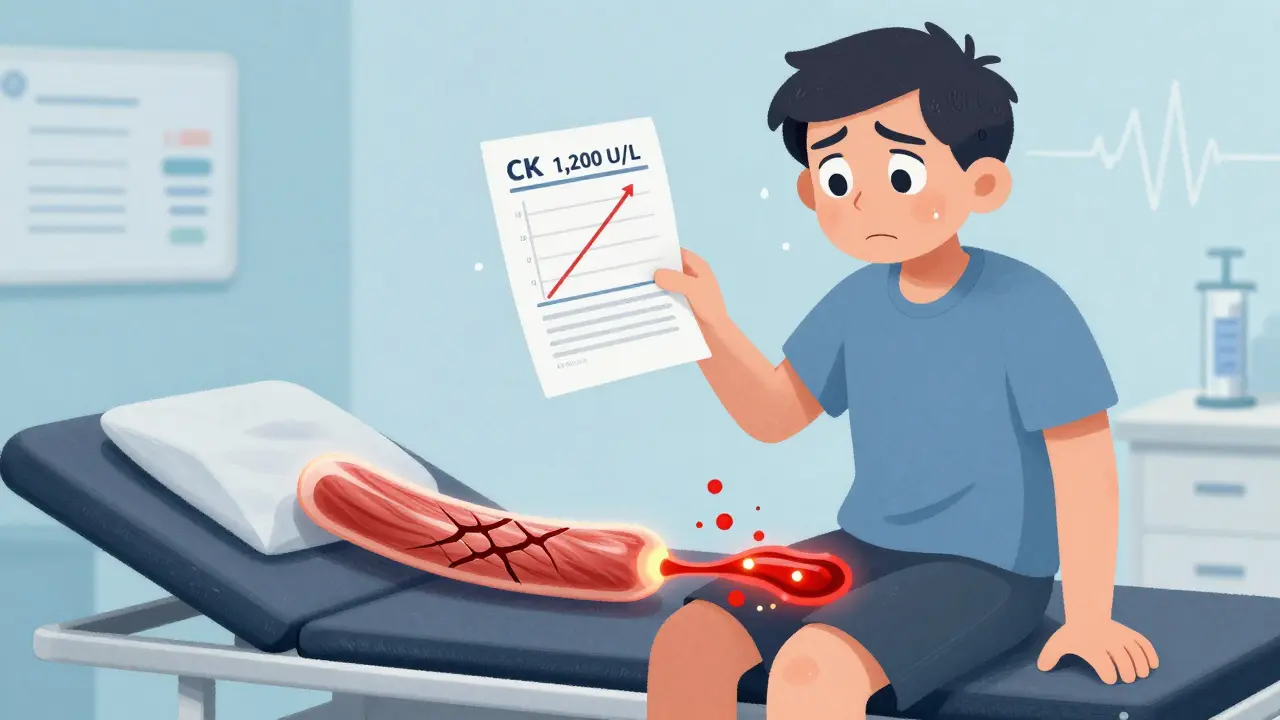
CK, or creatine phosphokinase, is an enzyme found mostly in your skeletal muscles. When muscle cells get damaged, CK leaks into the bloodstream. A normal CK level is under 200 U/L for most adults. If it jumps above 1,000 U/L, that’s a red flag. Above 5,000 U/L? That’s rhabdomyolysis-severe muscle breakdown that can lead to kidney failure.
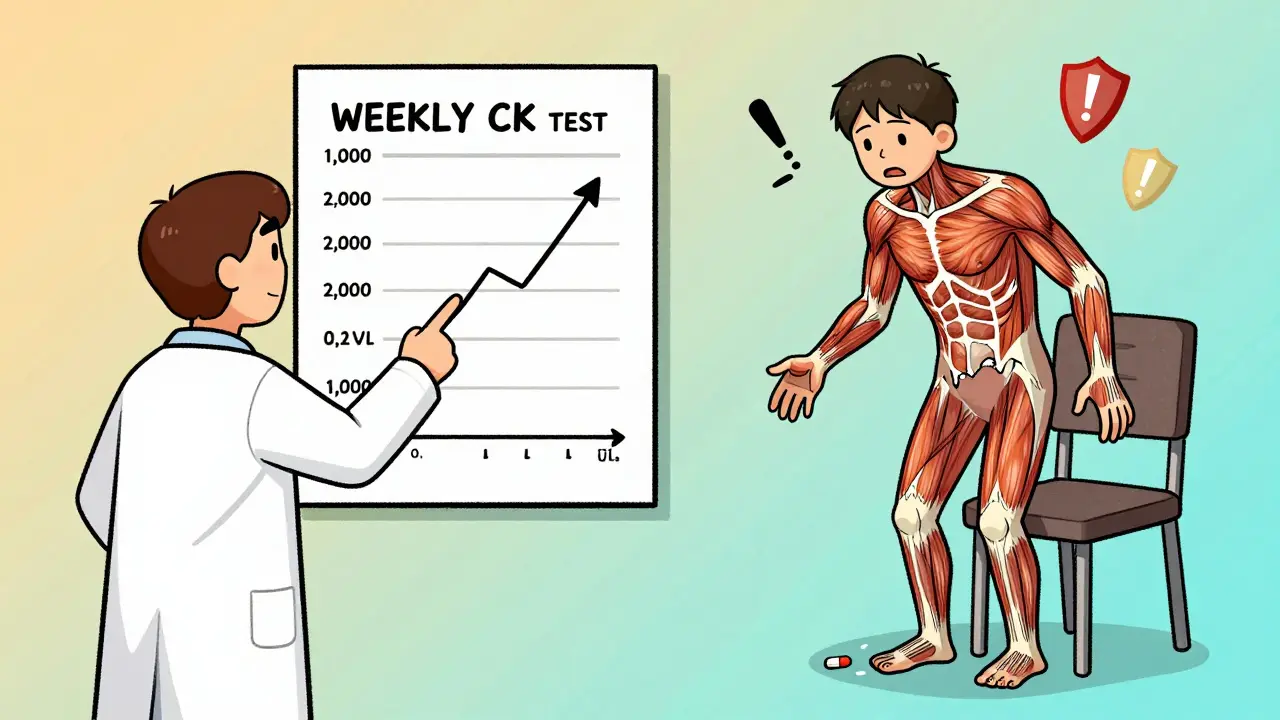
According to clinical guidelines from the University of Nebraska Medical Center, you need to check CK weekly while on daptomycin. Stop the drug if:
- You have muscle symptoms and CK is over 1,000 U/L
- You have no symptoms but CK is over 10 times the upper limit (around 2,000 U/L or higher)
Real-world data shows that 5-10% of patients on daptomycin develop CK levels above 1,000 U/L. That’s way higher than the 0.2% reported in early trials-because real patients aren’t healthy volunteers. They’re sick, old, on other meds, and often have poor circulation.
Who’s Most at Risk?
Not everyone on daptomycin will get muscle damage. But some people are sitting on a ticking clock:
- Patients on high doses (8-12 mg/kg/day)-common for bone and joint infections
- Those with heart disease, diabetes, or poor circulation-low oxygen makes daptomycin more toxic
- People taking statins-even though recent studies show the risk isn’t as high as once thought
- Anyone on daptomycin for more than two weeks-longer treatment = more muscle exposure
One case report described a patient with a prosthetic heart valve who got daptomycin every 48 hours (not daily) and ended up with a CK level of 6,250 U/L. He had underlying coronary disease. His body couldn’t deliver enough oxygen to his muscles, and daptomycin turned them into rubble.
Statins and Daptomycin: Should You Stop Your Cholesterol Pill?
For years, doctors told patients to stop statins when starting daptomycin. The fear was a deadly combo. But a 2014 study of 220 patients found something surprising: the group taking both drugs didn’t have significantly more muscle damage than those on daptomycin alone. The CK levels and muscle pain were higher in the statin group-but not enough to prove causation.
Still, most hospitals still recommend holding statins during daptomycin treatment. Why? Because the stakes are too high. One case of rhabdomyolysis can cost you your kidneys. So even if the risk is low, the safest move is to pause statins. Talk to your doctor. Don’t quit cold turkey-some statins need to be tapered.
What Happens If You Don’t Monitor CK?
Ignoring CK levels is like driving with your eyes closed. You might get lucky. Or you might end up in the ICU.
When muscle cells break down, they release myoglobin-a protein that clogs kidney tubules. That’s how rhabdomyolysis leads to acute kidney injury. In one study, 15% of patients with CK levels above 5,000 U/L needed dialysis. Most recovered after stopping daptomycin, but not all. And recovery takes weeks. You won’t just feel weak-you’ll lose mobility, strength, and independence.
And here’s the kicker: daptomycin-induced muscle damage is fully reversible-if caught early. If you stop the drug at CK 1,200 U/L, your muscles will heal. Wait until CK hits 8,000 U/L, and you might be left with permanent weakness.
How Does Daptomycin Compare to Other Antibiotics?
Vancomycin is cheaper and doesn’t cause muscle toxicity. But it’s harder to use-requires frequent blood tests, takes longer to kill bacteria, and can damage kidneys. Daptomycin kills MRSA faster and doesn’t need daily blood draws for drug levels. But you need weekly CK checks.
Fluoroquinolones like ciprofloxacin cause tendon ruptures. Daptomycin doesn’t. But it causes muscle breakdown instead. Both are serious. Neither should be used without monitoring.
Cost-wise, daptomycin is expensive-about $1,200 for two weeks. Vancomycin is $120. But if you get rhabdomyolysis, your hospital bill could hit $50,000. Monitoring costs $7.50 per test. The math is clear: check CK, save money, save muscle.
What Should You Do If You’re Prescribed Daptomycin?
Don’t panic. Daptomycin saves lives. But you need to be an active partner in your care:
- Ask your doctor if you’re at risk-heart disease, diabetes, or long-term use?
- Confirm you’ll get a CK test before starting and weekly after that
- Report any muscle pain, weakness, or dark urine immediately
- Ask if your statin should be paused
- Know the cutoff: stop daptomycin if CK >1,000 U/L with symptoms, or >10x ULN without
If you’re on daptomycin for a bone infection, you might be on it for 6-12 weeks. That’s a long time for your muscles to be under pressure. Don’t assume you’re fine just because you feel okay.
Is There a Better Way Forward?
Researchers are now looking at something called therapeutic drug monitoring-measuring how much daptomycin is actually in your blood. A target range of 666-939 mg·h/L seems to balance effectiveness and safety. If your levels are too high, your doctor can adjust the dose instead of just stopping the drug.
Future guidelines may include risk scores-factoring in oxygen levels, kidney function, and statin use-to predict who’s most likely to get hurt. For now, the best tool is still the CK test. Simple. Cheap. Life-saving.
Daptomycin is a powerful weapon. But like any weapon, it needs careful handling. Don’t let the urgency of your infection make you ignore the warning signs. Your muscles are counting on you to speak up.
Can daptomycin cause permanent muscle damage?
In most cases, no. Daptomycin-induced muscle damage is reversible if caught early and the drug is stopped. CK levels typically return to normal within 2-4 weeks after discontinuation. However, if rhabdomyolysis is severe and leads to kidney failure or prolonged muscle breakdown, some weakness or loss of function may persist. Early detection is key to full recovery.
How often should CK be checked during daptomycin therapy?
CK should be checked before starting daptomycin, then weekly during treatment. If you’re on a high dose (8 mg/kg or higher), or have risk factors like heart disease, your doctor may check it every 3-4 days. Never skip a test-even if you feel fine. Muscle damage can happen without symptoms.
Should I stop taking statins if I’m on daptomycin?
Most clinicians recommend pausing statins during daptomycin treatment, even though recent studies show the risk of interaction is lower than previously thought. The reason is simple: the consequences of muscle damage are severe, and statins add a small but unpredictable risk. It’s safer to hold them temporarily. Always consult your doctor before making changes to your medications.
Can daptomycin cause kidney damage?
Daptomycin itself doesn’t directly harm the kidneys. But if it causes rhabdomyolysis-severe muscle breakdown-myoglobin released from damaged muscles can clog kidney tubules and lead to acute kidney injury. This is why monitoring CK is critical: catching muscle damage early prevents kidney complications.
What’s the difference between daptomycin and vancomycin for treating MRSA?
Daptomycin kills MRSA faster and doesn’t require frequent blood level checks like vancomycin. But it carries a risk of muscle toxicity, requiring weekly CK monitoring. Vancomycin is cheaper and safer for muscles but can cause kidney damage and needs multiple daily doses. Daptomycin is often preferred for serious infections when speed and potency matter-but only if you’re willing to monitor closely.
Is daptomycin safe for older adults?
Older adults are at higher risk for daptomycin muscle toxicity due to age-related muscle loss, reduced kidney function, and higher rates of heart disease and circulation problems. Dosing should be based on actual weight, not ideal weight, and CK monitoring is even more critical. Many experts recommend starting at the lower end of the dosing range (4-6 mg/kg) in elderly patients unless the infection is life-threatening.






Joie Cregin
January 16, 2026 AT 22:39 PMMan, I had no idea daptomycin could wreck your muscles like that. My uncle was on it for a staph infection last year and he kept saying his legs felt like wet cardboard. They didn’t check his CK until he could barely walk. Thank you for laying this out so clearly - this should be mandatory reading for anyone getting prescribed this stuff.
Rob Deneke
January 17, 2026 AT 19:05 PMCK checks every week no excuses. I’ve seen people ignore this and end up in dialysis. Daptomycin saves lives but it’s not a free pass. If your doc isn’t ordering the test, ask for it like your muscles depend on it - because they do.
Chelsea Harton
January 18, 2026 AT 22:27 PMstatins are fine dont panic just monitor. my aunt did both and lived. also dark urine = go to er. not later. now.
waneta rozwan
January 19, 2026 AT 07:49 AMOh so now we’re treating antibiotics like nuclear reactors? Please. If you’re too frail to handle daptomycin, maybe you shouldn’t be on it in the first place. This overcautiousness is why medicine is so expensive. Stop micromanaging your muscles and trust your doctor.
Also, who even checks CK anymore? That’s a 1990s relic. We have AI now.
Jody Fahrenkrug
January 20, 2026 AT 19:44 PMMy dad was on this for 8 weeks after his hip replacement got infected. He felt fine the whole time. But they checked his CK every 5 days anyway. Turned out it was creeping up. They stopped it at 1,400. He’s back to gardening now. So yeah - even if you feel okay, get the test.
Kasey Summerer
January 22, 2026 AT 18:07 PMSo daptomycin = muscle nuke, vancomycin = kidney ninja. Cool. So what’s the winner? 🤔 I guess it’s like choosing between getting punched in the face or getting stabbed in the foot. Either way, you’re gonna limp. But at least the CK test is like a free health checkpoint. 🙌
Travis Craw
January 23, 2026 AT 04:05 AMjust wondering if anyone’s had the CK test done before starting daptomycin? mine was normal but i’m curious if others got baseline results. i’m on it for 6 weeks and kinda nervous now
Christina Bilotti
January 24, 2026 AT 20:01 PMWow. Someone actually wrote a comprehensive guide that doesn’t sound like it was drafted by a pharmaceutical rep. Impressive. I’m shocked. Maybe we should all start reading peer-reviewed literature instead of just trusting the guy who said ‘it’s fine’ at the pharmacy counter. Oh wait - we can’t, because most people don’t know how to access PubMed. Sad.