
Imagine buying a bottle of medication that looks perfect on the outside but has lost half its potency because it was stored in a slightly warm warehouse. This is exactly what stability testing is designed to prevent. It is the systematic process where manufacturers track how a drug changes over time under specific conditions. Without this rigorous monitoring, expiration dates would be guesses, and patients might receive ineffective or even harmful medicines.
This isn't just about checking if a pill still works; it's a complex scientific discipline governed by strict international rules. If you are involved in manufacturing, quality assurance, or regulatory affairs, understanding these protocols is non-negotiable. A single oversight can lead to costly recalls, delayed approvals, or worse-patient safety risks. In fact, data from the FDA shows that stability issues accounted for 17.3% of drug recalls in 2021 alone.
The Core Purpose: More Than Just an Expiration Date
At its heart, stability testing answers three critical questions: How long does the product last? Where should it be stored? And does it remain safe throughout its life? The goal is to determine the shelf life and storage conditions for pharmaceutical products. This ensures that every dose a patient takes meets the same quality standards as the first one produced.
The framework for this practice comes from the International Council for Harmonisation (ICH), which was formed in 1990 to align regulations across Europe, Japan, and the United States. Their guidelines, particularly ICH Q1A(R2), serve as the global standard. These documents require manufacturers to submit comprehensive stability data when applying for New Drug Applications (NDAs) or Abbreviated New Drug Applications (ANDAs). Essentially, you cannot get your drug approved without proving it stays stable.
| Condition Type | Temperature | Humidity | Purpose |
|---|---|---|---|
| Long-term (Temperate) | 25°C ± 2°C | 60% RH ± 5% | Determines real-time shelf life |
| Long-term (Hot/Humid) | 30°C ± 2°C | 65% RH ± 5% | For markets with higher ambient heat |
| Accelerated | 40°C ± 2°C | 75% RH ± 5% | Identifies potential instability quickly |
| Photostability | N/A | N/A | Exposure to light (1.2M lux hours visible, 200 Wh/m² UV) |
How the Process Works: Chambers, Samples, and Data
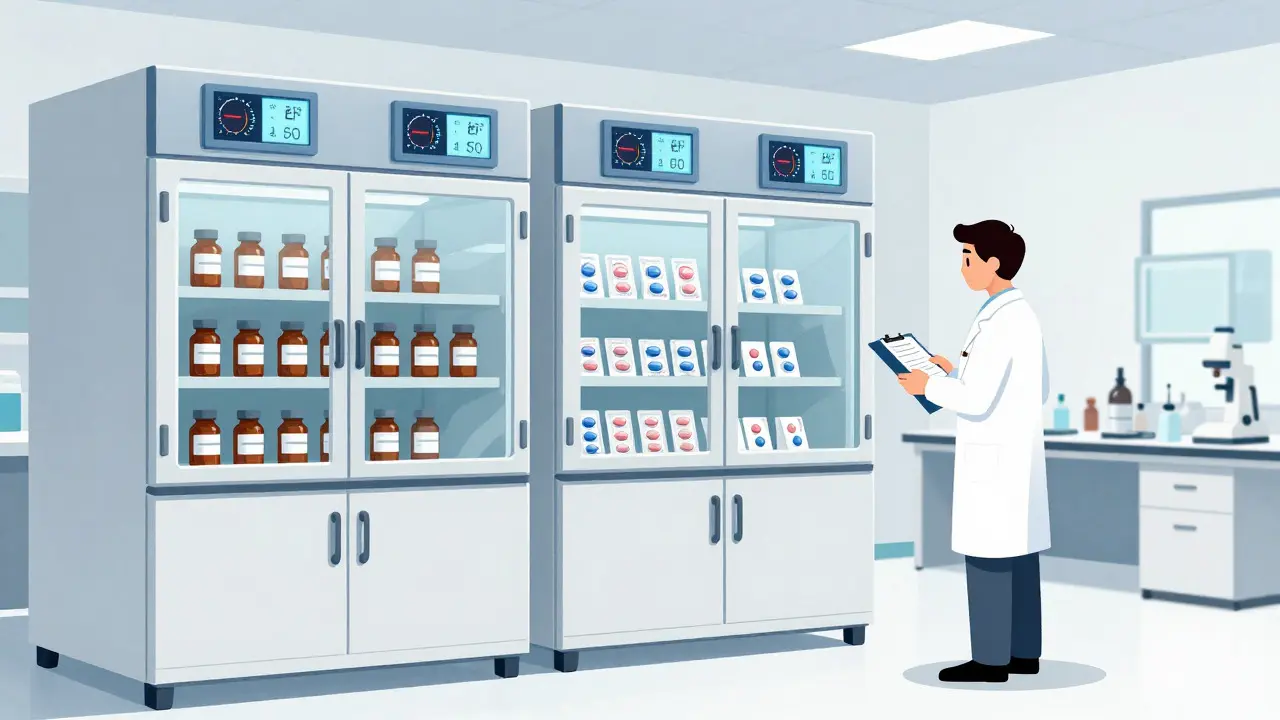
The physical setup involves placing packaged drug products inside specialized stability chambers. These aren't ordinary refrigerators; they are precision instruments that maintain exact temperature and humidity levels 24/7. Inside, samples are tested at regular intervals-typically at 0, 3, 6, 9, 12, 18, 24, and 36 months for new drugs.
What are we actually measuring? It’s not just whether the pill dissolves. Analysts evaluate multiple attributes:
- Physical properties: Appearance, color, pH, and hardness.
- Chemical properties: Assay (potency) and degradation products.
- Microbiological characteristics: Sterility and bioburden for injectables.
- Therapeutic efficacy: Dissolution profiles to ensure the drug releases correctly in the body.
Consider the cost. Major pharmaceutical companies spend between $500,000 and $2 million annually on this infrastructure. A single stability study for one formulation can run $50,000 to $150,000. Why such high investment? Because the alternative is far more expensive. A 2022 case study by SGS revealed that stability testing caught a critical interaction between a biologic drug and its container closure system. Catching this early prevented a potential $500 million launch failure.
Real-Time vs. Accelerated: The Trade-Offs
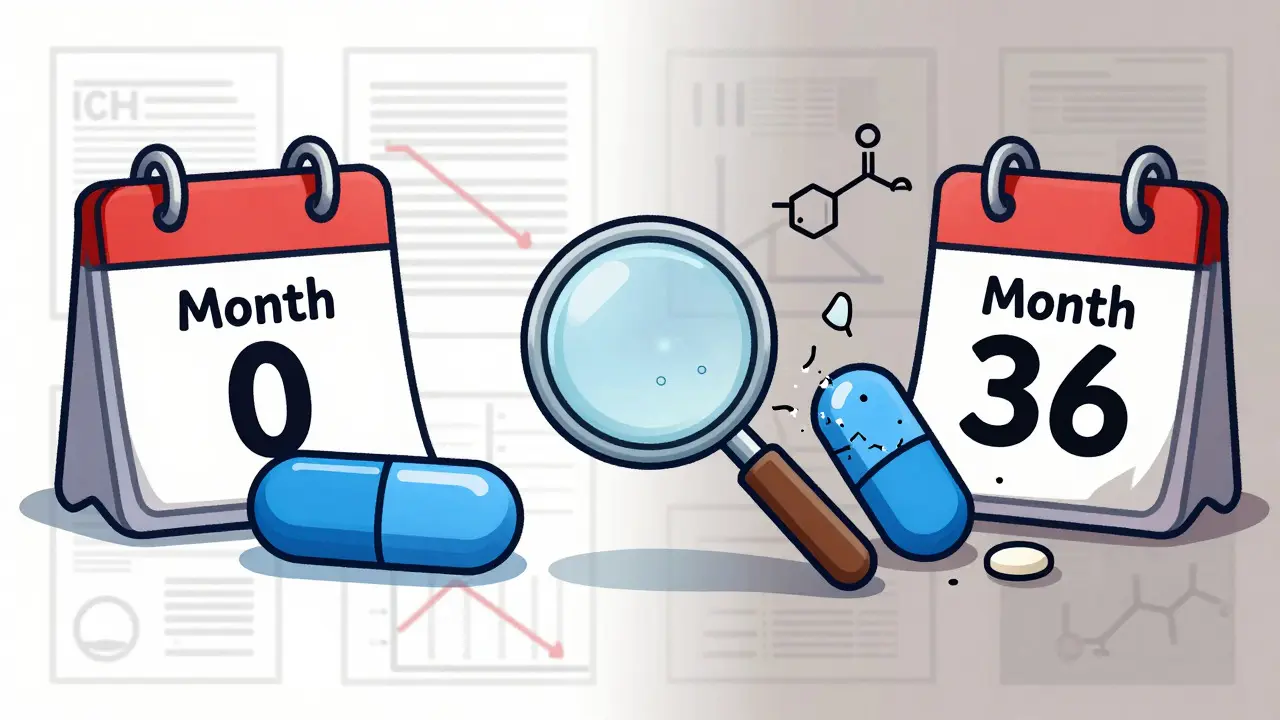
You might wonder why we don’t just speed up the process entirely. That’s where accelerated testing comes in. By exposing drugs to harsher conditions (like 40°C and 75% humidity), scientists can predict shelf life in just six months. However, this method has limits. As noted in a 2021 Journal of Pharmaceutical Sciences study, accelerated tests lack the precision of real-time studies. They are great for spotting red flags, but they can’t replace the definitive data gathered over 24-36 months in real-world conditions.
The statistical rigor required is intense. The ICH Q1E guideline demands a 95% confidence level that 95% of the population remains within specifications. This isn’t guesswork; it’s hard mathematics applied to chemistry. Simpler methods used in food industries, like mean kinetic temperature calculations, simply don’t cut it for pharmaceuticals where margin for error is zero.
Common Pitfalls and Real-World Challenges
Even with strict protocols, things go wrong. One of the biggest headaches for quality professionals is equipment failure. A Reddit discussion in r/pharmaceuticals highlighted a technician whose company suffered recurring humidity excursions in their stability chambers. This caused three-month data gaps, delaying their ANDA submission by eight months and costing an estimated $2.3 million in lost market entry time.
Another major issue is Out-of-Specification (OOS) results. When a sample fails, it triggers a formal investigation directed by Quality Assurance, mandated by 21 CFR 211.192. Ignoring these failures is a fast track to regulatory trouble. In 2021, the FDA issued a warning letter to a manufacturer who failed to investigate OOS stability results for a cancer drug. The result? A complete response letter that delayed approval by 14 months.
Chamber qualification itself is a constant battle. Temperature mapping studies are required quarterly per USP Chapter 1079, costing about $8,500 per chamber. According to the Parenteral Drug Association, 68% of professionals cite chamber maintenance as their top challenge. If your chamber isn’t calibrated to ISO 17025 standards, your entire dataset could be invalid.
In-House vs. Outsourcing: Making the Right Choice
Not every company can afford to build this capability from scratch. Setting up a compliant program takes 12-18 months and requires expertise in analytical chemistry (HPLC, GC, MS), statistics (using tools like JMP or Minitab), and regulatory law. Consequently, 72% of pharmaceutical companies outsource at least part of their stability testing to Contract Research Organizations (CROs) like SGS, Eurofins, or Charles River Laboratories.
Full-service outsourcing costs between $150,000 and $500,000 annually, depending on your portfolio size. While this shifts the burden, it doesn’t remove responsibility. You still need to manage the data. Interestingly, companies using electronic stability data management systems reduce review time by 55% compared to paper-based records. However, validating these digital systems takes 6-9 months of effort upfront.
Future Trends: AI and Continuous Manufacturing
The landscape is shifting. The FDA released draft guidance in 2023 on continuous manufacturing stability protocols, moving away from traditional batch-based testing toward real-time monitoring during production. The finalized ICH Q13 guideline establishes new requirements for this approach, with full implementation expected by 2025.
Looking further ahead, artificial intelligence is set to change the game. PhRMA predicts that AI and machine learning will reduce stability testing timelines by 30-40% by 2027. By modeling degradation pathways computationally, companies can predict issues before they happen physically. Meanwhile, the adoption of ICH Q12 principles for post-approval lifecycle management has already helped some firms reduce sample sizes by 40%, saving significant resources while maintaining data integrity.
How long does a typical stability study take?
For new molecular entities, real-time stability studies typically run for 24 to 36 months. Sampling occurs at 0, 3, 6, 9, 12, 18, 24, and 36 months. Accelerated studies run for only 6 months but are used primarily to identify potential issues rather than establish final shelf life.
What happens if a stability test fails?
A failure triggers an Out-of-Specification (OOS) investigation. Quality Assurance must lead a formal inquiry to determine if the error was due to laboratory mistake or actual product degradation. If the product is truly unstable, the shelf life may be shortened, or the formulation may need to be redesigned.
Why is photostability testing important?
Many drugs degrade when exposed to light. Photostability testing, guided by ICH Q1B, exposes products to specific levels of visible and UV light to ensure packaging adequately protects the drug from sunlight or store lighting during its shelf life.
Can small companies afford in-house stability testing?
It is challenging. With setup costs ranging from $500,000 to $2 million and annual maintenance expenses, most small biotechs outsource to CROs. About 82% of small biotech firms rely on external partners for stability testing to avoid the heavy capital expenditure.
How does AI impact stability testing?
AI and machine learning are being used to model degradation pathways, potentially reducing testing timelines by 30-40% by 2027. Instead of waiting years for physical data, predictive models can simulate how a drug will behave under various conditions, allowing for faster decision-making.


Terrence spry
I'm a pharmaceutical scientist specializing in clinical pharmacology and drug safety. I publish concise, evidence-based articles that unpack disease mechanisms and compare medications with viable alternatives to help readers have informed conversations with their clinicians. In my day job, I lead cross-functional teams advancing small-molecule therapies from IND through late-stage trials.
view all posts