

Sleep Aid Cognitive Risk Analyzer
Did you know that roughly 8.4% of U.S. adults use prescription sleep medications? That’s millions of people relying on pills to catch a wink. But here is the catch: while these drugs might help you fall asleep faster, they can sometimes make it harder for your brain to function when you wake up. We are talking about memory lapses, confusion, and even long-term risks like dementia.
If you or someone you love takes sleep aids, understanding the interaction between these drugs and your cognitive health is not just academic-it is essential. Not all sleep meds are created equal. Some target your brain in ways that protect cognition, while others actively impair it. Let’s break down what the science says about which pills are safe, which are risky, and what you should do instead.
The Hidden Cost of Common Sleep Medications
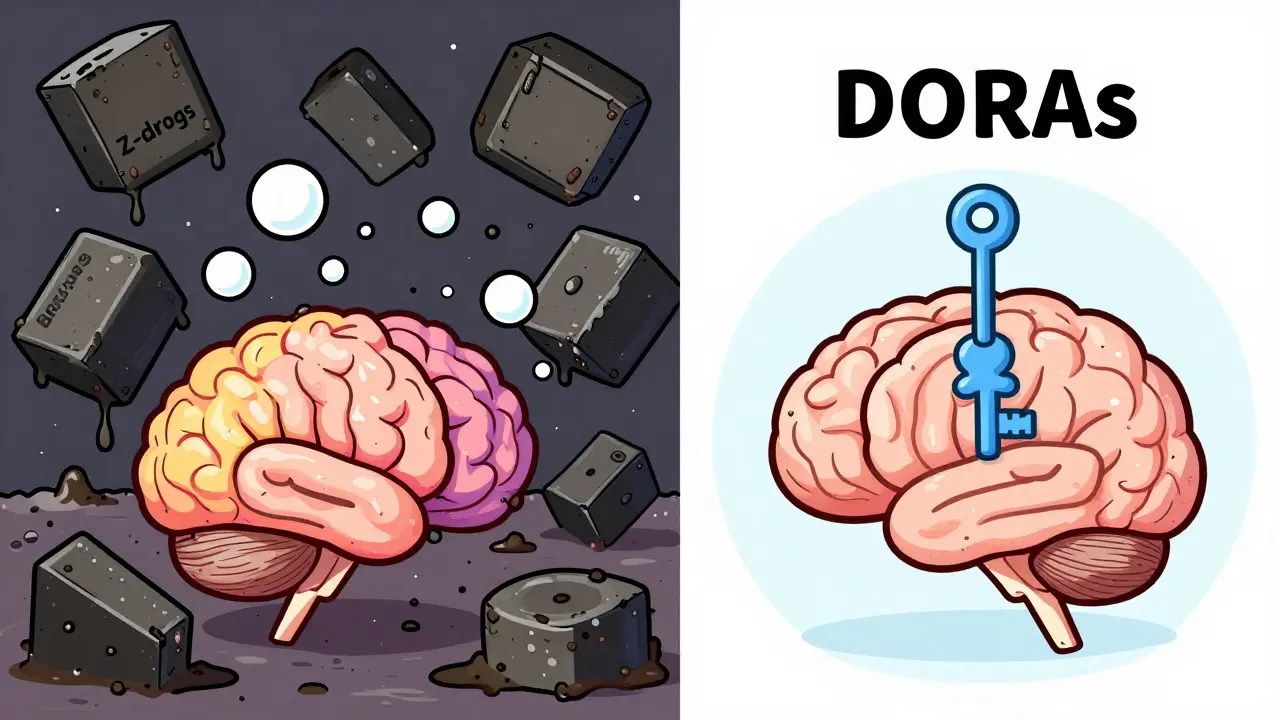
Most people think of Benzodiazepines, commonly known as BZDs, as the go-to for anxiety and sleep. Drugs like diazepam (Valium) or temazepam have been around since the 1960s. They work by boosting a neurotransmitter called GABA, which calms your nervous system. The problem? GABA receptors are everywhere in your brain, not just in the areas that control sleep. When you boost GABA globally, you slow down everything-including memory formation and reaction time.
Then there are the so-called "Z-drugs," like zolpidem (Ambien) and eszopiclone (Lunesta). These were marketed as safer alternatives because they supposedly targeted sleep-specific receptors more precisely. However, recent research published in Science Translational Medicine in 2023 showed that monkeys taking GABA-modulating drugs had 20% less accuracy on cognitive tests at high doses. For humans, this translates to next-day grogginess, amnesia episodes, and reduced learning capacity. In fact, a survey on SleepReview.com found that 73% of people who quit prescription sleep meds did so due to "brain fog."
| Medication Class | Mechanism of Action | Cognitive Risk Level | Key Side Effects |
|---|---|---|---|
| Benzodiazepines | Boosts GABA broadly | High | Memory loss, confusion, fall risk |
| Z-Drugs (e.g., Zolpidem) | Targets GABA-A alpha-1 | Moderate to High | Next-day impairment, complex sleep behaviors |
| Anticholinergics | Blocks acetylcholine | Very High | Mild cognitive impairment (MCI), dry mouth |
| DORAs (e.g., Suvorexant) | Blocks orexin receptors | Low to Potential Benefit | Daytime sleepiness, minimal memory impact |
Why Anticholinergics Are Particularly Dangerous
You might be surprised to learn that some older antidepressants and antihistamines used for sleep carry an anticholinergic burden. These drugs block acetylcholine, a chemical vital for memory and learning. Dr. Malaz Boustani from Indiana University led a pivotal 2010 study confirming that anticholinergics are directly linked to mild cognitive impairment (MCI). Unlike general fatigue, MCI involves noticeable memory loss that doesn’t yet disable daily life but is a red flag for future decline.
The scary part? This damage might not always be reversible if exposure continues. If you are taking diphenhydramine (Benadryl) or certain tricyclic antidepressants like amitriptyline for sleep, you are essentially putting a brake on your brain’s ability to form new memories. The American Geriatrics Society explicitly lists these as medications to avoid in older adults due to this exact risk.
A New Hope: Dual Orexin Receptor Antagonists (DORAs)
Not all news is bad. A newer class of drugs called Dual Orexin Receptor Antagonists (DORAs) has changed the game. Instead of sedating your entire brain, DORAs like suvorexant (Belsomra) and daridorexant (Quviviq) block orexin, a neuropeptide that keeps you awake. Think of it as turning off the "wakefulness" switch rather than forcing the "sleep" switch. Because they don’t interfere with GABA or acetylcholine, they spare your cognitive functions.
In a groundbreaking April 2023 study published in the Annals of Neurology, researchers from Washington University School of Medicine found that suvorexant actually reduced levels of key Alzheimer’s proteins in participants after just two nights. While Dr. Brendan Lucey cautioned against interpreting this as a cure-all, it suggests DORAs might offer neuroprotective benefits rather than harm. Clinical trials show suvorexant increases total sleep time by 25-30 minutes compared to placebo, with users reporting significantly less morning impairment than those on Z-drugs.
Race, Age, and Individual Risk Factors
Cognitive risk isn’t uniform across everyone. A nine-year study from the University of California-San Francisco monitoring 3,000 older adults revealed stark differences based on race. White participants who frequently took sleeping pills had a 79% higher chance of developing dementia compared to rare users. Surprisingly, Black participants showed no significant association between frequent pill use and dementia risk. Researchers believe this may stem from genetic differences in how metabolize these drugs or varying baseline rates of insomnia and comorbidities.
Age is another massive factor. Older adults process medications slower, meaning drugs stay in their system longer, amplifying side effects. The FDA added stronger warnings to benzodiazepine labels in December 2022 specifically addressing this vulnerability. If you are over 65, the threshold for switching from traditional sedatives to safer alternatives like DORAs or non-drug therapies should be much lower.
Interactions: Mixing Sleep Aids with Other Meds
Sleep aids rarely travel alone. Many patients take them alongside painkillers, antidepressants, or blood pressure meds. This creates dangerous interactions. Combining benzodiazepines with opioids, for example, can suppress breathing to fatal levels-a warning highlighted prominently on FDA black box labels. Even combining Z-drugs with alcohol or other CNS depressants drastically increases the risk of complex sleep behaviors, like sleepwalking or sleep-eating, where you perform tasks with no memory afterward.
Always check for anticholinergic load. If you are already taking a medication for allergies or depression that blocks acetylcholine, adding another anticholinergic sleep aid stacks the risk of cognitive decline. Talk to your pharmacist about your "total anticholinergic burden." It’s a simple metric that can save your brain health.

What Should You Do Instead?
If you are worried about cognitive side effects, the gold standard alternative is Cognitive Behavioral Therapy for Insomnia (CBT-I). Unlike pills, CBT-I addresses the root causes of insomnia-racing thoughts, poor sleep hygiene, and conditioned arousal. It requires 6-8 weekly sessions with a therapist, but studies show it produces more durable results without any cognitive side effects. Digital platforms like Sleepio offer this therapy for $300-$500, far cheaper than the $1,500+ for in-person care.
The learning curve is steeper; you won’t feel better in hours like with a pill, but in 2-3 weeks, you start seeing real change. By 2023, adoption of CBT-I in primary care had jumped to 47%, reflecting a shift away from quick-fix pharmacology. If you must use medication, consider short-term use only, and prefer DORAs over benzodiazepines or Z-drugs if cost allows.
Frequently Asked Questions
Do sleep aids cause dementia?
Long-term use of benzodiazepines and anticholinergics is associated with a higher risk of dementia and mild cognitive impairment. A 2021 study found routine users faced a 30% greater risk. However, newer DORAs like suvorexant show no such link and may even reduce Alzheimer's biomarkers. The risk depends heavily on the drug class, duration of use, and individual genetics.
Is zolpidem (Ambien) safe for long-term use?
Zolpidem is generally recommended for short-term use only. Long-term use can lead to tolerance, dependence, and cognitive side effects like next-day grogginess and memory lapses. While some studies show no direct link to dementia for zolpidem specifically, it still impairs acute cognitive performance and carries risks of complex sleep behaviors.
What are DORAs and why are they different?
DORAs (Dual Orexin Receptor Antagonists) like suvorexant and daridorexant work by blocking orexin, the protein that keeps you awake, rather than sedating the brain via GABA. This mechanism preserves cognitive function during the day and avoids the memory impairment associated with older sleep meds. They are considered safer for older adults.
Can I stop taking my sleep medication suddenly?
No, never stop benzodiazepines or Z-drugs abruptly. This can cause severe withdrawal symptoms, including rebound insomnia, anxiety, and seizures. The American Geriatrics Society recommends tapering off gradually over 4-8 weeks under medical supervision, often transitioning to CBT-I for lasting relief.
How does CBT-I compare to sleep pills?
CBT-I (Cognitive Behavioral Therapy for Insomnia) is considered the first-line treatment by major medical organizations. While pills provide immediate but temporary relief with potential side effects, CBT-I addresses the psychological and behavioral roots of insomnia. It takes 2-3 weeks to see benefits but offers durable, side-effect-free improvements in sleep quality and cognitive health.




Sean Luke
I specialize in pharmaceuticals and have a passion for writing about medications and supplements. My work involves staying updated on the latest in drug developments and therapeutic approaches. I enjoy educating others through engaging content, sharing insights into the complex world of pharmaceuticals. Writing allows me to explore and communicate intricate topics in an understandable manner.
view all posts