
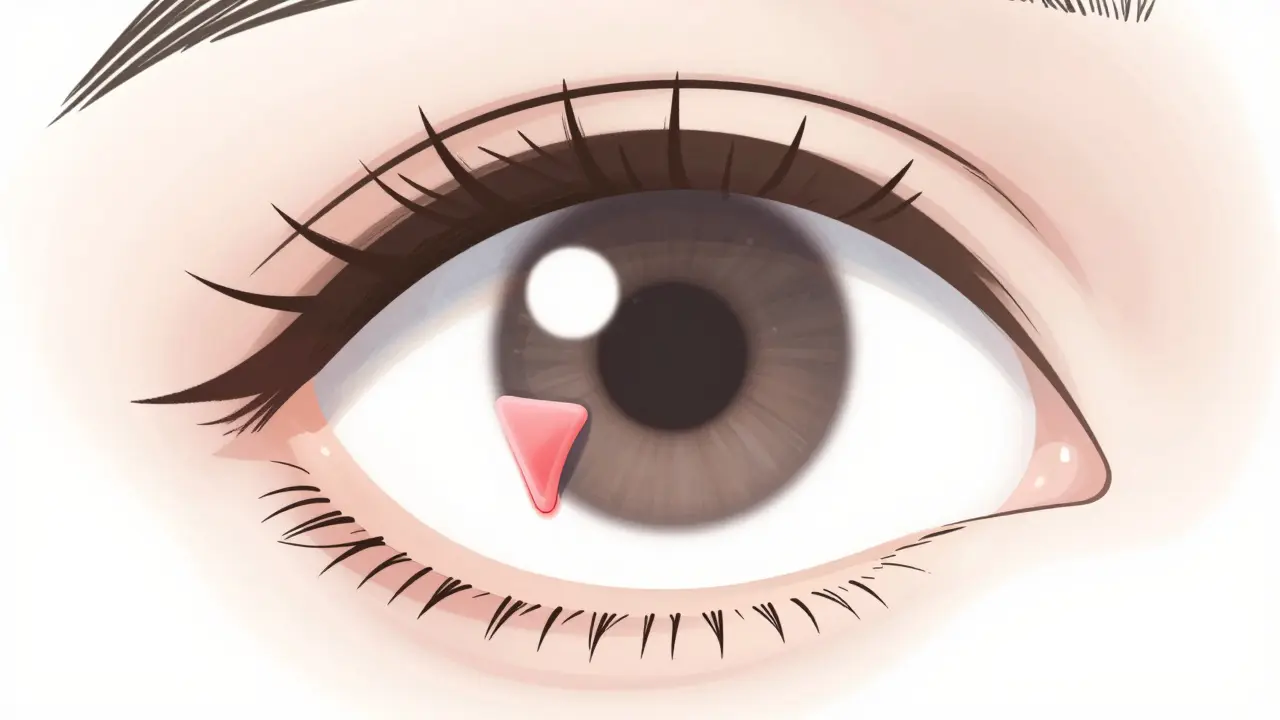
Imagine waking up and seeing a small, fleshy wing of tissue creeping across the clear part of your eye. For many, this isn't a nightmare, but a daily reality. This condition, known as pterygium is a noncancerous growth that starts in the conjunctiva (the clear tissue covering the white of the eye) and extends onto the cornea. Often called "Surfer's Eye," it's more than just a cosmetic nuisance; if left unchecked, it can warp your vision or make wearing contact lenses impossible.
What Exactly is Pterygium?
If you look in the mirror and see a pinkish, triangular growth on the white part of your eye, you're likely looking at a pterygium. It typically starts on the nasal side-the side closest to your nose-and grows toward the pupil. While it's not cancerous, it is aggressive. In high-risk areas, like the tropics, about 60% of people with this condition develop it in both eyes.
It's easy to confuse this with a pinguecula, which is also a yellowish growth on the conjunctiva. The key difference? A pinguecula stays on the white part of the eye. Once that tissue crosses the border and starts invading the cornea (the clear window of the eye), it officially becomes a pterygium. While a pinguecula is common among outdoor workers, a pterygium is the one that actually threatens your sight by causing astigmatism or blocking the pupil.
The Role of Sun Exposure and UV Rays
Why does this happen? While some people have a genetic predisposition-with a 40% higher chance if a close relative had it-the environment is the real culprit. Ultraviolet (UV) radiation is the strongest trigger. Think of it as a "sunburn" that doesn't heal, but instead causes the tissue to thicken and grow.
Research shows a direct link between cumulative UV exposure and the risk of development. People living within 30 degrees of the equator face a significantly higher risk. In fact, when UV exposure exceeds 15,000 joules per square meter, the risk of developing this growth jumps by 78%. This is why you see it so often in surfers, sailors, and farmers. If the UV index is above 3.0, your eyes are essentially under attack, which is why protective gear isn't optional-it's a necessity.
When Should You Worry About Growth?
A pterygium doesn't always require surgery. Many people live with a small, stable growth for decades. However, you should seek a professional evaluation if you notice the following:
- Blurry Vision: When the growth pushes on the cornea, it changes the eye's shape, leading to astigmatism.
- Contact Lens Issues: The raised tissue can prevent a lens from sitting flat, causing constant irritation.
- Constant Dryness: The growth can disrupt the tear film, making your eyes feel like they've been rubbed with sandpaper.
- Rapid Expansion: While some are slow, others can grow 0.5 to 2 millimeters per year under heavy sun exposure.
To get a real answer, an eye doctor uses a slit-lamp examination. This tool provides up to 40x magnification, allowing them to see exactly how far the growth has penetrated the cornea and whether it's actively progressing.

Surgical Options and Treatment Paths
If the growth is affecting your vision or looks unsightly, surgery is the only way to remove it. However, the biggest challenge with pterygium surgery isn't the removal-it's the regrowth. Without advanced techniques, 30-40% of patients see the growth return.
| Method | How it Works | Recurrence Rate | Best For |
|---|---|---|---|
| Bare Sclera | Simple removal of the growth | High (30-40%) | Very small, non-recurring cases |
| Mitomycin C | Chemical agent used to stop cell growth | Low (5-10%) | Preventing immediate regrowth |
| Conjunctival Autograft | Healthy tissue from elsewhere in the eye is transplanted | Very Low (~8.7%) | Permanent solution / High-risk patients |
| Amniotic Membrane | Biological membrane used as a scaffold | Lowest (High Success) | Recurrent cases where other methods failed |
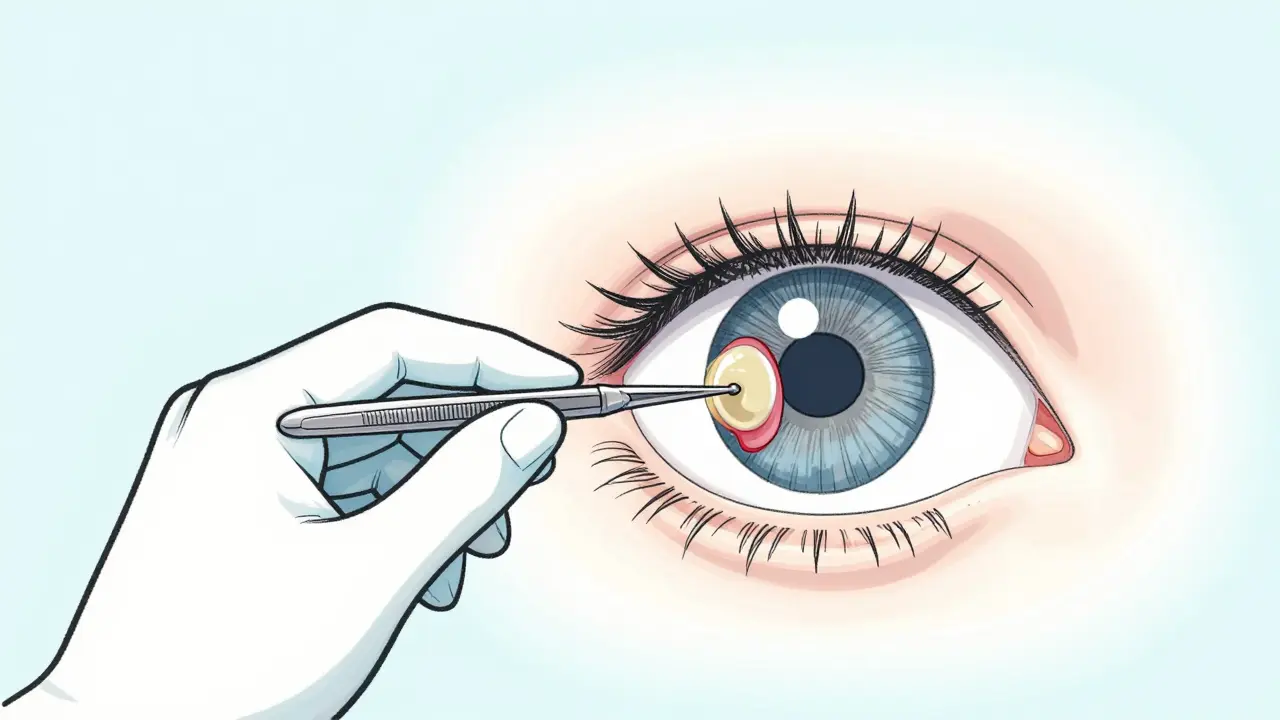
For most, a conjunctival autograft is the gold standard. Instead of just cutting the growth away and leaving a raw spot, the surgeon takes a small piece of healthy tissue from the upper part of the eye and grafts it over the area. This "patches" the hole and makes it much harder for the pterygium to grow back. For those who have already failed one surgery, amniotic membrane transplantation is now often recommended as the most effective way to stop the cycle of regrowth.
What to Expect During Recovery
The surgery itself is quick-usually around 35 minutes-but the aftermath requires patience. You can expect some redness and discomfort for two to three weeks. Many patients find the post-operative steroid drop regimen the most taxing part of the process, often lasting six weeks to keep inflammation down.
Newer options, like preservative-free lubricants such as OcuGel Plus, have helped patients manage the dry, scratchy feeling that follows surgery more effectively than standard artificial tears. The goal during this phase is to keep the eye lubricated and protected from the very thing that caused the problem: the sun.
Prevention: Stopping the Growth Before it Starts
If you already have a small pterygium, the goal is stability. You can't "cure" it with drops, but you can stop it from expanding. The most effective strategy is a combination of UV-blocking sunglasses and wide-brimmed hats. Your sunglasses should meet ANSI Z80.3-2020 standards, meaning they block 99-100% of both UVA and UVB rays.
Think of your eyes like your skin. If you wouldn't go to the beach for eight hours without sunscreen, don't do it without eye protection. Daily use of UV-blocking lenses has been shown in patient reports to halt the progression of early-stage growths entirely.
Can pterygium be treated with eye drops?
Eye drops cannot remove a pterygium. Lubricating drops can relieve the redness and irritation, and steroid drops may reduce inflammation during a flare-up, but the only way to physically remove the growth is through surgical excision.
Is pterygium cancerous?
No, a pterygium is a noncancerous (benign) growth. However, because it looks like a fleshy mass, it's important to have an ophthalmologist confirm the diagnosis to rule out other rarer ocular surface tumors.
How long does recovery from pterygium surgery take?
Most patients experience the worst discomfort for the first 2-3 weeks. Full healing and the disappearance of redness typically take several weeks, during which time a strict regimen of steroid and lubricant drops is required.
Will the growth come back after surgery?
Recurrence is a common risk. Simple removal has a 30-40% recurrence rate, but using a conjunctival autograft or Mitomycin C can lower that risk significantly, sometimes to below 10%.
Does it affect both eyes?
Yes, in high-risk populations (such as those in equatorial regions), about 60% of cases are bilateral, meaning they affect both eyes.
Next Steps for Management
If you suspect you have a growth, your first step is a comprehensive eye exam with a slit-lamp. If you're in the early stages, focus on "aggressive protection": wrap-around sunglasses and hats. If you're considering surgery, ask your surgeon specifically about the recurrence rates of their preferred method-whether they use a simple excision or a graft. If you've already had one surgery and the growth returned, ask about amniotic membrane transplantation as a more durable alternative.




David Snyder
April 12, 2026 AT 10:42 AMGlad to see a guide on this. It's a relief to know there are options like autografts that actually stick.
Randy Ryder
April 13, 2026 AT 00:55 AMThe mention of the conjunctival autograft is spot on, but we should probably dive deeper into the fibrovascular proliferation and the role of VEGF in the recurrence pathology. TheMitomycin C approach is basically trying to inhibit the proliferation of fibroblasts to prevent that scarring effect, which is why it's so effective compared to a simple excision that just leaves the scleral bed exposed to inflammatory responses.
Scott Lofquist
April 13, 2026 AT 01:37 AMImagine actually believing that a little bit of sun is the only culprit here 🙄. Genetics play a massive role and some people just have a predisposition regardless of their UV index. Get a real grip on the biology before posting this as gospel 🤡
Jasmin Stowers
April 14, 2026 AT 06:07 AMsunglasses really do make a difference
Kenzie Evans
April 14, 2026 AT 07:54 AMThe table is basic and doesn't even mention the recovery times for each specific method. It's honestly a lazy way to present medical data and assumes the reader doesn't know the difference between a scaffold and a graft.
Milo Tolley
April 14, 2026 AT 09:52 AMThe inflammation post-op is just... absolutely brutal!!! Using those steroid drops is like a full-time job!!! The sheer agony of that scratchy feeling is just... UNBEARABLE!!!
Clint Humphreys
April 16, 2026 AT 00:49 AMIt's funny how they push these "ANSI standards" for sunglasses, but have you noticed how the pharmaceutical companies are the ones funding the research for these high-cost grafts and amniotic membranes, almost as if they want us to depend on surgical interventions rather than simple natural barriers that the government doesn't want us to know about because it doesn't generate a recurring subscription fee for the medical-industrial complex that monitors our every move through health data
Brooke Mowat
April 17, 2026 AT 13:25 PMMy eyes feel like theyve been through a glitter storm some days!! It's just wild how our bodies react to the sun in such weird ways... like a little eye-wing just decidid to move in without paying rent lol
Ikram Khan
April 18, 2026 AT 11:20 AMWow, the amniotic membrane part is a game changer! I had no idea that was an option for recurrent cases!! 😲 Definitely going to keep this in mind for my next checkup!
Anurag Moitra
April 19, 2026 AT 12:57 PMOne should note that the use of wrap-around sunglasses is particularly effective for those who work in dusty environments, as it prevents both UV penetration and mechanical irritation.
S.A. Reid
April 21, 2026 AT 04:30 AMWhile I appreciate the rudimentary effort to educate the masses, one cannot help but find the reliance on such simplistic correlations between UV and growth quite quaint. It is my firm belief that the nuances of ocular surface disease are far too complex to be distilled into a table for the average layman, though the suggestion of a conjunctival autograft is a moderately acceptable piece of advice for those who cannot afford a truly bespoke surgical plan.
Shaylia Helland
April 21, 2026 AT 11:17 AMI've known a few people who spent years just ignoring it until the blurring became too much to handle and it's just a shame how often people wait until the last minute to get it checked... but i guess that's just how we are with health stuff usually just ignoring the signs until it hits the fan
rupa das
April 23, 2026 AT 04:20 AMsunglasses dont always stop it
Clare Elizabeth
April 24, 2026 AT 00:05 AMYou all can do this!! Just stay protected and keep your spirits up!! It's all about taking those small steps toward better eye health every day!!
Becca Suttmiller
April 24, 2026 AT 11:28 AMI appreciate the breakdown of the surgical options. It's helpful to have a baseline of information before going into a consultation with a specialist.