

Imagine the relief of hearing the words "you're cured." For thousands of people battling Hepatitis C, achieving a Sustained Virologic Response (or SVR) is exactly that-a functional cure. It means the virus is gone, and the medication worked. But here is the catch: curing the virus isn't the same as resetting your liver to a brand-new state. If your liver suffered significant damage before the cure, the risk of Hepatocellular Carcinoma (or HCC, the most common type of primary liver cancer) doesn't just vanish. Does this mean you're doomed to lifelong screenings? Not necessarily, but it does mean you need a personalized plan based on how scarred your liver actually is.
The Good News: SVR Slashes Your Risk
First, let's get the big win out of the way. Getting cured of Hepatitis C is one of the best things you can do for your long-term health. Research shows that achieving SVR leads to a massive drop in cancer risk-roughly a 71% to 79% reduction compared to people who stay infected or fail treatment. Whether you used the newer Direct-Acting Antivirals (or DAAs) or older interferon-based therapies, the trend is the same: the risk goes down significantly.
However, we have to talk about the "residual risk." In the medical world, a 70% reduction is fantastic, but it isn't 100%. For people with cirrhosis, the incidence of liver cancer remains higher than in the general population. For instance, data shows that cirrhotic patients who achieve SVR still face an HCC incidence rate of about 2.12 to 2.28 per 100 person-years. While that's much better than the 4.53 rate seen in untreated patients, it's enough that doctors cannot simply stop watching.
Why Does the Risk Linger After the Virus is Gone?
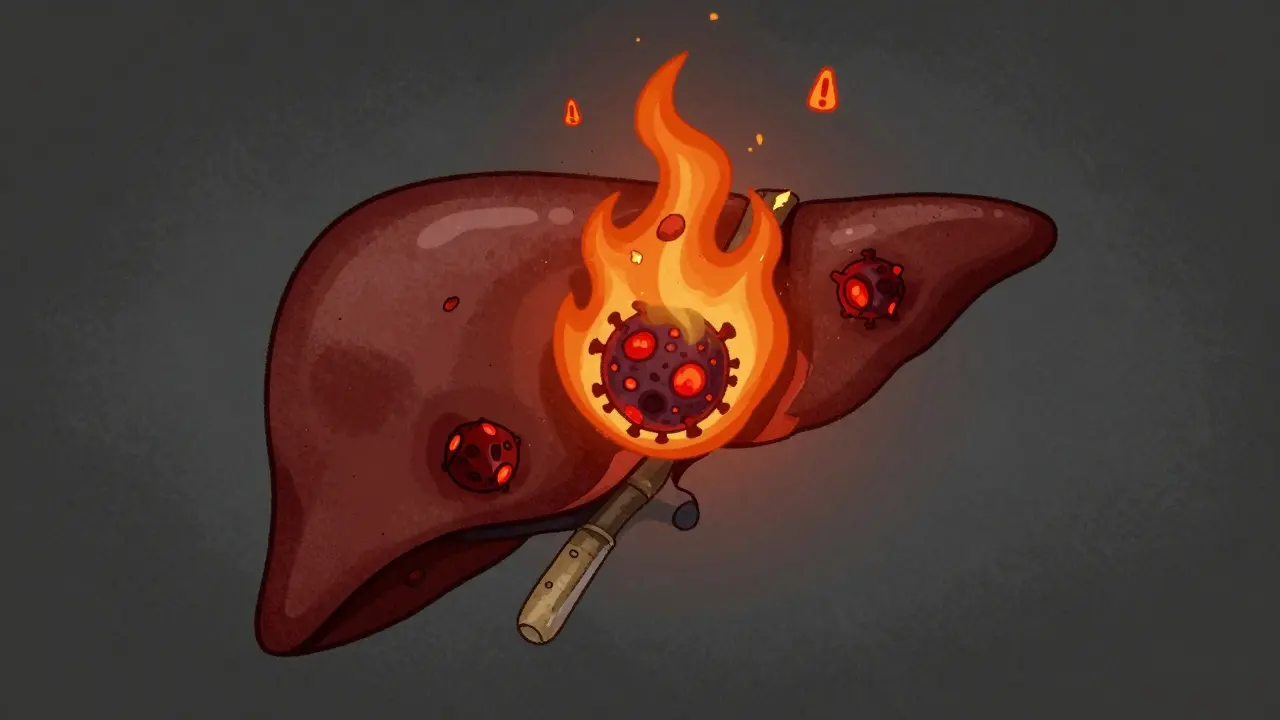
You might wonder, "If the virus is gone, what is causing the cancer?" It turns out that long-term inflammation does a number on your DNA. Even after the Hepatitis C Virus (or HCV) is eradicated, certain biological "switches" in the liver stay flipped. Molecular research has identified that pathways involving cell proliferation and inflammation don't always return to their baseline levels.
Specific proteins, like SPHK1, can remain upregulated, continuing to drive the processes that lead to tumors. Think of it like a fire that has been put out, but the embers are still hot enough to ignite a new flame if the conditions are right. This is why the focus shifts from "killing the virus" to "managing the damage."
The Deciding Factor: Your Fibrosis Score
The most important question your doctor will ask is: how much scarring (fibrosis) do you have? This is the primary driver for whether you need ongoing liver cancer risk monitoring. If you had mild or moderate liver damage before treatment, your risk after SVR is extremely low, and you might not need regular screenings.
But for those with advanced fibrosis (F3) or cirrhosis (F4), the story is different. Doctors use a few key tools to figure out where you stand:
- Transient Elastography (often called FibroScan): This measures liver stiffness. Generally, readings above 11.2 kPa after SVR suggest a higher risk that warrants continued surveillance.
- FIB-4 Index: A calculation based on your age and a few blood tests. A score above 3.25 is often used as a red flag for needing ongoing monitoring.
| Liver Condition (Pre-SVR) | HCC Risk Level | General Surveillance Recommendation |
|---|---|---|
| Mild to Moderate Fibrosis (F0-F2) | Very Low | Typically not required |
| Advanced Fibrosis (F3) | Low to Moderate | Debated (EASL: Yes | AASLD: No) |
| Cirrhosis (F4) | Moderate to High | Required indefinitely (usually every 6 months) |
The Great Divide: US vs. Europe
Interestingly, depending on where you live, your doctor might give you completely different advice. There is a noticeable "transatlantic divide" in guidelines.
In Europe, the European Association for the Study of the Liver (or EASL) takes a cautious approach. They recommend that anyone with advanced fibrosis (F3) or cirrhosis (F4) continue getting screened every six months, even after a cure. Their logic is simple: ultrasounds are relatively cheap, and missing a cancer diagnosis is a catastrophic mistake.
Across the pond, the American Association for the Study of Liver Diseases (or AASLD) is more selective. They generally suggest that if you have F3 fibrosis but not full-blown cirrhosis, you don't need routine screening after SVR. They argue that the absolute risk for F3 patients is so low that routine screening doesn't provide enough benefit to justify the cost and anxiety.
The Real-World Struggle: The "Cure Paradox"
There is a psychological side to this that doctors are really worried about. When patients are told they are "cured," they often stop seeing their specialists. They feel healthy, the virus is gone, and they assume the danger has passed. This is a dangerous misunderstanding.
Statistics show that only about 25% of eligible patients actually stick to their recommended semiannual ultrasound screenings after achieving SVR. This "treatment-induced stabilization" makes people feel a false sense of security. If you've been told you have cirrhosis, the cure is a milestone, not a finish line. You still need that ultrasound every six months to catch any potential nodules while they are small and treatable.

What’s Next? Personalized Screening
The future of liver care is moving away from "one size fits all." We are seeing the rise of dynamic risk calculators. For example, some experts are testing whether patients whose liver stiffness (TE) drops below 9.5 kPa after cure can safely extend their screening intervals to once a year instead of every six months.
We are also looking at better blood tests. The GALAD score-which combines age, gender, and three different protein markers-has shown an 85% sensitivity in detecting early HCC in post-SVR patients. This could eventually replace or supplement the standard ultrasound, making screening more accurate and less reliant on the skill of the technician.
If my HCV test is undetectable, why can I still get liver cancer?
While the virus is gone, the long-term inflammation it caused can leave permanent "scars" and genetic mutations in your liver cells. These changes can trigger cancer growth even without the active presence of the virus.
How often should I get screened after SVR?
For those with cirrhosis, the standard recommendation is an ultrasound every six months. For those with advanced fibrosis (F3), it depends on the guidelines your doctor follows (EASL recommends screening, while AASLD generally does not).
Can my liver scarring go away after the cure?
Yes, it is possible. Many patients experience fibrosis regression, meaning some of the scarring improves after the virus is gone. This is why some doctors suggest re-testing your liver stiffness after treatment to see if your risk level has changed.
What is the best way to monitor my liver?
Currently, the gold standard is a combination of abdominal ultrasound and sometimes blood markers like alpha-fetoprotein (AFP). Newer tools like the GALAD score and FibroScan are also becoming more common for risk stratification.
Do I need to worry if I only had mild fibrosis before treatment?
Generally, no. If you did not have advanced fibrosis or cirrhosis before achieving SVR, the risk of developing liver cancer is considered extremely low, and routine surveillance is typically not necessary.
Next Steps for Your Health
If you've recently achieved SVR, your next move should be a clear conversation with your hepatologist. Don't leave the office until you know your specific fibrosis stage (F0-F4). If you are in the F3 or F4 category, set a recurring calendar alert for your six-month screenings. If you are unsure about your risk, ask for a FibroScan or a FIB-4 calculation to get a concrete number on your liver stiffness. Remember, the goal is to stay ahead of the disease-catching a potential issue early makes it vastly more treatable.




David Snyder
April 14, 2026 AT 06:11 AMIt's honestly so great to see the success rates of DAAs these days. Just stay positive and keep up with those check-ups!
Kenzie Evans
April 14, 2026 AT 10:01 AMThe FIB-4 index is basically a joke if you actually know how to read a lab report properly. Most doctors just glance at it and call it a day without looking at the whole clinical picture. Typical lazy medicine. Honestly, anyone who thinks a simple calculation replaces a proper biopsy is just playing pretend with their health.
Jasmin Stowers
April 15, 2026 AT 12:14 PMtrue this is helpful info
S.A. Reid
April 17, 2026 AT 06:58 AMOne must wonder if these transatlantic discrepancies in guidelines are merely a matter of medical philosophy or perhaps something more coordinated. It is quite fascinating how the AASLD dismisses F3 risks while the EASL insists upon surveillance. I suspect the pharmaceutical conglomerates exert a subtle, invisible influence on these "recommendations" to streamline costs for insurers in the States. It is a most curious arrangement, wouldn't you agree?
Mary Johnson
April 19, 2026 AT 03:05 AMThey just want us in the system forever! First they "cure" you and then they tell you that you still need scans every six months for the rest of your life. It's a total racket. They create the fear so they can keep charging for the ultrasounds and the blood work. Don't trust the system to actually let you go once they've made their money off the DAAs. It's all a big cycle of planned dependency and fear-mongering to keep the clinics full!
Mark Dueben
April 20, 2026 AT 17:32 PMI think it's important to remember that everyone's journey with liver health is different. If you're feeling overwhelmed by the screening schedule, maybe talk to a support group. We're all in this together and the key is just staying consistent with the medical advice.
rupa das
April 21, 2026 AT 13:45 PMwho cares about f3 vs f4 anyway it all just comes down to the doctor you get
Scott Lofquist
April 22, 2026 AT 20:05 PMActually, the EASL guidelines are objectively superior because they prioritize patient safety over cost-cutting. 🙄 It's honestly embarrassing that US doctors ignore the F3 risk just because it's "low." Low doesn't mean zero! 🙄 Ethics should always come before insurance premiums. 🙄
Randy Ryder
April 24, 2026 AT 16:32 PMThe mention of the GALAD score is intriguing. Combining age, gender, and AFP, GAG, and DCC markers really allows for a more nuanced approach to HCC surveillance compared to the crude sensitivity of a standard ultrasound. I'd be curious to see the longitudinal data on how these biomarkers correlate with the SPHK1 upregulation mentioned. It's essentially moving toward a molecular-level precision in risk stratification which is exactly where hepatology needs to be.
Milo Tolley
April 26, 2026 AT 11:44 AMThe sheer audacity of the "Cure Paradox"!!! To be told you are cured and then suddenly find out you're basically a ticking time bomb of hepatocellular carcinoma... the psychological trauma is UNREAL!!!! 😱 My FibroScan was slightly elevated and I practically had a panic attack!!! The lack of communication from providers about residual risk is an ABSOLUTE TRAGEDY!!!!
Olivia Lo
April 26, 2026 AT 18:11 PMFrom a systemic perspective, the lingering inflammation reflects a failure of the liver's regenerative capacity to fully reset the epigenetic landscape. The continued upregulation of pro-inflammatory cytokines creates a microenvironment conducive to oncogenesis regardless of the viral load being zero. We must balance the clinical utility of frequent imaging against the potential for over-diagnosis and unnecessary biopsies. It is a delicate equilibrium between vigilant surveillance and the preservation of the patient's quality of life, especially when considering the asynchronous guidelines across different global health authorities. The focus should remain on the individual's histological profile and their specific comorbidities to avoid a generic approach to care.
Becca Suttmiller
April 27, 2026 AT 20:52 PMI appreciate the breakdown of the differences between the US and European guidelines. It's helpful to know that there is a debate among experts so I can bring it up during my next appointment.