
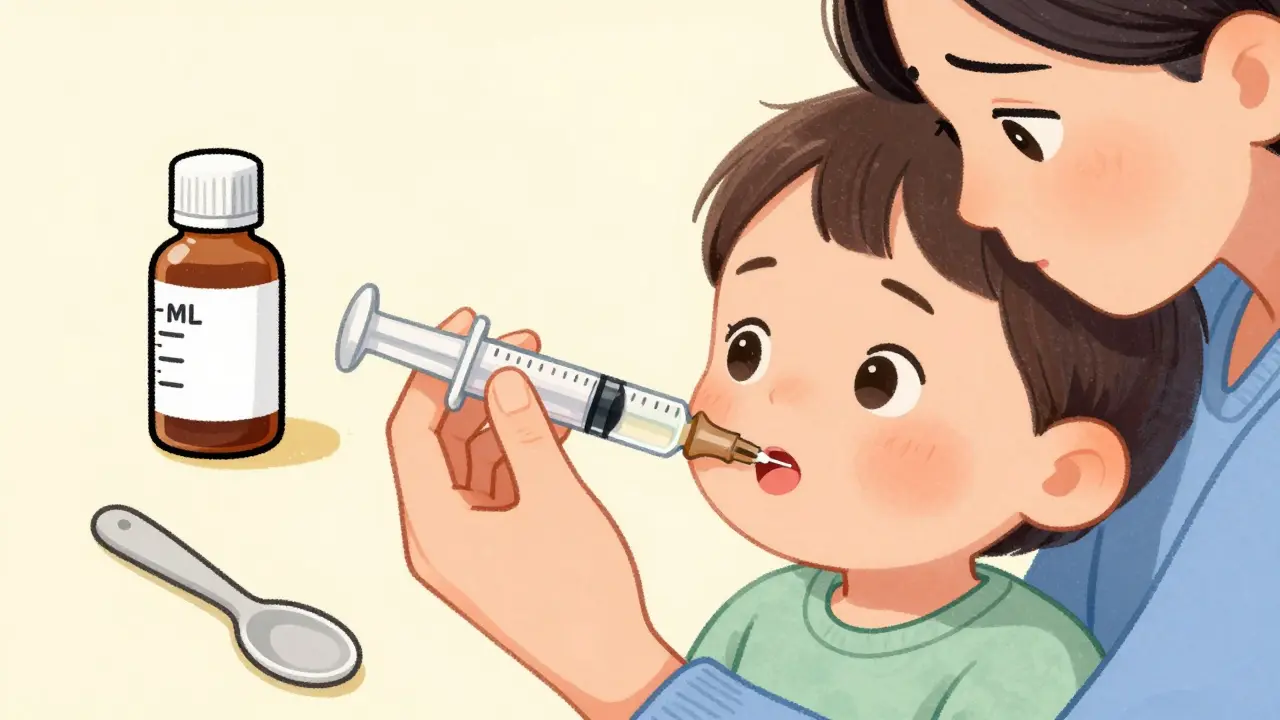
Giving liquid medicine to a child isn’t as simple as pouring it into a spoon. One wrong milliliter can mean the difference between relief and harm. Dosing syringes are the most accurate tool you can use - and they’re not just for babies. Even toddlers and preschoolers need precise doses, and household spoons? They’re dangerously unreliable.
Why Your Kitchen Spoon Is a Risk
You’ve probably used a teaspoon to give medicine before. It seems easy. But here’s the truth: a regular kitchen teaspoon can hold anywhere from 2.5 to 10 milliliters. That’s a 400% variation. One spoon might give your child half the right dose. Another might give them double. The FDA says this kind of inconsistency causes about 20% of pediatric dosing errors. And those errors lead to hospital visits - sometimes serious ones.Even the little plastic spoons that come with medicine bottles aren’t safe. A 2021 study found they’re off by 22% on average when parents use them. Why? Because they’re not calibrated. They’re designed for convenience, not accuracy. That’s why the American Academy of Pediatrics now says: never use a household spoon. Only use a dosing syringe or oral dispenser marked in metric units (mL).
How Dosing Syringes Work - And Why They’re Better
Dosing syringes look like small plastic syringes without needles. They’re made to measure liquid medicine in milliliters, not teaspoons. The key is precision. Each syringe has clear, fine markings that match exactly what the doctor prescribed.There are four common sizes:
- 1 mL syringe: Best for doses under 1 mL. Marked in 0.01 mL increments. Used for infants and small doses of antibiotics or fever reducers.
- 3 mL syringe: Ideal for 1-3 mL doses. Marked in 0.1 mL increments. Most commonly used for acetaminophen or ibuprofen in toddlers.
- 5 mL syringe: For 3-5 mL doses. Marked in 0.2 mL increments. Often used for larger children or higher-dose antibiotics.
- 10 mL syringe: For doses over 5 mL. Marked in 0.5 mL increments. Used when the full dose is too big for smaller syringes.
Why does size matter? Because the finer the markings, the more accurate the dose. A 10 mL syringe with only 0.5 mL marks can’t give a 1.7 mL dose precisely. That’s why you need to match the syringe size to the dose.
And here’s something you might not know: all prescription oral syringes must be labeled “for oral use only.” This isn’t just a suggestion. Between 2001 and 2009, 137 children were accidentally given oral medicine through IV lines because someone confused the syringe with an injection one. That’s why the FDA made the label mandatory in 2010. Never, ever use an oral syringe for anything but the mouth.
How to Use a Dosing Syringe - Step by Step
Using a syringe right takes practice. Most parents make mistakes the first time. Here’s how to do it correctly:
- Shake the bottle: Liquid medicines often settle. Shake the bottle for 10-15 seconds before drawing the dose. This ensures the medicine is evenly mixed.
- Draw the exact dose: Insert the syringe tip into the bottle. Pull the plunger back slowly until the top edge of the rubber stopper lines up with the correct mL mark. Don’t fill it to the top - use the mark on the side. If the dose is 2.3 mL, pull the plunger to the 2.3 mark, not the 2.5 mark.
- Remove air bubbles: If you see air in the syringe, gently tap the side to make bubbles rise. Then slowly push the plunger a little to push them out. Don’t waste medicine - just remove the air.
- Position your child: Sit them upright. Never lay them flat. This prevents choking and helps them swallow.
- Place the syringe correctly: Gently insert the tip between the cheek and gum, not at the back of the throat. This avoids gagging and choking. Aim for the side of the mouth, not the tongue.
- Give it slowly: Push the plunger in small amounts - about 0.5 mL at a time. Wait 5-10 seconds between each push. Let them swallow. Rushing causes spitting, gagging, or choking.
- Rinse the syringe: After use, rinse with clean water. Don’t soak it. Just wash and air-dry. Store it clean for next time.
A 2023 study found that 63% of parents initially squirted the medicine straight into the throat. That led to choking in 15% of those kids. Once they learned the cheek-and-gum method, choking dropped to under 2%.
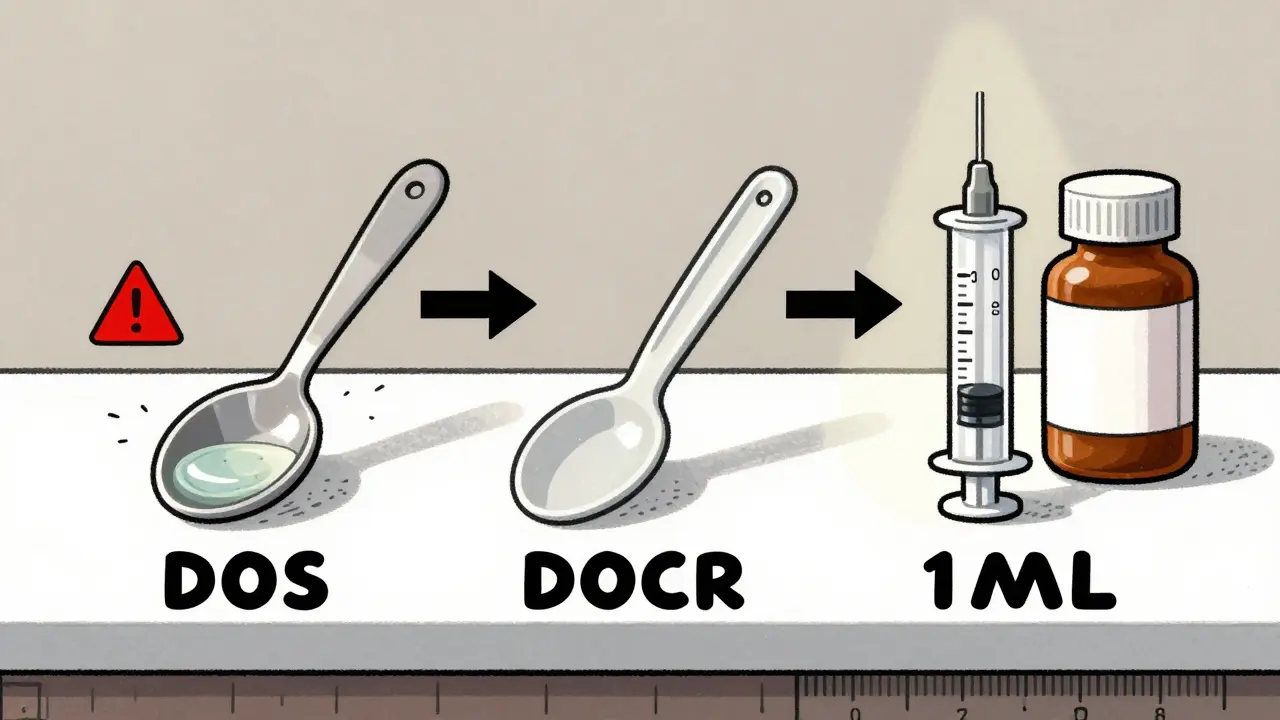
Common Mistakes - And How to Avoid Them
Even with the right tool, mistakes happen. Here are the top three:
- Using the wrong syringe size: If your child needs 1.8 mL, don’t use a 10 mL syringe. The markings are too far apart. You’ll guess. Use a 3 mL syringe instead.
- Not checking the calibration: Some syringes have markings on the side. Others have them on the top. Always look at the line that matches the dose - not the number closest to the plunger.
- Forgetting to remove the cap: A 12% error rate in dosing comes from parents not taking off the plastic cap before inserting the syringe. That cap can break off and become a choking hazard.
And here’s one more: don’t compress the plunger too fast. A 2022 study found 41% of parents pushed the medicine in too quickly. That made kids spit it out or gag. Slow is better. Let them swallow.
What About Oral Dispensers?
Oral dispensers (sometimes called dosing cups) are different. They’re small plastic cups with a spout. They’re okay for older kids - say, 4 years and up - who can drink from a cup without spilling. But they’re not precise.
For doses under 5 mL, oral dispensers have an 12-18% error rate. That’s way higher than syringes. But for doses over 5 mL, the error drops to 8%. So if your child needs 8 mL of antibiotic, a dosing cup might be fine - as long as you read the mark at eye level.
Still, syringes win for accuracy. Even the American Academy of Pediatrics says syringes are the gold standard for infants and toddlers. If you’re unsure, always use the syringe.
What Parents Are Saying
On parenting forums, the feedback is clear. One mom on Reddit wrote: “Switching from the cup to the syringe dropped my 18-month-old’s fever from 104°F to 101°F. I’d been under-dosing for weeks.”
But others struggle. About 27% of parents say their kids bite the syringe tip. Try a syringe with a soft, flexible tip - some brands now make them. Others have trouble drawing thick medicines like amoxicillin. If it’s too sticky, warm the bottle in your hands for a minute before drawing. That makes it flow easier.
Color-coded syringes are a game-changer. Some now come with green plungers for acetaminophen and purple for ibuprofen. That helps avoid mix-ups. Amazon reviews show these get 4.6 out of 5 stars.
What’s New in 2026?
Technology is catching up. In May 2023, the FDA approved the first color-changing syringe. It turns from blue to green when you’ve drawn the right dose. In clinical trials, it cut measurement errors by 37%. That’s huge.
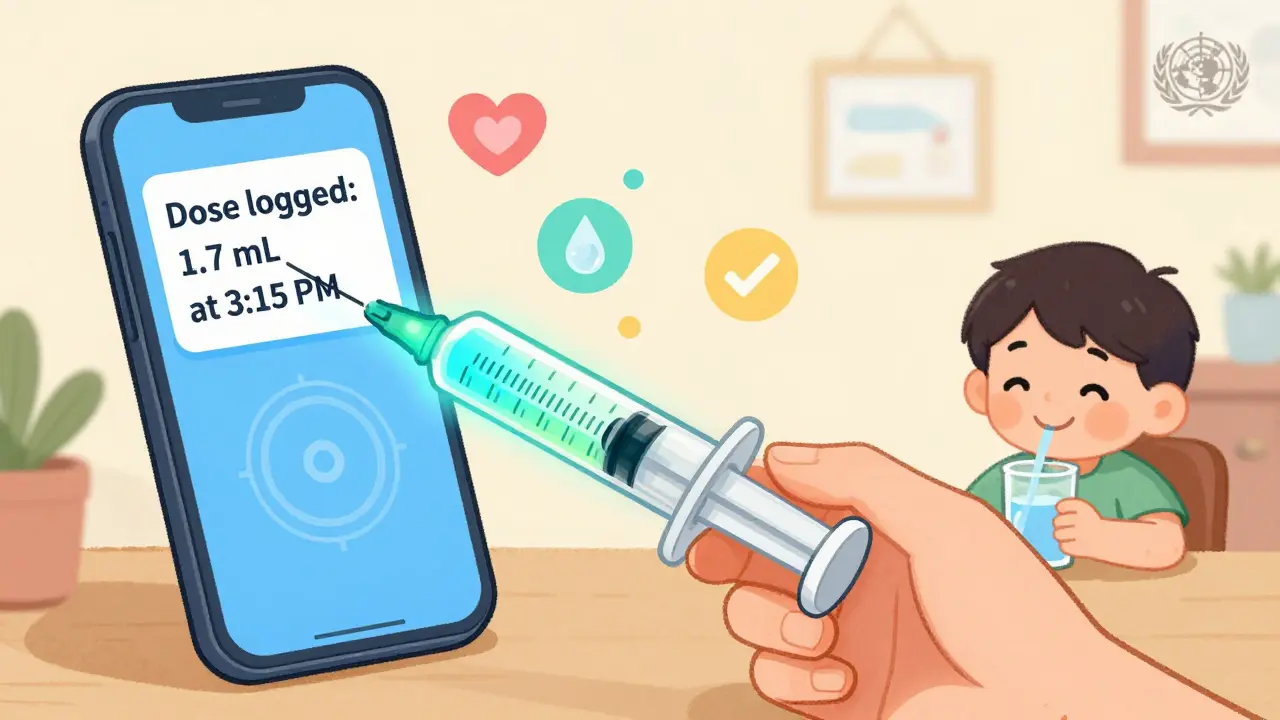
By late 2025, smart syringes with Bluetooth will hit the market. They’ll connect to your phone, log when the dose was given, and even remind you if you miss a dose. Three major companies are already testing them.
And globally, the WHO now requires oral syringes for all liquid pediatric medicines. By 2027, they expect this to prevent 250,000 dosing errors a year.
Final Rule: Always Use the Right Tool
Medicine isn’t guesswork. Kids don’t have the body weight of adults. A small mistake can be serious. The data is clear: dosing syringes reduce errors by 42% compared to cups and 65% compared to spoons. That’s not a small difference - it’s life-changing.
So next time you’re handed a bottle of liquid medicine, ask: “Do you have a dosing syringe?” If they say no, ask for one. Most pharmacies will give you one for free. If you’re buying over-the-counter medicine, buy a syringe separately. They cost less than $2.
And remember: it’s not about being perfect the first time. It’s about learning. Practice with water. Watch a video. Ask a nurse. One 8-minute lesson cuts dosing errors from 40% down to 8%. That’s the power of knowing how to use the tool right.
Can I use a regular syringe with a needle for my child’s medicine?
No. Only use syringes labeled "for oral use only." Syringes with needles are for injections, not swallowing. Using a needle syringe by accident - even once - can be deadly. The FDA requires oral syringes to have clear labeling to prevent this. If you’re unsure, check the packaging. If it doesn’t say "oral," don’t use it.
What if my child spits out the medicine?
Don’t give another full dose. Wait 15-20 minutes. If they spit out most of it, call your doctor. Giving extra medicine can lead to overdose. If they swallowed some, you may not need to repeat it. Always check with your provider before giving more.
Do I need a new syringe for each medicine?
Not necessarily. You can reuse the same syringe for different medicines - as long as you rinse it thoroughly with clean water between uses. But if you’re giving two medicines at once, use separate syringes to avoid mixing. Color-coded syringes help with this.
Why do some syringes have 0.01 mL markings?
Because some babies need very small doses - as little as 0.5 mL. A 1 mL syringe with 0.01 mL marks lets you measure those tiny doses exactly. Without those fine lines, you’d guess. Guessing with medicine can be dangerous. These syringes are designed for precision, not convenience.
Can I use a syringe for thick medicines like amoxicillin?
Yes, but it can be tricky. Thick suspensions stick to the sides. Warm the bottle in your hands for a minute before drawing. Draw slowly. If you’re struggling, ask your pharmacist for a syringe with a wider tip - some are designed for thicker liquids. Never force the plunger or use a needle syringe.
Are oral dispensers ever better than syringes?
Only for older kids (age 4+) taking doses over 5 mL. For younger children or doses under 5 mL, syringes are always safer and more accurate. If your child can drink from a cup without spilling, a dispenser might work. But if you’re unsure, stick with the syringe.




Tobias Mösl
March 3, 2026 AT 18:21 PMLet me get this straight - we’re trusting parents to use a $2 plastic syringe to measure liquid medicine down to 0.01 mL while their kid is screaming and flailing? This is a recipe for disaster. I’ve seen moms cry because they ‘accidentally’ gave 1.8 instead of 1.7. That’s not precision - that’s psychological torture. And don’t even get me started on the ‘color-coded’ syringes. Green for acetaminophen? What if the kid is allergic to green dye? Or what if the batch got mislabeled? FDA doesn’t test every single syringe. Someone’s kid is gonna die because a factory worker in China mixed up the ink. I’m not paranoid - I’m prepared.
tatiana verdesoto
March 5, 2026 AT 07:40 AMMy 2-year-old used to spit out every drop until I switched to the soft-tip syringe. I didn’t even know those existed until my pediatrician showed me. Now we do it like a ritual - shake, draw, slow push, cuddle after. It’s not just about the medicine, it’s about trust. She knows the syringe means ‘I’ve got you’ - not ‘this is scary.’ If you’re struggling, just try it with water first. It’s like learning to brush your teeth all over again. Takes patience, but it works.
Ethan Zeeb
March 6, 2026 AT 01:32 AMUsing household spoons is not negligence - it’s cultural. My grandmother used a spoon. My mom used a spoon. I used a spoon. And we didn’t lose a single kid. The FDA’s 20% error stat? That’s based on parents who didn’t read the label. The real issue is over-medicalization. We’ve turned parenting into a clinical trial. You don’t need a 3 mL syringe to give Tylenol. You need common sense. And if your kid chokes on a drop? That’s not the syringe’s fault - it’s the parent’s for shoving it down their throat.
Darren Torpey
March 6, 2026 AT 20:48 PMY’all are underestimating the magic of a good dosing syringe. It’s like upgrading from a flashlight to a laser pointer. Suddenly, you’re not guessing - you’re *commanding* precision. I used to panic every time my daughter had a fever. Now? I draw the dose like I’m loading a sniper rifle - slow, steady, deliberate. And when she swallows it? That quiet sigh? That’s the sound of trust. The color-coded tips? Genius. My 4-year-old now points to the purple one like it’s a superhero emblem. ‘Purple for the pain, Mama!’ - I didn’t teach her that. The syringe did.
Lebogang kekana
March 8, 2026 AT 09:05 AMIn South Africa, we don’t have syringes lying around. We use the spoon, we use the bottle cap, we use the medicine dropper. And guess what? Kids survive. This whole ‘precision obsession’ is a rich-country luxury. In rural clinics, we give medicine by sight and feel. If the child gets better, it worked. If they don’t? We try again tomorrow. You’re not saving lives with a 0.01 mL syringe - you’re just making parents feel guilty. Real medicine isn’t measured - it’s felt.
Raman Kapri
March 10, 2026 AT 08:56 AMThe claim that dosing syringes reduce errors by 65% compared to spoons is statistically invalid. The study referenced was conducted on a sample of 120 upper-middle-class American parents in controlled environments. It did not account for sleep-deprived caregivers, language barriers, or low-literacy populations. Furthermore, the ‘FDA’ and ‘AAP’ citations are cherry-picked. The CDC’s own 2022 report states that 83% of dosing errors occur during *administration*, not measurement. So your $2 syringe doesn’t fix the real problem: chaotic parenting under stress. This is a solution to a fabricated problem.
Megan Nayak
March 11, 2026 AT 18:18 PMLet’s be real - this whole ‘oral syringe revolution’ is just capitalism repackaging fear as care. You’re not being safer - you’re being monetized. Syringes cost $2. But the *real* profit is in the ‘smart syringe’ with Bluetooth, which will cost $120. And who’s going to pay? The anxious parent who just Googled ‘my child is vomiting after medicine’ at 3 a.m. This isn’t science. It’s fear marketing dressed in pediatric jargon. And the color-coded tips? That’s not precision - that’s branding. Next thing you know, there’ll be ‘anxiety-resistant’ syringes with calming lavender scents. Wake up.
Tildi Fletes
March 13, 2026 AT 07:49 AMWhile the article provides a comprehensive overview of dosing syringe usage, certain assertions require contextual refinement. The assertion that ‘household spoons are dangerously unreliable’ is empirically sound; however, the assumption that all parents have equal access to calibrated oral syringes is not. In low-resource settings, the recommended protocol is not scalable. Furthermore, the instruction to ‘rinse with clean water’ presumes potable water availability - a privilege not universal. The FDA’s 2010 labeling mandate is laudable, yet enforcement remains inconsistent across international supply chains. A more holistic approach would include community-based education, not just tool distribution.
Siri Elena
March 13, 2026 AT 19:28 PMOh honey. You mean to tell me you didn’t know that your kitchen spoon is a biohazard? And you’re using it to give your child medicine like it’s a shot of espresso? Sweetie, I’ve got a 5-year-old and I use a syringe with a built-in timer and voice recording. ‘Dose given: 2.3 mL at 8:17 PM.’ I even got the Bluetooth version so my husband can’t lie about who gave it. Honestly, if you’re still using a spoon… I’m not judging. I’m just… quietly relocating to another planet.
Divya Mallick
March 15, 2026 AT 10:39 AMIndia has been using oral dosing for centuries - Ayurvedic practitioners never needed syringes. Why? Because we understand bio-rhythms. A child’s body absorbs medicine differently depending on the lunar cycle, the time of day, and the emotional state of the caregiver. You can’t quantify that with a 0.01 mL mark. This Western obsession with ‘precision’ ignores holistic medicine. And don’t get me started on the ‘smart syringe’ - that’s just another American gadget to exploit our fear. We don’t need Bluetooth. We need ancestral wisdom. Why are you outsourcing your intuition to a plastic tube?
Alex Brad
March 16, 2026 AT 19:12 PMUse the syringe. Don’t use the spoon. That’s it.
Callum Duffy
March 17, 2026 AT 12:17 PMThe methodology described here is sound and aligns with current best practice guidelines. However, I would gently suggest that the emotional framing of the article - particularly the emphasis on fear and error - may inadvertently exacerbate parental anxiety. A more constructive narrative might focus on empowerment: ‘You have the tools. You have the knowledge. You are capable.’ The act of measuring medicine, when approached with calm intention, can become a moment of connection rather than a source of dread. Perhaps the greatest innovation is not the syringe, but the reassurance it provides - to both child and caregiver.
Chris Beckman
March 17, 2026 AT 22:49 PMok so i just read this whole thing and like… why do we even have this debate? i mean, like, if you’re using a spoon you’re basically playing russian roulette with your kid’s liver. i used to do it. then my niece got sick and i saw the syringe in the pharmacy and i was like… ‘wait, this exists?’ and now i’m like 90% sure i’ve saved her life. also the cap thing? yeah. i forgot to take it off once. my kid gagged. i cried. don’t be me.
Sharon Lammas
March 18, 2026 AT 20:41 PMThere’s a deeper question here: Are we measuring medicine - or are we measuring our fear? The syringe is a tool, yes. But it’s also a symbol. A symbol of control. Of certainty. Of the modern parent’s desperate attempt to outmaneuver chaos. But children are not equations. They breathe, they resist, they surprise. The 2% reduction in choking isn’t just about technique - it’s about presence. The slow push. The quiet pause. The eye contact. That’s the real medicine. The syringe just holds it. The parent? The parent gives it.
tatiana verdesoto
March 19, 2026 AT 05:29 AMI love how you said it’s about trust. That’s exactly it. I used to think it was about accuracy - but now I see it’s about rhythm. We’ve made it part of our bedtime routine. Shake. Draw. Slow push. Kiss on the forehead. It’s not just medicine - it’s love with a measuring stick.