
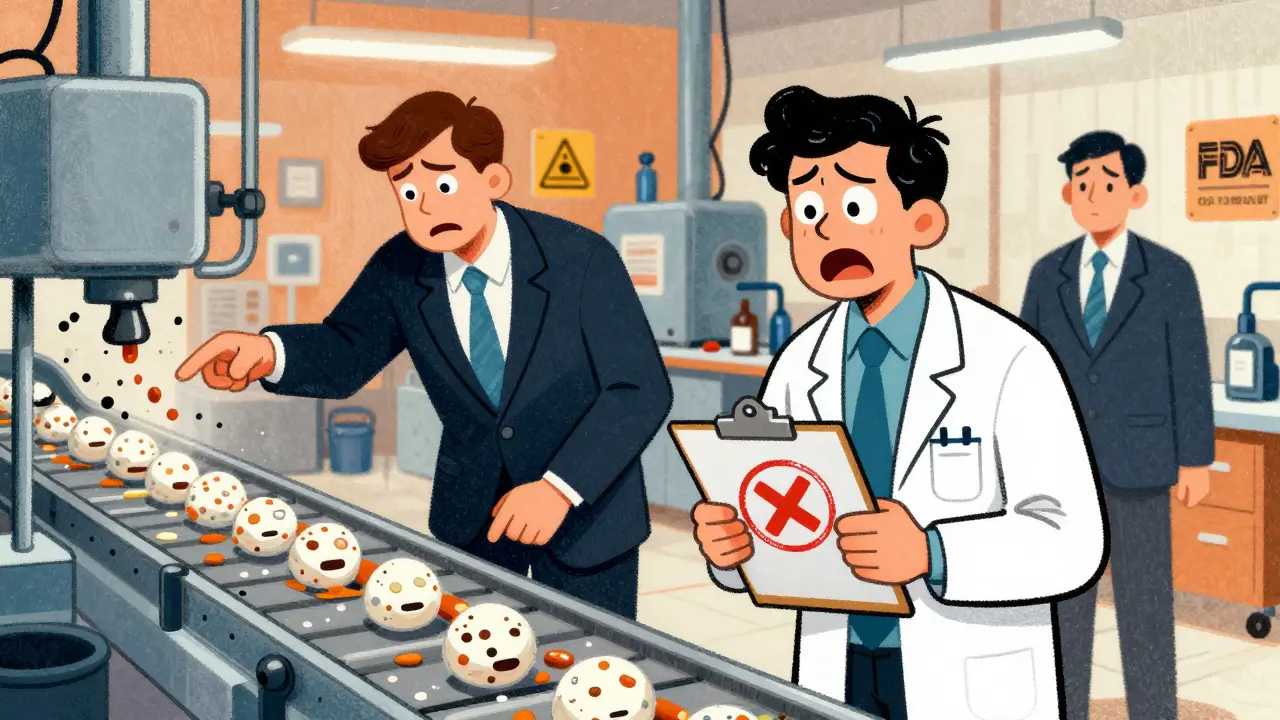
You spend months perfecting your formula, only to have the U.S. Food and Drug Administration (FDA) shut down your production line because of a paperwork error or a contaminated batch. It sounds like a nightmare, but it is becoming the new reality for manufacturers worldwide. In 2025, the FDA did not just increase its inspection numbers; it changed how it looks at quality. They are no longer satisfied with checking boxes. They want to see a genuine quality culture embedded in your daily operations.
If you run a pharmaceutical or medical device facility, you need to know exactly what triggers an FDA warning letter today. The stakes are higher than ever. As of late 2025, the FDA has placed 147 facilities on Import Alert 66-40, effectively banning their products from entering the U.S. market without physical examination. This is not a minor hiccup; it is a business-ending event. Understanding the specific deficiencies that lead to this outcome is your first line of defense.
The Shift from Technical Checks to Cultural Assessment
For years, manufacturers thought they could pass inspections by having perfect documentation, even if the underlying processes were shaky. That era is over. Dr. David Lim, a principal consultant at Compliance Architects, analyzed 127 warning letters issued in the first nine months of 2025 and found a disturbing trend. In 78% of those cases, leadership prioritized production schedules over compliance. The FDA sees through this. They now view 'quality culture' as the root cause of almost every technical failure.
This shift means inspectors are asking different questions. Instead of just asking, "Do you have a validation protocol?" they ask, "Did your team stop the line when they noticed a deviation, or did they rush to meet the deadline?" The FDA’s Center for Drug Evaluation and Research (CDER) launched the Quality Management Maturity (QMM) initiative in early 2024 to help companies move beyond basic rules. By September 2025, 87 manufacturers had engaged in these voluntary assessments. The message is clear: if you treat quality as a cost center rather than a core value, you will fail.
Aseptic Processing: The Most Common Failure Point
If there is one area where the FDA draws a hard line, it is sterility. Aseptic processing controls appeared in 47% of all 2025 warning letters, making it the single most cited deficiency. This makes sense because sterile products, like injectables and eye drops, leave no room for error. A single contaminant can kill a patient.
The most frequent complaints involve inadequate media fill studies. These tests simulate the manufacturing process using a nutrient-rich broth instead of the drug product to see if bacteria grow. If your media fill fails, or worse, if you do not perform it correctly, the FDA assumes your entire batch is compromised. For example, in July 2025, Health and Natural Beauty USA Corp. received a warning letter specifically citing failures in maintaining sterile environments during critical operations. Similarly, Creative Essences, Inc. was flagged in September 2025 for similar lapses. You cannot guess your way through sterility assurance. Every gowning procedure, every air filtration check, and every environmental monitoring sample must be documented and validated.
Data Integrity: The ALCOA+ Standard
Data integrity issues appear in 39% of warning letters, but here is the catch: many of these violations are elementary. We are not talking about complex cybersecurity breaches. We are talking about basic honesty and control. The FDA requires all electronic records to meet ALCOA+ principles: Attributable, Legible, Contemporaneous, Original, Accurate, plus Complete, Consistent, Enduring, and Available.
In September 2025, Guangxi Yulin Pharmaceutical Group Co. Ltd. was cited for lacking audit trails in UV-Vis and IR instruments. An audit trail is a secure, computer-generated record that allows for reconstruction of the course of events relating to the creation, modification, or deletion of an electronic record. Without it, you cannot prove that someone did not delete a failed test result. Even more alarming was a finding highlighted by quality specialist Maria Chen: some facilities still use laminated production records with erasable markers. Imagine writing a batch record, realizing you made a mistake, and wiping it away with a wet cloth. To the FDA, this is not a clerical error; it is evidence of potential fraud. If your data cannot be trusted, your product cannot be trusted.

Material Control and Supply Chain Risks
You might trust your suppliers, but does the FDA? Material control deficiencies show up in 35% of warning letters. The biggest issue here is the failure to test high-risk raw materials for dangerous contaminants. Glycerin and sorbitol are common ingredients, but they have been sources of diethylene glycol (DEG) contamination in the past, which caused hundreds of deaths globally. The FDA expects you to test for DEG and ethylene glycol (EG) at sensitivity levels of 0.1% w/w, following USP General Chapter <1085>.
Health and Natural Beauty USA Corp. was again cited in July 2025 for failing to test glycerin for DEG. Foshan Yiying Hygiene Products Co., Ltd. was warned in May 2025 for inadequate verification of supplier testing reliability. You cannot simply accept a Certificate of Analysis (CoA) from a vendor and call it a day. You must verify their methods, audit their facilities, and perform independent testing on incoming goods. Your supply chain is only as strong as its weakest link, and the FDA holds you responsible for that link.
Process Validation Gaps
Process validation proves that your manufacturing process consistently produces a product meeting its quality attributes. Yet, 28% of 2025 warning letters cited gaps here. Some companies skip validation entirely for simple products, assuming that if it worked once, it will work again. This is a fatal flaw. The FDA requires scientifically sound analytical methods and robust validation studies.
In the case of Health and Natural Beauty USA Corp., the FDA noted the absence of validation studies for toothpaste manufacturing. While toothpaste may seem low-risk compared to insulin, it is still a regulated product that must meet strict specifications. Process validation typically requires three consecutive successful batches with in-process controls meeting pre-specified acceptance criteria, as outlined in the FDA’s 2022 Process Validation Guidance. If you change a raw material source, a machine setting, or a cleaning procedure, you must re-validate. Skipping this step is an invitation for a Form 483 observation.
| Deficiency Category | Frequency in Warning Letters | Key Example / Citation |
|---|---|---|
| Aseptic Processing Controls | 47% | Inadequate media fill studies (Health and Natural Beauty USA Corp.) |
| Data Integrity Failures | 39% | No audit trails in instruments (Guangxi Yulin Pharmaceutical) |
| Material Control Issues | 35% | Failure to test for DEG in glycerin |
| Process Validation Gaps | 28% | Lack of validation for simple products like toothpaste |

Geographic Trends and Regional Weaknesses
Where you manufacture matters less than how you manufacture, but geographic patterns in FDA enforcement are undeniable. In 2025, facilities in China, India, and Malaysia accounted for 73% of all warning letters. However, the types of failures differ by region.
Chinese manufacturers are most frequently cited for analytical method validation issues, with 28 warning letters in 2025 alone. Indian facilities struggle heavily with data integrity controls, receiving 24 warnings. This is partly due to local regulatory environments; for instance, India’s CDSCO inspects fewer than 2% of domestic facilities annually, meaning companies often lack rigorous internal checks. Malaysian facilities face criticism for quality unit oversight, with 9 warnings noting that the Quality Unit lacked proper authority to stop production. The FDA has responded by increasing unannounced foreign facility inspections by 40% in 2025, targeting 68% of these at Asian sites. Do not assume your location protects you. The FDA is coming to you, unannounced.
Remediation: What the FDA Expects
Receiving a warning letter is not the end, but it is a crisis. The FDA mandates engagement of independent CGMP consultants in 92% of cases. You cannot fix this internally without external scrutiny. Remediation timelines typically range from 6 to 18 months, depending on severity.
For data integrity, you must implement validated audit trails with user-specific access controls and sequential timestamping. Keep electronic records for a minimum of 180 days. For material control, develop scientifically justified testing protocols for high-risk components. For process validation, demonstrate three consecutive successful batches. The good news? Facilities that implement comprehensive quality culture programs see 63% fewer repeat inspection findings and 41% faster remediation timelines. Investing in culture pays off.
Looking Ahead: 2026 Enforcement Trends
The FDA is not slowing down. In October 2025, they announced an expansion of unannounced inspections to include domestic U.S. facilities, planning 1,200 such inspections in 2026 compared to 850 in 2025. Furthermore, the QMM assessment results may begin influencing inspection frequency decisions in the second quarter of 2026. Industry analysts predict a 15-20% increase in warning letters related to quality culture deficiencies next year. Emerging focus areas include digital quality management systems, supply chain transparency, and continuous manufacturing validation. If you are not already preparing for these shifts, you are already behind.
What are the most common FDA manufacturing deficiencies in 2025?
The top deficiencies are aseptic processing controls (47% of warning letters), data integrity failures (39%), material control issues (35%), and process validation gaps (28%). Aseptic processing remains the highest risk due to the direct impact on patient safety.
How does the FDA define data integrity?
The FDA uses the ALCOA+ principles: data must be Attributable, Legible, Contemporaneous, Original, Accurate, Complete, Consistent, Enduring, and Available. Lack of audit trails or use of erasable records are major violations.
What happens if my facility receives an FDA warning letter?
You must engage an independent CGMP consultant, develop a corrective action plan, and submit it to the FDA. Remediation typically takes 6-18 months. Failure to comply can lead to Import Alert 66-40 status, blocking your products from the U.S. market.
Why is quality culture so important to the FDA now?
In 78% of 2025 warning letters, leadership prioritized schedule over compliance. The FDA believes that technical failures stem from cultural weaknesses. They now assess whether employees feel empowered to stop production for quality reasons.
Are foreign facilities inspected more frequently?
Yes. Unannounced foreign facility inspections increased by 40% in 2025, with 68% targeting Asian facilities. The FDA plans to expand unannounced inspections to domestic U.S. facilities in 2026 as well.
What is Import Alert 66-40?
It is a regulatory mechanism that places facilities on hold, requiring physical examination of each shipment before entry into the U.S. As of November 2025, 147 facilities were listed due to critical CGMP violations.
How can I prevent aseptic processing failures?
Ensure rigorous media fill studies, maintain sterile environments during critical operations, and validate all gowning and environmental monitoring procedures. Never skip validation steps, even for simple products.
What should I test for in raw materials like glycerin?
Test for diethylene glycol (DEG) and ethylene glycol (EG) at sensitivity levels of 0.1% w/w, following USP General Chapter <1085>. Do not rely solely on supplier Certificates of Analysis.



Sean Luke
I specialize in pharmaceuticals and have a passion for writing about medications and supplements. My work involves staying updated on the latest in drug developments and therapeutic approaches. I enjoy educating others through engaging content, sharing insights into the complex world of pharmaceuticals. Writing allows me to explore and communicate intricate topics in an understandable manner.
view all posts